Complete Guide to AI Infrastructure in 2026
Artificial intelligence is rapidly becoming the operational foundation of modern enterprises. From automation and cybersecurity to analytics and customer experiences, AI systems are now deeply integrated into business infrastructure.
But successful AI adoption requires far more than selecting a language model or connecting an API. Enterprises need scalable, secure, and resilient AI infrastructure capable of supporting distributed workloads, real-time inference, governance, and continuous optimization.
Key Insight: AI infrastructure is no longer optional for enterprise scalability. It has become a core competitive advantage.
What Is AI Infrastructure?
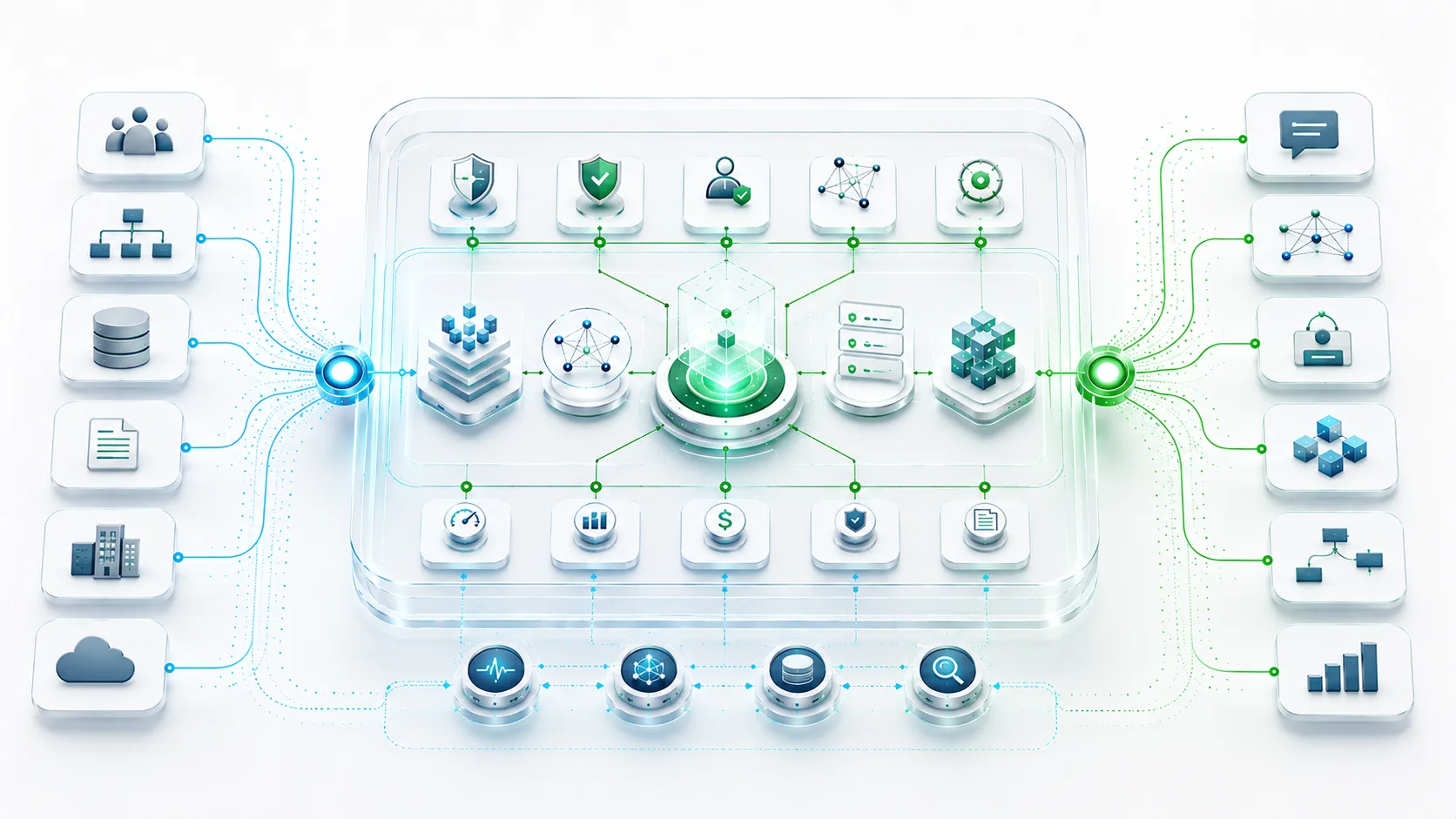
AI infrastructure refers to the hardware, software, cloud systems, networking environments, operational frameworks, and data architectures required to build, train, deploy, and manage artificial intelligence applications at scale.
Model Training
Support large-scale machine learning and LLM training workloads.
AI Deployment
Enable scalable real-time inference across enterprise applications.
Data Processing
Handle massive datasets efficiently, securely, and reliably.
AI Operations
Manage monitoring, orchestration, governance, and optimization.
Why AI Infrastructure Matters in 2026
AI workloads are becoming significantly more complex as enterprises move beyond experimentation into production-scale deployments.
Modern enterprises are now managing:
- Multi-model AI ecosystems
- Real-time inference pipelines
- Retrieval-Augmented Generation systems
- AI agents and autonomous workflows
- Vector database environments
- GPU-intensive compute systems
- Enterprise-scale automation pipelines
Traditional infrastructure environments were never designed for these demands. Modern AI systems require scalable architectures capable of balancing performance, observability, security, and cost optimization simultaneously.
Core Components of AI Infrastructure
1. Compute Infrastructure
Compute infrastructure powers AI training and inference operations. This layer determines how efficiently models can process data and scale workloads.
GPUs TPUs Distributed Clusters AI Accelerators
2. Data Infrastructure
Data infrastructure enables organizations to collect, process, store, and retrieve massive datasets required for AI operations.
Data Lakes Vector Databases ETL Pipelines Streaming Systems
3. Cloud Infrastructure
Cloud-native environments have become foundational for scalable AI deployment strategies.
AWS AI Google Vertex AI Azure AI Kubernetes
4. LLMOps & AI Operations
LLMOps frameworks help organizations manage AI systems throughout their operational lifecycle.
- Model monitoring
- Version control
- Inference optimization
- AI governance
- Observability systems
- Deployment pipelines
Key Challenges in AI Infrastructure
Scalability
AI workloads are unpredictable. Infrastructure must scale dynamically without affecting reliability or performance.
Cost Optimization
GPU-heavy environments can become expensive without orchestration, monitoring, and workload optimization.
Security
AI systems process sensitive enterprise data, requiring encryption, access control, and governance.
Latency
Real-time AI products require low-latency inference pipelines to maintain performance and user experience.
AI Infrastructure Best Practices
- Adopt cloud-native architecture to improve scalability, resilience, and deployment flexibility.
- Use Kubernetes for workload orchestration, deployment automation, and infrastructure consistency.
- Implement observability to monitor latency, resource usage, model drift, and system health.
- Prioritize AI governance to support compliance, transparency, and responsible AI adoption.
AI Infrastructure Trends for 2026
AI Agents
Autonomous AI agents are increasing orchestration and infrastructure demands.
Hybrid AI Environments
Organizations are combining cloud and on-prem systems for better flexibility, cost control, and security.
Enterprise RAG Systems
Retrieval-Augmented Generation is becoming standard for enterprise search, knowledge management, and AI assistants.
How YggyTech Helps Enterprises Build Scalable AI Infrastructure
YggyTech helps enterprises architect scalable AI ecosystems that align with operational goals, security requirements, and long-term digital transformation strategies.
Build Enterprise-Grade AI Infrastructure
Scalable AI systems require scalable architecture. YggyTech helps organizations build secure, intelligent, and future-ready AI environments.
Talk to Our Team
Ava Mitchell
UX & Digital Experience Strategist
Ava combines product psychology, interface systems, and user-centered design to create digital experiences that feel intuitive and scalable. Her work at YGGY Tech focuses on high-conversion UX systems, enterprise interfaces, and design-driven growth.