Continuous Compliance for Autonomous AI Systems
Enterprise AI is evolving rapidly. Autonomous agents now analyze data, coordinate workflows, make recommendations, trigger actions, and interact directly with business systems. As AI autonomy increases, so does the challenge of maintaining compliance.
Traditional compliance programs were built around periodic reviews, manual audits, and retrospective reporting. Autonomous AI systems operate continuously, making decisions in real time across distributed environments. Governance must therefore evolve from periodic validation to continuous validation.
This shift is driving the rise of Continuous Compliance for Autonomous AI Systems.
Continuous compliance enables enterprises to monitor, validate, and enforce governance requirements throughout the entire AI lifecycle. Rather than checking compliance quarterly or annually, organizations can verify compliance continuously as AI systems operate.
What Is Continuous Compliance?
Continuous compliance is the practice of automatically validating governance, security, regulatory, and operational requirements throughout system execution.
For autonomous AI environments, this means compliance becomes an active operational capability rather than a passive reporting process.
Continuous compliance frameworks evaluate:
- Policy adherence
- Data governance requirements
- Access controls
- Model usage policies
- Security controls
- Regulatory obligations
- Operational risk thresholds
- Agent behavior controls
The result is real-time governance visibility across enterprise AI ecosystems.
Why Traditional Compliance Models Are Breaking Down
Conventional compliance frameworks assume systems change slowly and operate within predictable boundaries.
Autonomous AI introduces a different reality.
Modern enterprises now manage:
- Multi-agent AI ecosystems
- Real-time inference platforms
- Dynamic orchestration systems
- Cloud-native AI infrastructure
- Autonomous workflow execution
By the time a traditional audit identifies a problem, thousands of AI-driven decisions may already have occurred.
Continuous compliance addresses this gap by validating governance requirements at runtime.
The Core Pillars of Continuous Compliance
1. Policy-as-Code
Governance requirements must be translated into machine-readable policies.
Examples include:
- Data access restrictions
- Risk thresholds
- Agent permissions
- Compliance controls
- Workflow approval requirements
Policy-as-Code provides the foundation for automated governance.
2. Runtime Compliance Validation
Every AI action can be evaluated against compliance requirements before execution.
This enables:
- Policy enforcement
- Risk assessment
- Governance validation
- Automated approvals
- Escalation management
3. Continuous Monitoring
Observability platforms provide visibility into AI behavior, infrastructure health, workflow execution, and governance compliance.
Monitoring becomes a critical component of compliance assurance.
4. Audit Automation
Continuous compliance platforms automatically generate audit evidence, execution logs, decision traces, and governance records.
This dramatically reduces manual audit preparation.
Continuous Compliance in Autonomous AI Environments
Autonomous AI systems often operate without direct human intervention.
These systems may:
- Initiate workflows
- Allocate resources
- Generate content
- Analyze transactions
- Trigger operational responses
- Coordinate multiple agents
Continuous compliance ensures every action remains aligned with organizational policies and regulatory obligations.
The Role of AI Control Planes
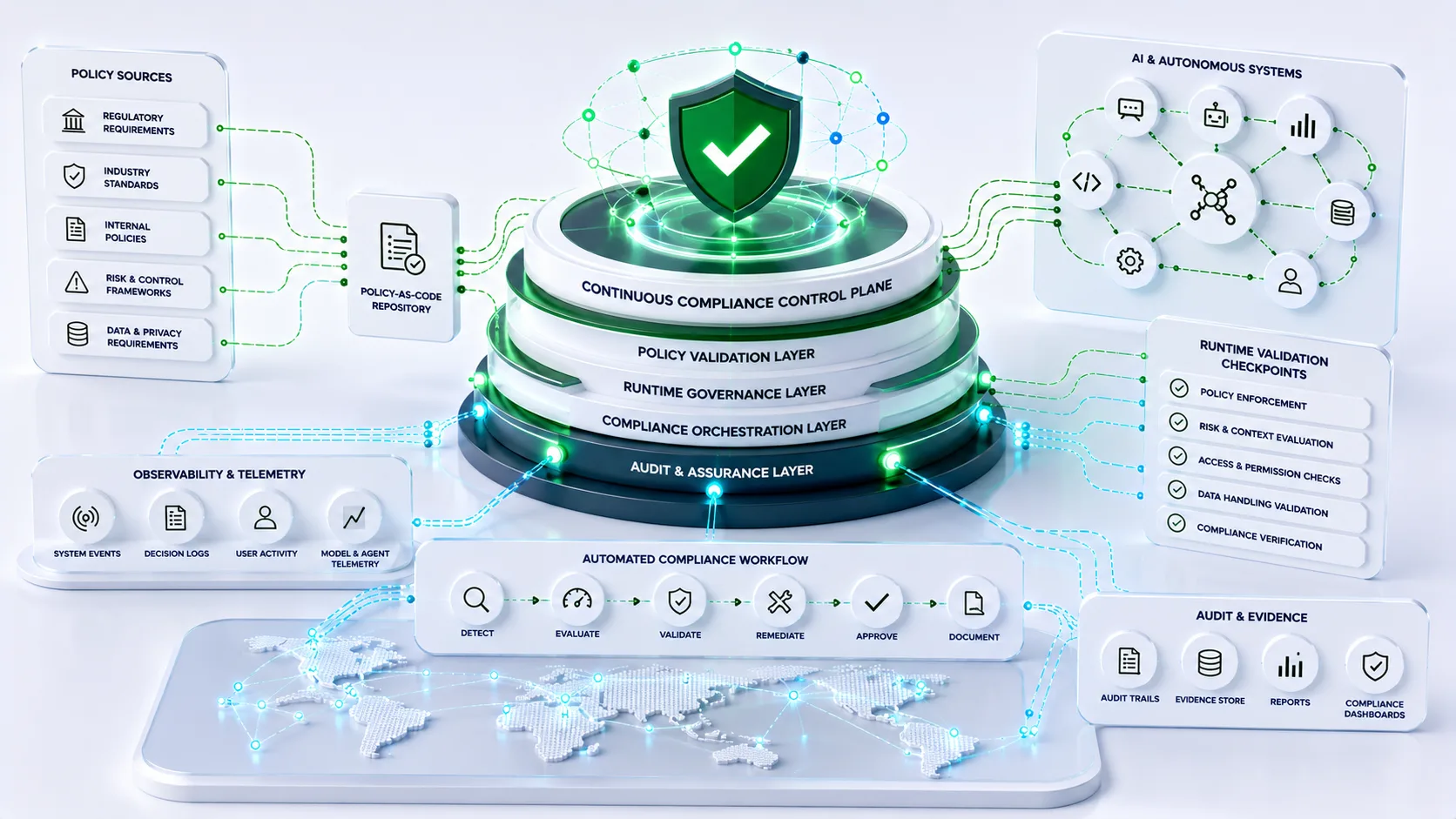
AI control planes are becoming the operational foundation of continuous compliance.
They provide centralized governance capabilities including:
- Policy management
- Identity controls
- Compliance validation
- Observability integration
- Workflow governance
- Agent oversight
Control planes enable enterprises to enforce governance consistently across distributed AI environments.
Key Enterprise Use Cases
Financial Services
Continuous validation of transaction controls, regulatory policies, fraud prevention requirements, and approval workflows.
Healthcare
Real-time monitoring of patient data access, AI recommendations, privacy controls, and compliance obligations.
Cybersecurity
Autonomous threat response systems governed through continuous policy enforcement and operational oversight.
Software Delivery
AI-assisted deployment systems validating governance requirements before infrastructure changes are executed.
Customer Operations
Continuous monitoring of customer-facing AI systems to ensure compliance with communication and privacy requirements.
Key Metrics for Continuous Compliance
Leading organizations track governance-focused operational metrics such as:
- Policy compliance rate
- Governance violation frequency
- Audit coverage percentage
- Escalation rates
- Unauthorized action attempts
- Compliance remediation time
- Runtime policy enforcement success rate
These metrics provide measurable visibility into governance effectiveness.
Challenges Enterprises Must Address
- Rapid AI adoption
- Evolving regulations
- Cross-platform governance complexity
- Policy fragmentation
- Multi-agent coordination risks
- Data governance challenges
- Operational scalability requirements
Addressing these challenges requires governance engineering, automation, and strong operational discipline.
Building a Continuous Compliance Strategy
Organizations should focus on six foundational capabilities:
- Policy-as-Code implementation
- Runtime governance systems
- AI observability platforms
- Centralized AI control planes
- Automated audit frameworks
- Compliance automation workflows
Together, these capabilities create a governance architecture capable of supporting autonomous operations at enterprise scale.
The Future of Continuous Compliance
As autonomous AI systems become increasingly sophisticated, compliance will evolve from monitoring to intelligent governance.
Future compliance platforms will automatically adapt policies, evaluate risk dynamically, and orchestrate governance decisions in real time.
The objective is simple: enable AI autonomy without sacrificing trust, accountability, or regulatory compliance.
Key Takeaways
- Autonomous AI systems require continuous governance rather than periodic audits.
- Continuous compliance validates policies, controls, and regulations in real time.
- Policy-as-Code enables automated governance enforcement.
- AI control planes provide centralized compliance orchestration.
- Continuous compliance improves trust, transparency, and operational resilience.
How YggyTech Helps
YggyTech helps enterprises implement governance-first AI architectures through AI control planes, Policy-as-Code frameworks, runtime governance platforms, compliance automation systems, and operational intelligence solutions.
Our approach enables organizations to scale autonomous AI confidently while maintaining compliance, security, reliability, and operational transparency.
Conclusion
The future of enterprise AI depends on trust.
As organizations deploy increasingly autonomous systems, compliance can no longer be treated as a periodic exercise. It must become a continuous operational capability embedded directly within AI infrastructure.
Continuous compliance provides the governance foundation necessary for enterprises to scale AI responsibly, securely, and confidently in the age of autonomy.
FAQs
What is continuous compliance in AI?
Continuous compliance is the practice of automatically validating governance, security, and regulatory requirements throughout AI system operation.
Why is continuous compliance important for autonomous AI?
Autonomous AI systems operate continuously and require real-time governance to prevent policy violations and reduce operational risk.
How does Policy-as-Code support continuous compliance?
Policy-as-Code converts governance requirements into executable policies that can be automatically enforced during AI execution.
What role do AI control planes play?
AI control planes centralize governance, policy enforcement, observability, and compliance validation across AI environments.
What are the benefits of continuous compliance?
Benefits include improved governance, automated audits, reduced risk, stronger compliance posture, and greater operational visibility.

Ethan Brooks
Senior AI Systems Strategist
Ethan specializes in enterprise AI architecture, scalable automation systems, and intelligent workflow optimization. At YGGY Tech, he writes about practical AI implementation, cloud-native systems, and how modern businesses can eliminate operational fragmentation through intelligent infrastructure.