Governance Fabric for Enterprise AI: Unifying Policies Across Models, Agents, and Workflows
Enterprise AI adoption has entered a new phase.
Organizations are no longer deploying isolated AI models for individual use cases. Instead, they are operating increasingly complex ecosystems consisting of foundation models, autonomous agents, retrieval systems, orchestration platforms, decision engines, and AI-powered workflows distributed across the business.
While this expansion unlocks enormous value, it also creates a significant challenge:
How do enterprises govern AI consistently when decisions are being made across dozens of models, hundreds of agents, and thousands of workflows?
Many organizations have discovered that traditional governance approaches are becoming fragmented and difficult to scale.
Policies exist in multiple systems. Compliance controls vary between platforms. Security rules are implemented differently across environments. Audit trails become disconnected. Operational oversight becomes increasingly complex.
This is why leading enterprises are investing in Governance Fabric architectures.
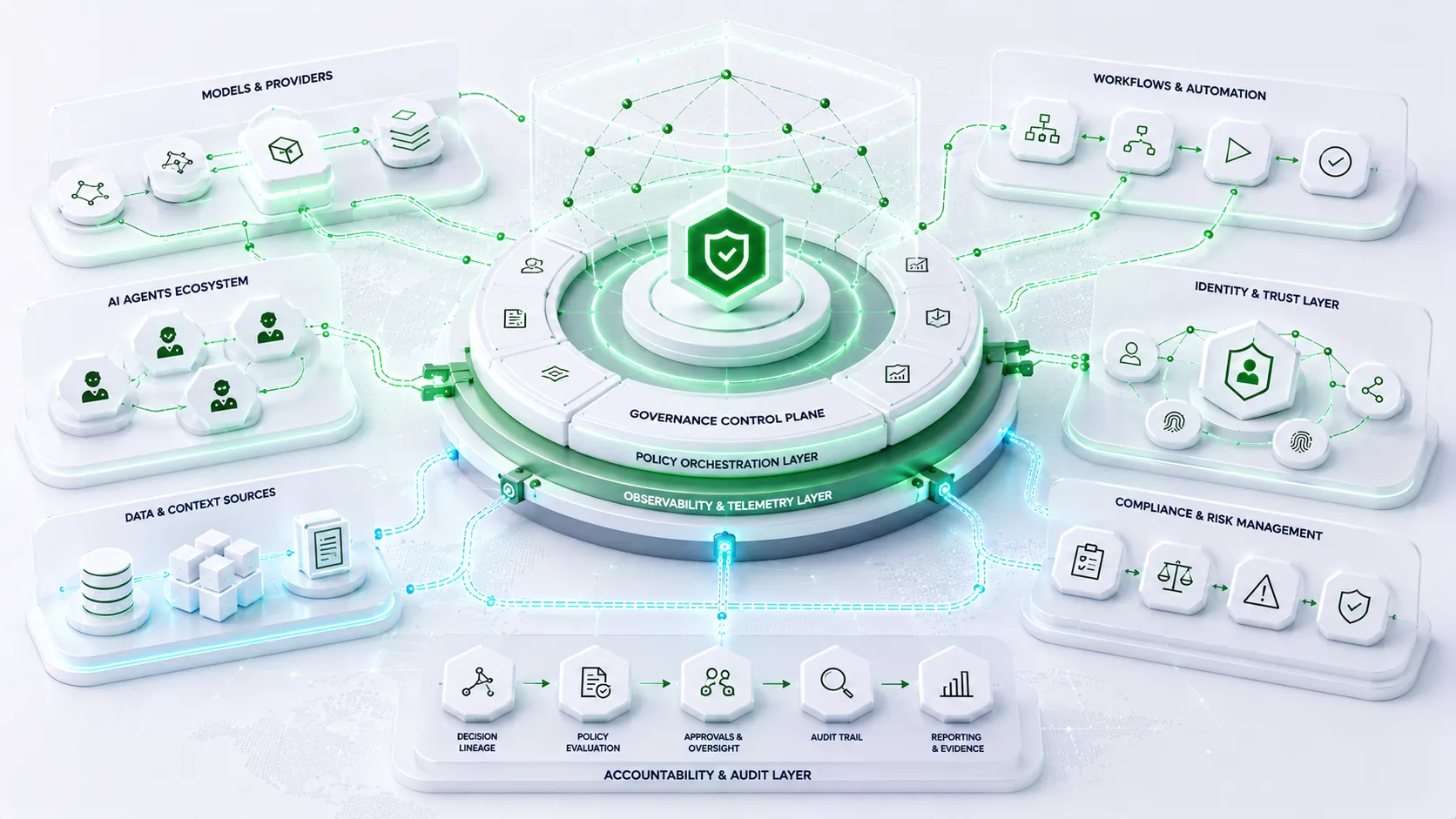
A Governance Fabric provides a unified governance layer that spans models, agents, workflows, infrastructure, and business operations, enabling consistent policy enforcement across the entire AI ecosystem.
What Is a Governance Fabric?
A Governance Fabric is a distributed governance architecture that provides centralized policy management and decentralized enforcement across enterprise AI systems.
Rather than embedding governance controls into individual applications, organizations establish a common governance layer that operates across the entire AI environment.
This fabric connects:
- Foundation models
- AI agents
- RAG systems
- Workflow orchestration platforms
- Enterprise applications
- Data systems
- Infrastructure environments
- Compliance frameworks
The result is a consistent governance model regardless of where AI decisions are executed.
Why Traditional Governance Models Are Breaking Down
Legacy governance frameworks were designed for conventional software systems.
Modern AI ecosystems introduce entirely new challenges.
Organizations now manage:
- Multiple LLM providers
- Autonomous AI agents
- Dynamic workflows
- Hybrid cloud deployments
- Third-party AI services
- Rapidly changing AI models
Each environment often implements governance differently.
This creates governance silos that increase operational risk.
Without a unified approach, enterprises struggle to maintain consistency across security, compliance, accountability, and operational oversight.
The Five Layers of an AI Governance Fabric
1. Policy Layer
The policy layer defines enterprise-wide governance requirements.
Examples include:
- Data access policies
- Privacy controls
- Security requirements
- Compliance mandates
- Risk thresholds
- Decision approval rules
This layer serves as the authoritative source of governance truth.
2. Identity and Trust Layer
Governance depends on identity.
Every participant in the AI ecosystem must be identifiable.
This includes:
- Human users
- AI agents
- Applications
- Services
- Data sources
- Infrastructure components
The trust layer establishes authentication, authorization, and Zero Trust enforcement across AI operations.
3. Execution Governance Layer
This layer validates policies during runtime.
Examples include:
- Prompt validation
- Agent authorization
- Workflow approval checks
- Context access controls
- Decision guardrails
- Compliance verification
Governance becomes part of operational execution rather than an afterthought.
4. Observability Layer
Governance requires visibility.
The observability layer provides insight into:
- Model interactions
- Agent behavior
- Policy enforcement events
- Workflow execution
- Security incidents
- Compliance violations
This visibility enables continuous governance monitoring.
5. Accountability Layer
Every AI decision should be traceable.
The accountability layer captures:
- Decision lineage
- Policy evaluations
- Model outputs
- Agent actions
- Approval workflows
- Audit evidence
This creates a foundation for enterprise trust and compliance.
How Governance Fabric Differs from Traditional Governance
Traditional governance is often centralized but disconnected from runtime operations.
Governance Fabric architectures are operational by design.
Instead of reviewing decisions after they occur, governance becomes embedded directly into AI execution pathways.
This shift enables:
- Real-time policy enforcement
- Continuous compliance validation
- Automated risk management
- Dynamic governance controls
- Scalable operational oversight
The Role of AI Control Planes
AI control planes are becoming a critical implementation mechanism for Governance Fabric architectures.
Control planes provide centralized governance services while allowing distributed execution.
They coordinate:
- Policy enforcement
- Model governance
- Agent lifecycle management
- Identity controls
- Observability systems
- Compliance workflows
Many enterprises are treating AI control planes as the operational foundation of governance fabrics.
Governance Fabric and Autonomous Agents
Agent ecosystems create unique governance challenges.
Autonomous agents can make decisions, access systems, initiate actions, and coordinate with other agents.
A Governance Fabric enables organizations to manage:
- Agent permissions
- Agent identity
- Agent accountability
- Inter-agent trust
- Decision validation
- Operational guardrails
This becomes increasingly important as multi-agent architectures expand.
Governance Fabric and Compliance Automation
Regulatory requirements continue to evolve across industries.
Governance Fabrics support compliance by automating:
- Policy validation
- Control enforcement
- Audit evidence generation
- Compliance reporting
- Risk monitoring
- Governance workflows
Automation reduces compliance overhead while improving consistency.
Enterprise Use Cases
Financial Services
Governance Fabrics help enforce regulatory controls across AI-driven lending, risk management, fraud detection, and customer service systems.
Healthcare
Organizations can govern patient data access, AI-assisted decision-making, and compliance requirements consistently across clinical systems.
Manufacturing
Governance architectures help coordinate autonomous operational systems while maintaining safety and compliance requirements.
Enterprise Knowledge Platforms
Organizations can govern how AI systems access, retrieve, and utilize enterprise knowledge.
Multi-Agent Operations
Agent ecosystems benefit from centralized governance while maintaining distributed autonomy.
Benefits of Governance Fabric Architecture
- Consistent policy enforcement
- Reduced governance fragmentation
- Improved compliance readiness
- Enhanced operational visibility
- Greater AI accountability
- Scalable governance operations
- Stronger security posture
- Faster AI adoption
Challenges Organizations Must Address
- Cross-platform integration
- Policy standardization
- Legacy system compatibility
- Identity federation
- Governance scalability
- Operational complexity
- Change management
Building a governance fabric requires both technical architecture and organizational alignment.
Building a Governance Fabric Strategy
Leading enterprises are focusing on six foundational capabilities:
- Policy-as-Code implementation
- Unified identity architecture
- Runtime governance enforcement
- AI observability platforms
- Accountability frameworks
- Continuous compliance automation
Together, these capabilities create an enterprise-wide governance operating model.
The Future of Governance Fabric Architectures
As AI systems become more autonomous and interconnected, governance will increasingly operate as a distributed platform capability rather than a standalone compliance function.
Future Governance Fabrics will support:
- Autonomous policy adaptation
- Cross-enterprise governance federation
- AI-native compliance automation
- Dynamic risk scoring
- Real-time governance intelligence
- Multi-agent trust orchestration
The organizations that establish governance fabrics today will be better positioned to scale AI safely, securely, and responsibly tomorrow.
Key Takeaways
- Enterprise AI governance is becoming increasingly fragmented.
- Governance Fabrics provide a unified governance layer across AI ecosystems.
- Policy enforcement, observability, identity, and accountability are foundational components.
- Governance must operate at runtime rather than solely through oversight processes.
- Governance Fabrics enable scalable, trustworthy AI operations.
How YggyTech Helps
YggyTech helps organizations design and implement Governance Fabric architectures through AI control planes, policy orchestration platforms, identity governance systems, observability frameworks, compliance automation, and operational governance strategies.
Our approach enables enterprises to unify governance across models, agents, workflows, and infrastructure while accelerating responsible AI adoption.
Conclusion
The future of enterprise AI depends on governance that scales as quickly as innovation.
As organizations deploy increasingly complex AI ecosystems, fragmented governance approaches become difficult to manage and impossible to sustain.
Governance Fabric architectures provide a unified operating model that connects policies, controls, observability, compliance, and accountability across the enterprise.
For organizations building the next generation of AI-powered operations, Governance Fabric is emerging as the foundation of scalable and trustworthy AI governance.
FAQs
What is a Governance Fabric?
A Governance Fabric is a distributed governance architecture that provides centralized policy management and consistent governance enforcement across enterprise AI systems.
Why do enterprises need Governance Fabrics?
They help unify governance across multiple models, agents, workflows, cloud environments, and business systems.
How does Governance Fabric support compliance?
It automates policy validation, audit evidence generation, compliance monitoring, and governance enforcement.
What role do AI control planes play?
AI control planes provide the operational infrastructure that enables governance services to be applied consistently across distributed AI environments.
How does Governance Fabric improve AI governance?
It reduces fragmentation, increases accountability, improves visibility, and enables scalable governance across enterprise AI ecosystems.

Ethan Brooks
Senior AI Systems Strategist
Ethan specializes in enterprise AI architecture, scalable automation systems, and intelligent workflow optimization. At YGGY Tech, he writes about practical AI implementation, cloud-native systems, and how modern businesses can eliminate operational fragmentation through intelligent infrastructure.