Runtime Security for AI Agents: Protecting Autonomous Systems in Production
Enterprise AI is rapidly evolving beyond chat interfaces and copilots.
Organizations are increasingly deploying autonomous AI agents capable of making decisions, executing workflows, interacting with business systems, retrieving information, and coordinating with other agents.
These systems are becoming active participants in enterprise operations.
As autonomy increases, a new security challenge emerges:
How do organizations protect AI agents after they have been deployed into production?
Traditional security models focus on applications, users, networks, and infrastructure.
AI agents introduce an entirely new operational entity that requires continuous monitoring, governance, and protection.
This is where Runtime Security for AI Agents becomes essential.
Runtime security provides the controls, visibility, and enforcement mechanisms necessary to protect autonomous systems while they actively operate within enterprise environments.
The Rise of Autonomous Enterprise Agents
Modern AI agents can perform increasingly sophisticated tasks.
Examples include:
- Executing business workflows
- Managing customer interactions
- Performing data analysis
- Automating operational processes
- Coordinating multi-agent tasks
- Accessing enterprise applications
- Generating decisions and recommendations
Unlike traditional software, agents can dynamically decide what actions to take.
This flexibility creates enormous value—but also introduces new security risks.
Why Traditional Security Is No Longer Enough
Traditional security frameworks were designed for deterministic systems.
AI agents behave differently.
Their behavior is influenced by:
- Context
- Prompts
- Retrieved knowledge
- External tools
- Model reasoning
- Environmental conditions
As a result, security teams cannot rely solely on static controls.
They must continuously monitor what agents are doing in real time.
Security becomes an operational discipline rather than a deployment checkpoint.
What Is Runtime Security for AI Agents?
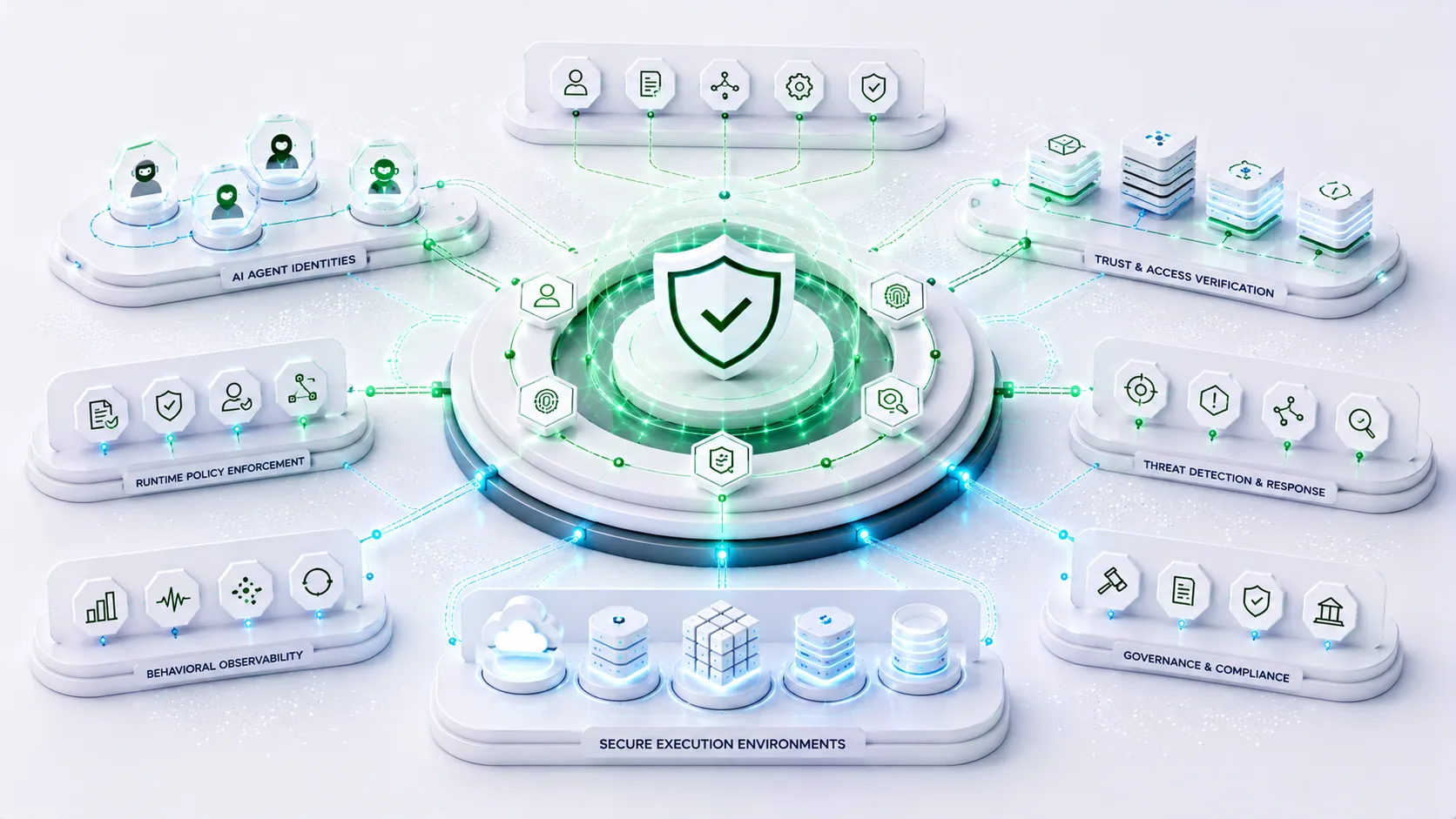
Runtime security refers to the continuous protection, monitoring, validation, and governance of AI agents while they actively operate within production environments.
Rather than focusing only on pre-deployment testing, runtime security evaluates agent behavior during execution.
This includes:
- Identity verification
- Permission enforcement
- Behavior monitoring
- Threat detection
- Policy validation
- Activity auditing
- Risk assessment
The goal is to ensure agents operate safely, securely, and within approved governance boundaries.
The Six Pillars of AI Agent Runtime Security
1. Agent Identity
Every autonomous agent should possess a verifiable identity.
Identity enables organizations to determine:
- Who created the agent
- What systems it can access
- Which permissions it possesses
- How it should be governed
- What policies apply
Without identity, accountability becomes impossible.
2. Authorization Controls
Agents should only access resources necessary to perform assigned tasks.
Modern runtime security platforms increasingly apply:
- Least-privilege access
- Role-based controls
- Context-aware permissions
- Dynamic authorization
- Task-specific access policies
Authorization reduces operational risk and limits potential damage.
3. Behavioral Monitoring
Runtime security requires continuous observation of agent activity.
Organizations monitor:
- Tool usage
- Workflow execution
- API interactions
- Data access patterns
- Decision pathways
- Cross-agent communication
Behavioral visibility provides the foundation for security operations.
4. Threat Detection
AI agents can encounter threats that traditional systems rarely face.
Examples include:
- Prompt manipulation
- Unauthorized tool usage
- Context poisoning
- Data exfiltration attempts
- Privilege escalation
- Agent impersonation
Runtime detection systems identify and respond to these threats as they occur.
5. Governance Enforcement
Security and governance are increasingly interconnected.
Runtime controls enforce:
- Operational policies
- Compliance requirements
- Workflow restrictions
- Risk thresholds
- Approval checkpoints
Governance becomes embedded directly into agent execution.
6. Accountability and Auditability
Every action performed by an AI agent should be traceable.
Organizations increasingly require:
- Decision lineage
- Activity logs
- Execution records
- Policy evaluations
- Approval histories
Auditability supports both governance and security investigations.
Common Runtime Threats Facing AI Agents
Prompt Injection Attacks
Attackers may attempt to manipulate agent behavior through malicious instructions embedded within data, documents, websites, or communications.
Runtime protection systems monitor for suspicious behavioral changes and policy violations.
Unauthorized Tool Execution
Agents frequently interact with external tools and APIs.
Runtime controls ensure agents only execute approved actions within defined boundaries.
Data Exposure Risks
Agents often access sensitive business information.
Security platforms monitor data access behavior to prevent unauthorized disclosure.
Agent-to-Agent Trust Exploitation
Multi-agent environments create new attack surfaces.
Organizations must verify trust relationships between agents before allowing collaboration.
Model Manipulation
Changes in model behavior can introduce security and governance risks.
Runtime monitoring helps detect unusual output patterns and operational anomalies.
The Role of Zero Trust in AI Agent Security
Many enterprises are extending Zero Trust principles into AI environments.
Under this model:
- No agent is automatically trusted
- Every action is verified
- Every request is validated
- Every interaction is monitored
- Every permission is continuously evaluated
Zero Trust provides a powerful foundation for runtime security architectures.
Runtime Security and Multi-Agent Systems
Enterprise AI increasingly relies on teams of agents working together.
These ecosystems introduce additional security requirements.
Organizations must secure:
- Agent communication
- Shared context
- Decision delegation
- Workflow coordination
- Trust relationships
Runtime security platforms provide visibility across these distributed interactions.
Observability as a Security Capability
AI observability is becoming one of the most important components of runtime security.
Observability platforms capture:
- Prompts
- Responses
- Agent decisions
- Workflow execution paths
- Tool interactions
- Knowledge retrieval events
This information allows security teams to investigate incidents and identify emerging risks.
Runtime Security and Governance Fabric Architectures
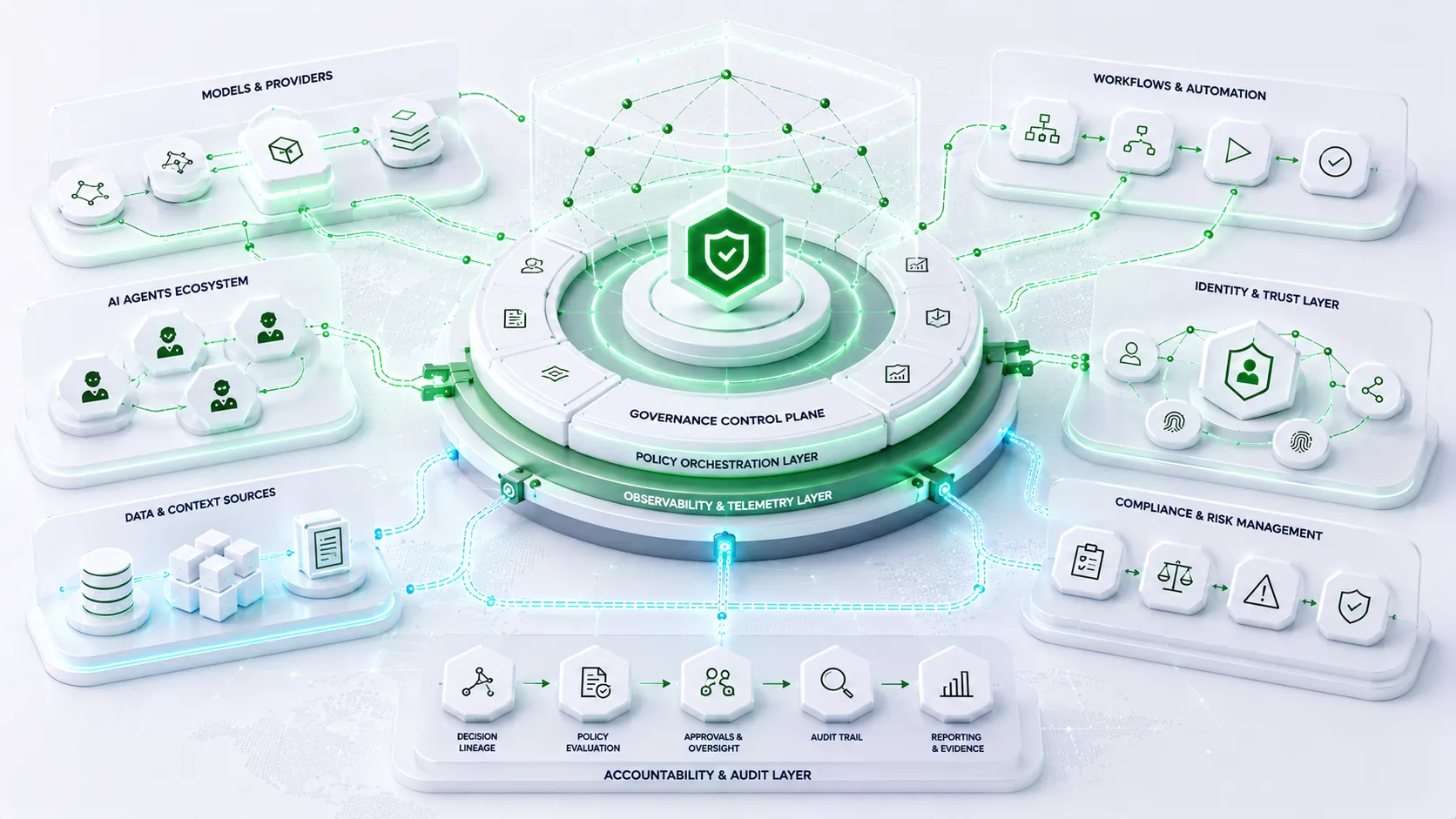
Governance Fabric architectures are increasingly serving as the enforcement layer for runtime security.
These systems help organizations:
- Apply policies consistently
- Validate agent behavior
- Enforce compliance controls
- Manage trust relationships
- Maintain operational oversight
Security becomes integrated into the broader governance ecosystem.
Enterprise Use Cases
Customer Service Agents
Runtime controls prevent unauthorized data access while ensuring customer interactions remain compliant.
Financial Operations
Security frameworks help validate decisions, monitor transactions, and enforce governance requirements.
Healthcare Systems
Runtime protections support patient privacy, access controls, and regulatory compliance.
Knowledge Intelligence Platforms
Organizations secure how agents access and utilize enterprise knowledge resources.
Autonomous Operations
Production agents executing operational tasks require continuous monitoring and risk management.
Key Metrics for Runtime Security
- Policy compliance rates
- Unauthorized action attempts
- Agent trust scores
- Security incident frequency
- Runtime validation coverage
- Threat detection rates
- Audit trail completeness
- Risk escalation events
These metrics help organizations evaluate security maturity.
Challenges Organizations Must Address
- Rapid agent proliferation
- Complex multi-agent ecosystems
- Limited visibility
- Governance fragmentation
- Identity management complexity
- Cross-platform integration challenges
- Evolving threat landscapes
Addressing these challenges requires a combination of security, governance, observability, and operational excellence.
Building a Runtime Security Strategy
Leading enterprises are focusing on six foundational capabilities:
- Agent identity management
- Zero Trust architectures
- Runtime observability platforms
- Threat detection systems
- Governance automation
- Continuous compliance validation
Together, these capabilities create a resilient security foundation for autonomous operations.
The Future of Runtime Security for AI Agents
As autonomous systems become increasingly embedded within enterprise operations, runtime security will evolve into a core operational capability.
Future platforms will increasingly support:
- Autonomous threat detection
- Real-time behavioral analysis
- Adaptive trust scoring
- AI-native security operations
- Cross-agent risk intelligence
- Self-healing security controls
The organizations that invest in runtime security today will be better positioned to scale autonomous systems safely tomorrow.
Key Takeaways
- Autonomous AI agents introduce entirely new security challenges.
- Runtime security protects agents while they actively operate in production.
- Identity, authorization, observability, and governance are foundational capabilities.
- Zero Trust principles are increasingly being applied to AI ecosystems.
- Multi-agent environments require continuous monitoring and trust management.
- Runtime security is becoming essential for enterprise AI adoption at scale.
How YggyTech Helps
YggyTech helps organizations secure autonomous AI systems through AI identity frameworks, runtime governance platforms, observability architectures, Zero Trust security models, compliance automation, and enterprise AI control planes.
Our approach enables enterprises to deploy AI agents confidently while maintaining security, accountability, and operational resilience.
Conclusion
AI agents are rapidly becoming active participants in enterprise operations.
As autonomy increases, security can no longer stop at deployment.
Organizations need continuous visibility, governance, validation, and protection throughout the operational lifecycle of every autonomous system.
Runtime Security for AI Agents provides the foundation for achieving that goal.
For enterprises building the future of autonomous operations, runtime security is not simply a security requirement—it is a prerequisite for trust.
FAQs
What is runtime security for AI agents?
Runtime security is the continuous monitoring, validation, protection, and governance of AI agents while they actively operate within production environments.
Why do AI agents require runtime security?
Because autonomous agents can make decisions, access systems, and execute actions dynamically, organizations need continuous oversight beyond traditional security controls.
How does Zero Trust apply to AI agents?
Zero Trust requires continuous verification of identities, permissions, actions, and interactions rather than assuming trust by default.
What role does observability play in AI security?
Observability provides visibility into agent behavior, workflows, decisions, and interactions, helping organizations detect threats and maintain governance.
How does runtime security support enterprise AI governance?
It enforces policies, validates actions, maintains audit trails, supports compliance, and provides operational oversight across autonomous AI systems.

Mason Carter
Cloud & Infrastructure Engineer
Mason focuses on scalable cloud ecosystems, DevOps modernization, and secure distributed infrastructure. His insights at YGGY Tech explore resilient architecture design, Kubernetes operations, cybersecurity strategy, and enterprise scalability.