Agent Identity and Access Management: The Enterprise Security Layer for Autonomous AI Systems
Agent identity and access management gives enterprises the security layer required to control AI agents, non-human identities, tool permissions, credentials, autonomous workflows, and system-level actions. As AI agents begin operating across enterprise environments, access control must evolve from human-centric IAM into agent-aware authorization architecture.
Why Agent Identity and Access Management Matters
Enterprise AI is moving from passive assistants to autonomous agents that can read data, call APIs, execute workflows, update systems, trigger messages, generate code, open tickets, analyze incidents, and coordinate multi-step business processes. This shift creates a new security problem: AI agents need access to tools and data, but uncontrolled access can turn them into high-risk non-human identities with broad enterprise reach.
Traditional identity and access management was designed around employees, service accounts, applications, and machines. AI agents are different. They can interpret natural language, make plans, choose tools, respond to changing context, and operate inside workflows that were previously handled by humans. Agent identity and access management is the discipline of assigning, limiting, monitoring, governing, and retiring the identities and permissions used by autonomous AI systems.
Key Insight
AI agents should never inherit open-ended access simply because a user, workflow, or application can access a tool. Every agent needs its own identity, permission boundary, approval path, and audit trail.
What Agent Identity and Access Management Actually Is
Agent identity and access management is the enterprise security architecture for controlling how AI agents authenticate, authorize, access data, call tools, use credentials, execute workflows, escalate decisions, and leave audit evidence. It extends IAM, PAM, zero trust, API security, cloud security, DevSecOps, LLMOps, and AI governance into the world of autonomous AI systems.
The goal is not to prevent AI agents from operating. The goal is to make their access safe, scoped, observable, and accountable. Enterprises need agents to operate with enough permission to complete useful work, but not enough permission to expose sensitive data, bypass policy, trigger unsafe actions, or create untraceable operational changes.
Agent Identity
Assigns unique, traceable identities to AI agents, workflows, orchestration services, and autonomous execution contexts.
Scoped Permissions
Limits which data, APIs, files, systems, and tools an agent can access for a specific task or workflow.
Action Governance
Controls what agents can execute, when approval is required, and how actions are validated before completion.
Auditability
Records agent plans, tool calls, permissions, credentials, approvals, outputs, failures, and escalation decisions.
Why Human-Centric IAM Is Not Enough for AI Agents
Human-centric IAM assumes that a known user chooses an action and that systems enforce access based on role, group, device posture, session, and policy. AI agents complicate that model. A user may ask an agent to complete a task, but the agent may break the task into steps, retrieve context, call tools, select APIs, retry failures, and make intermediate decisions. The person initiates the request, but the agent executes the workflow.
If the agent simply borrows the user’s full permissions, it may overreach. If it uses a shared service account, teams lose accountability. If it stores credentials without lifecycle controls, it becomes a security liability. If it calls tools without approval gates, it can create operational risk. Agent IAM solves these problems by separating user identity, agent identity, tool identity, and workflow authorization.
Enterprise Signal
The enterprise risk is not only that an AI agent answers incorrectly. The greater risk is that an AI agent performs a real action with excessive, unclear, or untraceable permissions.
From User Permissions to Delegated Agent Permissions
Agents should not automatically inherit everything a user can access. Instead, enterprises should issue delegated permissions that are narrower than the user’s full role and specific to the agent’s approved purpose.
From Static Roles to Context-Aware Authorization
Agent authorization should consider the task, tool, data sensitivity, workflow state, risk tier, user authority, approval status, environment, and potential business impact before access is granted.
Core Layers of Agent IAM Architecture
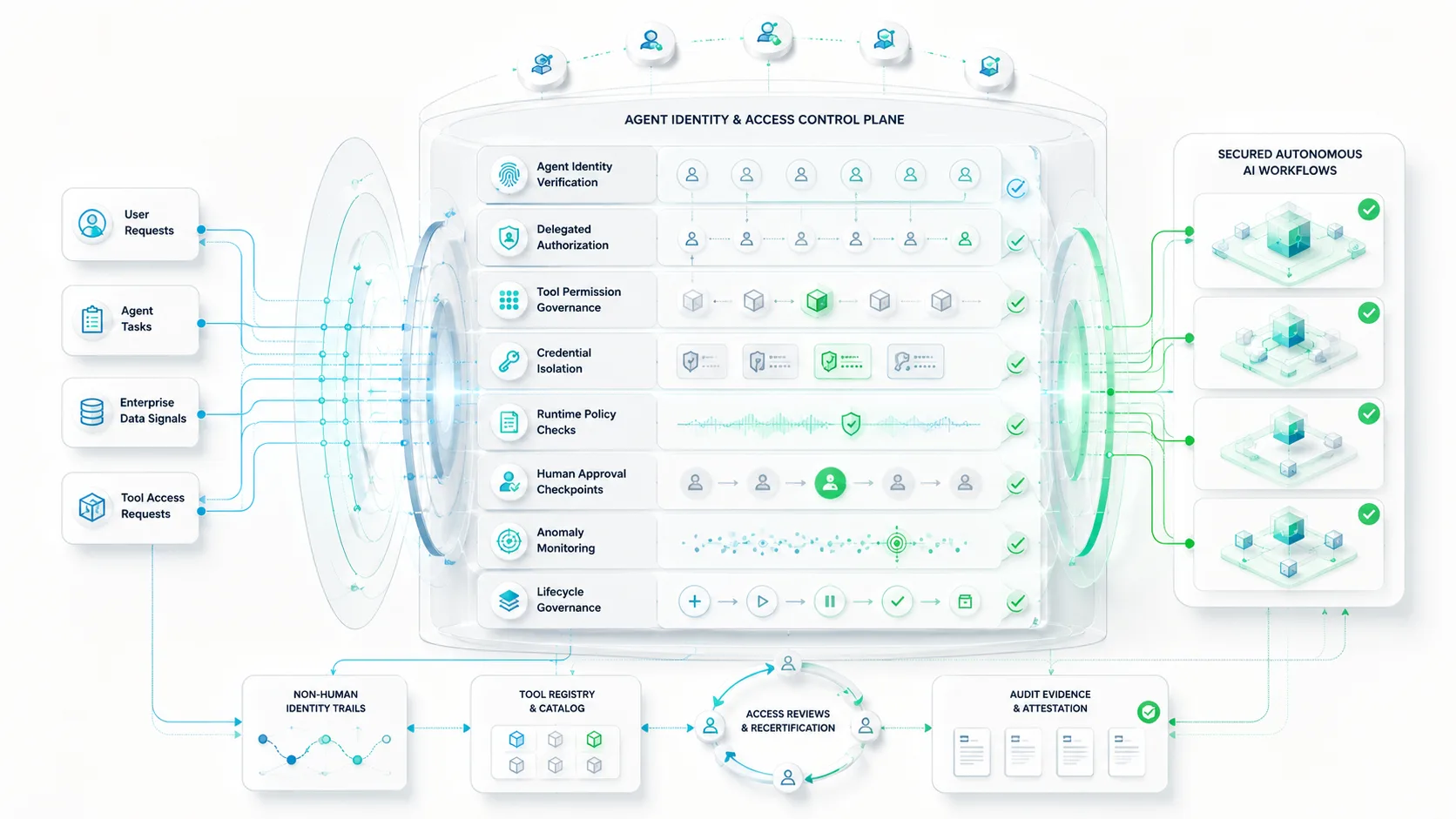
Agent identity and access management should be designed as a layered security architecture. The strongest systems do not rely on one permission check. They combine identity, authorization, credential management, tool governance, runtime policy, observability, and lifecycle control.
Reference Agent IAM Layers
Agent Access Must Be Purpose-Bound
An AI agent should have a clearly defined purpose. Permissions should map to that purpose, not to broad organizational roles. A customer support agent, security triage agent, finance analysis agent, and engineering automation agent should each operate with different access boundaries.
Agent Access Must Be Time-Bound
Long-lived credentials and indefinite permissions are dangerous for autonomous systems. Agent access should be temporary, revocable, rotated, and tied to approved workflow execution wherever possible.
Non-Human Identity Management for AI Agents
AI agents belong to the broader category of non-human identities, but they need more governance than traditional service accounts. A service account usually performs a known technical action. An AI agent may interpret goals, select tools, coordinate tasks, use memory, and act differently depending on context. That makes identity design foundational to AI agent security.
Unique Agent Identity
Every production agent should have a unique identity so actions are traceable to the agent, owner, workflow, and execution context.
Owner Mapping
Each agent should map to a business owner, technical owner, risk owner, and operational support path.
Lifecycle State
Agent identities should have lifecycle stages: proposed, approved, tested, active, suspended, deprecated, and retired.
Identity Principle
If an enterprise cannot identify which agent performed an action, which workflow authorized it, and which owner approved it, the access model is not mature enough for autonomous AI.
Tool Permission Governance for AI Agents
Tool use is where AI agent risk becomes operational. An agent that only summarizes information creates one category of risk. An agent that can update a CRM record, deploy code, approve an invoice, reset credentials, modify cloud infrastructure, or send customer communication creates a much higher category of risk. Tool permission governance defines which tools agents can use and under what conditions.
Tool Registry and Risk Classification
Every tool available to an AI agent should be registered, categorized, and assigned a risk level. Read-only tools, analytical tools, workflow creation tools, external communication tools, financial tools, deployment tools, and administrative tools should not receive the same control treatment.
Action-Level Authorization
It is not enough to approve access to a tool. Enterprises should approve what the agent can do inside the tool. A ticketing tool may allow read, create, update, assign, close, or escalate actions. Each action should have separate authorization logic based on risk and workflow context.
Tool Governance Guardrail
AI agents should not receive tool access as a broad capability. They should receive action-specific permissions tied to approved workflows, policy conditions, and runtime validation.
Credential Security and Secrets Management
Agent IAM must include strong credential controls. AI agents may need tokens, API keys, OAuth grants, service credentials, cloud roles, database access, or delegated user permissions. Poor credential management can turn an agent into a durable attack path. The enterprise must avoid shared secrets, static keys, excessive scopes, and unmonitored credential use.
Short-Lived Credentials
Use temporary tokens and just-in-time access instead of long-lived credentials stored inside agent workflows.
Secret Isolation
Keep secrets outside prompts, memory, logs, traces, model context, and generated output channels.
Credential Rotation
Rotate credentials automatically and revoke them when agents are suspended, retired, or moved between environments.
Usage Monitoring
Monitor credential use by agent, workflow, tool, environment, data source, and approval state.
Key Takeaways
- ✓ Agent identity and access management controls how AI agents authenticate, authorize, access tools, use data, and execute workflows.
- ✓ AI agents should have unique identities instead of shared service accounts or untraceable inherited user permissions.
- ✓ Tool permissions should be scoped by action, workflow, risk tier, approval status, and business impact.
- ✓ Agent credentials should be short-lived, isolated, rotated, monitored, and revoked as part of lifecycle governance.
- ✓ Mature agent IAM connects identity, authorization, tool governance, observability, security operations, and AI governance into one operating model.
Runtime Authorization for Autonomous AI Workflows
Agent access decisions should not happen only at deployment time. Autonomous workflows require runtime authorization because risk changes as the agent receives instructions, retrieves context, selects tools, and prepares actions. A low-risk request may become high-risk if the agent attempts to access sensitive data, modify records, send messages, or trigger external workflows.
Policy Decision Points
Enterprises should define policy decision points inside agent workflows. Before an agent retrieves sensitive data, calls a tool, writes to a system, or completes a high-impact action, policy should evaluate whether the action is allowed, blocked, modified, or escalated.
Human-in-the-Loop Approval
Human approval should be reserved for actions where business impact, compliance exposure, customer risk, financial consequence, or security sensitivity is high. The approval request should include the agent’s intent, source context, planned action, expected impact, and available rollback path.
Runtime Principle
Agent authorization should be continuous. The system should evaluate access at the moment of action, not only when the agent is created.
Agent Observability and Access Audit Trails
Agent IAM depends on observability. Security and platform teams need to see which agent acted, what user or workflow initiated the request, what data was accessed, which tools were called, which credentials were used, what policy decisions occurred, and whether the outcome matched the approved intent.
Access Trails
Access trails should record every meaningful access event: request origin, agent identity, user delegation, retrieved sources, tool calls, permission checks, credentials used, action result, and human approvals. This evidence supports incident response, compliance, and operational learning.
Behavior Anomaly Detection
Enterprises should monitor for unusual agent behavior: unexpected tools, abnormal access frequency, repeated permission denials, broad data queries, failed escalation attempts, unusual credential use, or changes in workflow patterns. These signals can reveal misuse, misconfiguration, or emerging risk.
Auditability Guardrail
A secure agent system should make every autonomous action explainable: who initiated it, which agent executed it, what permission allowed it, and what business outcome resulted.
Common Mistakes
Many enterprises approach AI agent access as a tooling issue rather than an identity governance issue. That leads to agents with unclear ownership, excessive permissions, shared credentials, weak logging, and poor lifecycle control. Agent IAM must be treated as enterprise security architecture.
- Letting agents inherit full user permissions. Agents need delegated, task-specific access, not unrestricted access to everything a user can reach.
- Using shared service accounts. Shared identities make it difficult to trace which agent performed which action and why.
- Approving tool access without action limits. Agents should be authorized for specific actions inside tools, not entire tool surfaces.
- Storing secrets in prompts or memory. Credentials should never appear in model context, logs, traces, or long-term agent memory.
- Skipping lifecycle governance. Agent permissions must be reviewed, rotated, suspended, and retired as systems change.
- Ignoring runtime authorization. Autonomous workflows need policy checks at the point of action, not only during initial deployment.
Enterprise Architecture Perspective
From an enterprise architecture perspective, agent identity and access management is the trust layer for autonomous AI systems. It connects IAM, zero trust, privileged access management, API security, AI governance, LLMOps, observability, security operations, and workflow automation. Without this layer, enterprises risk deploying agents that can act across systems without sufficient accountability.
The strongest architecture treats agent access as a governed control plane. Agent identities are registered. Permissions are scoped. Tools are classified. Credentials are temporary. Actions are validated. Human approvals are triggered by risk. Every decision is observable. Every agent can be suspended. Every action can be audited.
Architecture Principle
AI agents should be treated as governed enterprise actors: identifiable, permissioned, observable, accountable, and removable from the environment when risk changes.
Implementation Strategy for Agent Identity and Access Management
Enterprises should implement agent IAM in phases. The objective is to enable safe agent adoption without creating uncontrolled access paths. Teams should begin by identifying agents, mapping access needs, defining permission patterns, and building reusable controls that support multiple agentic workflows.
Phase 1: Inventory AI Agents and Non-Human Identities
Create an inventory of agents, copilots, automation workflows, service identities, model-connected tools, and agent orchestration systems. Map owners, data access, credentials, tools, environments, and business functions.
Phase 2: Define Agent Access Policies
Define policies for identity assignment, delegated access, least privilege, tool classification, human approval, credential handling, logging, review cadence, and suspension. Policies should be practical enough for engineering teams to implement consistently.
Phase 3: Build Runtime Authorization Controls
Add policy checks before data retrieval, tool use, write actions, external communication, workflow escalation, and high-impact execution. Connect these checks to observability and incident response systems.
Phase 4: Operationalize Review and Governance
Review agent access regularly, rotate credentials, retire unused identities, investigate anomalous behavior, and update permission models as agents evolve. Agent IAM should improve continuously with production telemetry.
Implementation Checklist
Foundation
- Inventory production and planned AI agents
- Assign business and technical owners
- Map tools, data, APIs, and credentials
- Classify agents by autonomy and risk tier
Controls
- Create unique agent identities
- Apply least privilege and delegated access
- Use short-lived credentials
- Require approval for high-risk tool actions
Operations
- Monitor agent access and tool calls
- Review permissions on a schedule
- Suspend agents on anomaly or policy breach
- Maintain audit evidence for every action
Measuring Agent IAM Maturity
Agent IAM maturity should be measured by how well the enterprise can identify, control, monitor, review, and revoke agent access. A mature organization does not only know which AI agents exist. It knows what each agent can do, why it can do it, who owns it, how access is approved, and how risk is contained.
Metrics to Track
How YggyTech Helps
YggyTech helps enterprises design and implement agent identity and access management for autonomous AI systems. We help organizations move from experimental agent workflows to secure, governed, observable, and production-ready agent architectures.
Agent IAM Strategy
We define agent identity models, access policies, tool permission governance, ownership structures, and maturity roadmaps.
Secure Agent Architecture
We design delegated access, runtime authorization, credential isolation, approval gates, agent observability, and audit trails.
Governance and Operations Integration
We connect agent IAM with AI governance, LLMOps, DevSecOps, security operations, observability, cloud security, and compliance evidence.
Our expertise spans enterprise AI, AI agents, cybersecurity, identity architecture, cloud infrastructure, DevSecOps, LLMOps, AI governance, AI observability, and software architecture. That systems-level perspective matters because agent IAM is not only an access-control problem. It is the trust foundation for autonomous enterprise AI.
Secure AI Agents Before They Become Enterprise Access Risk
YggyTech helps technology leaders build agent identity and access management systems that control AI agent identities, tool permissions, credentials, workflows, approvals, audit trails, and autonomous access at enterprise scale.
Talk to YggyTechFAQs About Agent Identity and Access Management
What is agent identity and access management?
Agent identity and access management is the security discipline for assigning, controlling, monitoring, and governing the identities, permissions, credentials, tools, actions, and lifecycle of AI agents and autonomous AI workflows.
Why do AI agents need unique identities?
AI agents need unique identities so enterprises can trace actions, assign ownership, enforce permissions, review access, detect anomalies, revoke credentials, and prove accountability when agents access data or use tools.
How is agent IAM different from traditional IAM?
Traditional IAM focuses mainly on users, applications, devices, and service accounts. Agent IAM adds controls for autonomous decision-making, delegated permissions, tool calls, workflow actions, runtime authorization, agent credentials, and AI-specific audit trails.
What should an agent IAM framework include?
An agent IAM framework should include agent inventory, unique identities, ownership mapping, least privilege, delegated access, tool permission governance, short-lived credentials, approval gates, runtime policy checks, observability, audit trails, and lifecycle governance.
How can enterprises start securing AI agent access?
Enterprises should start by inventorying AI agents, assigning owners, mapping data and tool access, creating unique agent identities, limiting permissions, securing credentials, adding approval gates, monitoring tool calls, and reviewing agent access regularly.

Liam Walker
Product & AI Research Analyst
Liam researches emerging AI tools, automation workflows, and next-generation digital products. He contributes fresh perspectives on startup technology trends, AI productivity systems, and modern SaaS innovation for fast-growing companies.