AI Context Mesh Architecture: Synchronizing Enterprise Knowledge Across Distributed AI Systems
Enterprise AI systems do not fail only because models lack intelligence. They fail because agents, copilots, workflows, and retrieval pipelines operate with incomplete, inconsistent, stale, or unauthorized context. An AI context mesh architecture addresses this problem by establishing a distributed but governed knowledge layer that synchronizes trusted context across the enterprise without forcing every system into one monolithic repository.
The next generation of enterprise AI infrastructure will not be organized around a single model or vector database. It will be organized around governed context services that can identify, assemble, authorize, refresh, trace, and deliver the right knowledge to every AI system at runtime.
What Is AI Context Mesh Architecture?
AI context mesh architecture is a distributed enterprise architecture for discovering, governing, transforming, synchronizing, and delivering knowledge to AI applications. It treats context as a reusable operational capability rather than an application-specific prompt attachment or isolated retrieval pipeline.
In many organizations, every AI team independently connects to document repositories, creates embeddings, defines chunking strategies, configures vector databases, builds access filters, and assembles prompts. This produces duplicated infrastructure and incompatible representations of enterprise knowledge. A sales copilot may interpret a customer differently from a support agent. A compliance assistant may retrieve an outdated policy while an operational workflow accesses the current version. A planning agent may carry memory that conflicts with the system of record.
A context mesh replaces these fragmented pipelines with interoperable context domains, shared delivery contracts, semantic routing, distributed ownership, and centrally enforceable governance. Knowledge remains close to the teams that understand it, while enterprise standards determine how that knowledge is represented, accessed, trusted, monitored, and exchanged.
Distributed Ownership
Business and platform domains retain responsibility for the knowledge, metadata, policies, and service-level expectations they understand best.
Shared Context Contracts
AI systems consume context through stable schemas, provenance metadata, authorization rules, freshness indicators, and quality expectations.
Runtime Assembly
Context is dynamically assembled for a specific user, agent, objective, workflow stage, risk level, and model constraint.
Governed Interoperability
Policy, lineage, observability, retention, and access controls remain consistent across models, agents, clouds, and applications.
Why Enterprise AI Context Management Matters Now
Enterprise AI has moved beyond isolated chat interfaces. Organizations are deploying specialized copilots, autonomous agents, multi-agent workflows, model-routing layers, RAG services, embedded AI features, and decision-support systems. Each workload requires a different combination of operational data, historical records, policies, permissions, semantic knowledge, user state, and execution memory.
Context fragmentation becomes an operational risk
When each application builds its own context pipeline, the enterprise accumulates multiple definitions of truth. Retrieval indexes become stale at different rates. Access controls are implemented inconsistently. Sensitive fields may be stripped in one workflow but exposed in another. Source lineage disappears once information is converted into prompt text. Teams cannot confidently explain why two AI systems produced contradictory answers from supposedly identical enterprise data.
Model scale does not solve knowledge inconsistency
A larger model may reason more effectively over the context it receives, but it cannot repair missing evidence, resolve an unknown source version, or determine whether a user was authorized to see the retrieved material. Enterprise reliability depends on the quality and governance of the entire context supply chain, not only the model endpoint.
Agentic systems increase context complexity
Autonomous systems need context across multiple execution stages. Planning may require organizational goals and policies. Tool selection may require capability metadata and security constraints. Execution may require live transactional data. Validation may require business rules, historical outcomes, and approval state. Memory must persist useful observations without preserving sensitive, incorrect, or obsolete information indefinitely.
Context should be treated as a governed runtime product with owners, contracts, service levels, quality metrics, and lifecycle controls—not as unstructured text inserted between a system prompt and a user request.
The Core Layers of an AI Context Mesh Architecture
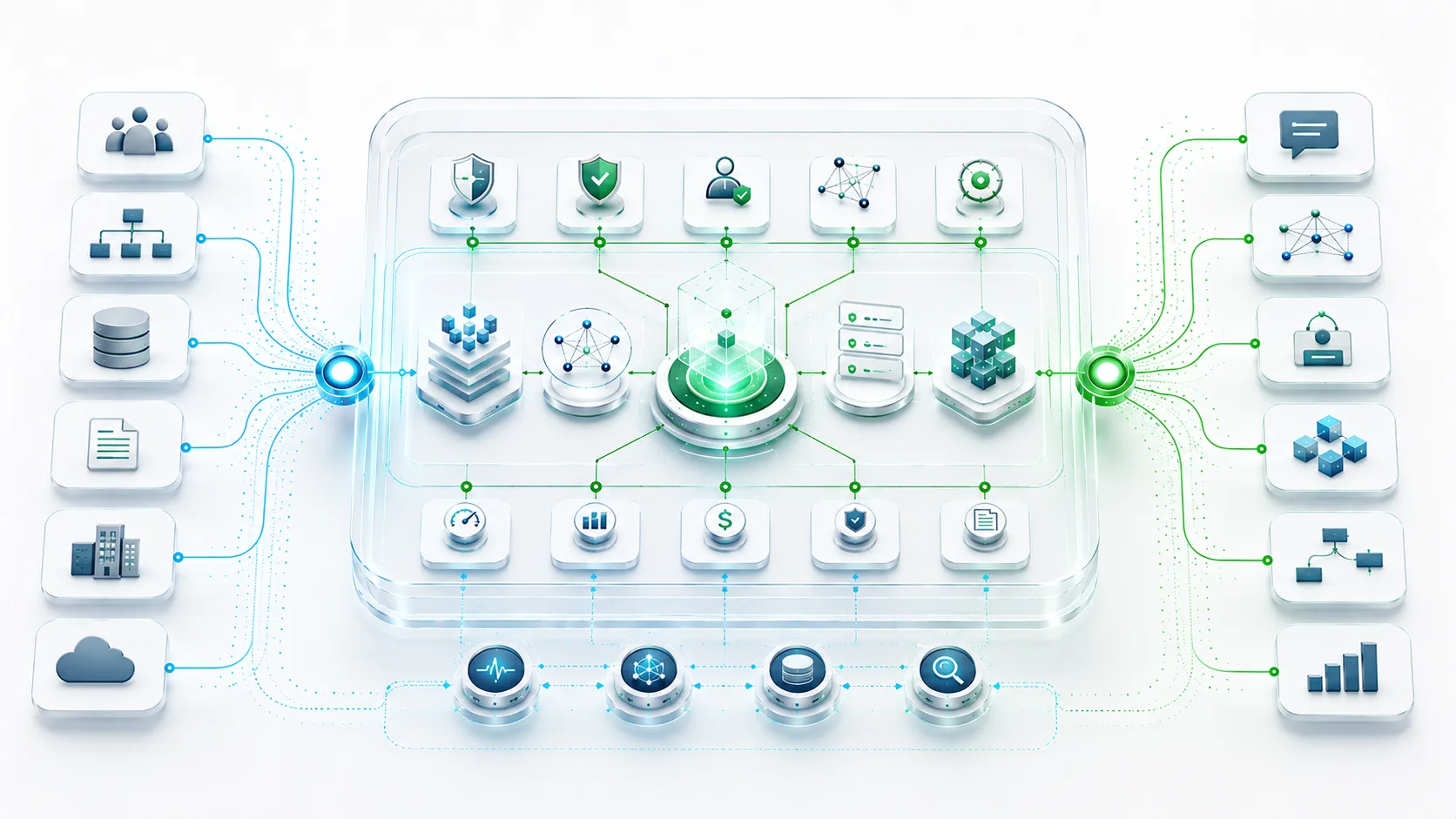
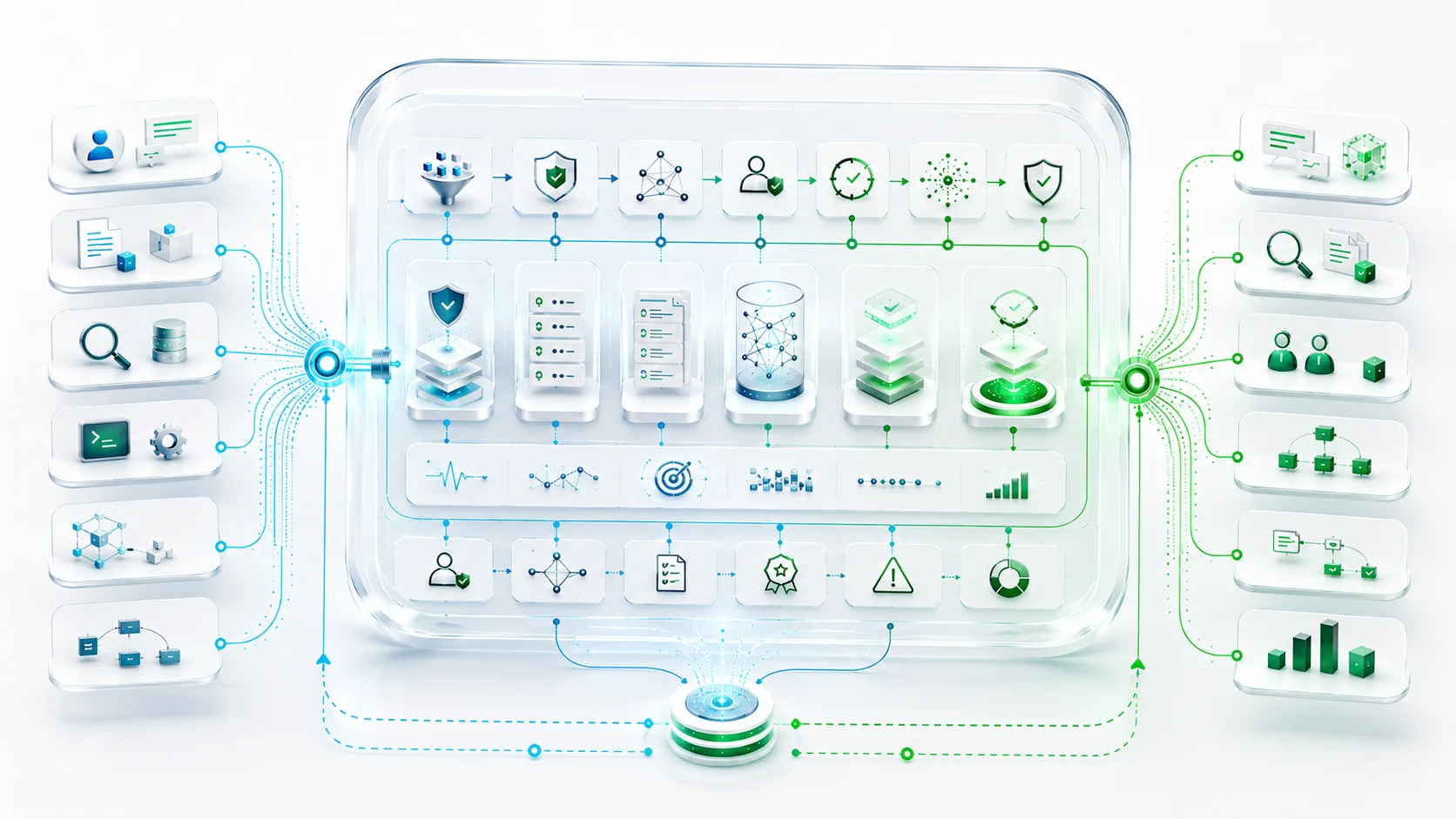
A production-grade context mesh is not one database or middleware product. It is a coordinated architecture spanning source systems, semantic representations, retrieval services, policies, runtime assembly, memory, observability, and feedback. The layers can be deployed incrementally, but they should share a coherent operating model.
Knowledge Source Layer
Connects documents, databases, event streams, APIs, knowledge graphs, repositories, collaboration platforms, operational tools, and approved external sources.
Ingestion and Normalization
Extracts, validates, classifies, transforms, deduplicates, enriches, chunks, and versions information while preserving source lineage.
Semantic Representation
Builds embeddings, entities, relationships, taxonomies, metadata, temporal markers, and domain-specific semantic models.
Context Domain Services
Expose reusable context products for customer, product, policy, engineering, finance, operations, security, and other enterprise domains.
Policy and Trust Layer
Enforces identity, purpose limitation, data classification, regional controls, consent, retention, source trust, and risk-based access policies.
Runtime Context Orchestration
Selects sources, retrieves evidence, ranks results, applies filters, compresses information, manages token budgets, and assembles model-ready context.
Context should move through a controlled supply chain
- 1 Discover: Identify relevant context products based on task, domain, user identity, workflow state, and system intent.
- 2 Authorize: Evaluate whether the caller, agent, delegated identity, model, and intended action are permitted to access the material.
- 3 Retrieve and rank: Combine semantic, keyword, graph, structured, temporal, and event-driven retrieval according to domain requirements.
- 4 Transform: Redact, summarize, structure, compress, normalize, or translate context for the target model and use case.
- 5 Deliver and observe: Provide context with citations, trust signals, expiry information, and trace identifiers while capturing downstream outcomes.
Context Domains: The Operating Units of the Mesh
The context mesh should be divided into logical domains that reflect enterprise ownership and decision boundaries. A context domain packages knowledge, retrieval methods, metadata, policies, quality expectations, and interfaces around a coherent business or technical area.
Examples include customer context, product context, employee context, operational context, policy context, security context, software delivery context, and financial context. Each domain can source information from multiple underlying systems while presenting AI applications with a stable and governed interface.
Customer Context Domain
Unifies profile, account, entitlement, lifecycle, interaction, contract, support, consent, and relationship data without replacing their systems of record.
Policy Context Domain
Provides authoritative policies, effective dates, jurisdiction, control mappings, exceptions, approval state, and machine-readable obligations.
Engineering Context Domain
Connects architecture decisions, service ownership, source code, incidents, deployment state, dependencies, observability, and runbooks.
Operational Context Domain
Combines real-time events, capacity, inventory, workflow status, schedules, incidents, constraints, and execution dependencies.
A context product needs an explicit contract
An API response containing text is not sufficient. Every enterprise context product should communicate the conditions under which its content can be trusted and used.
- Identity: Which principal, user, service, or delegated agent requested the context?
- Provenance: Which source produced the information, and which transformations were applied?
- Freshness: When was the information observed, indexed, validated, and last changed?
- Classification: What sensitivity, residency, retention, and disclosure rules apply?
- Confidence: How authoritative, complete, and relevant is the result for the requested purpose?
- Expiry: How long may the AI system retain or act on the supplied context?
Runtime Context Orchestration for AI Agents and Applications
The runtime orchestration layer is responsible for turning distributed knowledge into task-specific model input. It should not simply issue one similarity search and concatenate the highest-scoring chunks. Enterprise context assembly is a decision process involving user intent, domain selection, authorization, temporal relevance, source authority, model limits, cost, latency, and risk.
Semantic routing before retrieval
A context router determines which domains and retrieval strategies are appropriate for the task. A request about a contract renewal may require customer, legal, product, and pricing context. A production incident may require live telemetry, deployment history, service ownership, architecture decisions, and relevant runbooks. Routing reduces unnecessary retrieval, limits exposure, improves latency, and creates clearer audit trails.
Hybrid retrieval and evidence fusion
Different knowledge types require different access patterns. Semantic retrieval is useful for conceptual similarity. Keyword retrieval is valuable for exact identifiers and terminology. Knowledge graphs support relationship traversal. SQL and APIs provide authoritative structured values. Event streams provide current operational state. A context mesh can combine these methods and reconcile their outputs through evidence-ranking and conflict-resolution policies.
Token-aware context composition
Context must be prioritized, compressed, and structured according to the target model and task. The orchestrator may provide full evidence for high-risk decisions, summaries for historical background, structured fields for deterministic values, and references for optional follow-up retrieval. The objective is not to maximize prompt length. It is to maximize useful, authorized, attributable information per unit of latency and model capacity.
Every context package should carry evidence identifiers, source timestamps, policy decisions, relevance signals, and a trace ID. Without these attributes, model output cannot be reliably investigated, evaluated, or reproduced.
Synchronizing Context Across Distributed AI Systems
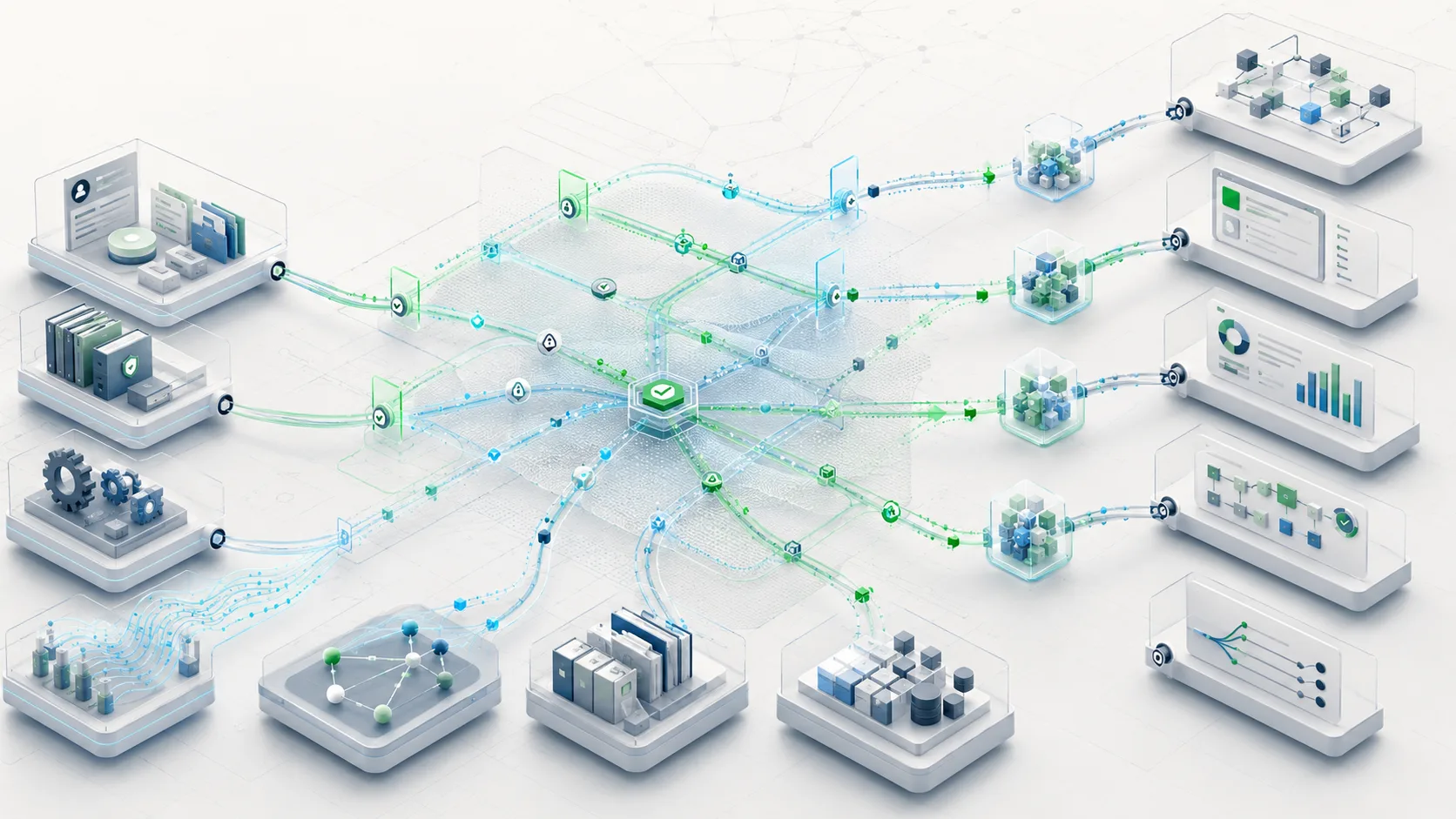
Synchronization does not mean copying every piece of enterprise data into a universal AI repository. That approach increases duplication, residency risk, stale information, and operational cost. A context mesh synchronizes knowledge through contracts, metadata, events, version awareness, cache policies, and selective materialization.
Event-driven freshness
Critical source changes should trigger context updates or invalidations. A revised policy can publish an event that marks previous indexed versions as superseded. A customer entitlement change can invalidate cached context. A service deployment can update engineering context used by operational agents. Event-driven synchronization reduces the delay between system-of-record changes and AI behavior.
Versioned context snapshots
Some decisions must be reproducible according to the knowledge available at a specific point in time. Versioned snapshots allow teams to reconstruct which policy, customer state, model configuration, prompt template, and evidence set influenced an output. This is particularly important for regulated workflows, financial decisions, security operations, and high-impact automation.
Selective materialization and federated access
Frequently accessed and latency-sensitive context may be materialized in dedicated retrieval stores. Highly sensitive or rapidly changing information may remain behind source APIs and be fetched at runtime. The architecture should support both patterns under a shared contract so consuming AI applications do not need to manage every storage technology independently.
Security, Governance, and Trust Boundaries
Context infrastructure sits directly between sensitive enterprise knowledge and probabilistic AI systems. It must therefore be designed as a security boundary, not merely a data-access convenience. Authorization should apply before retrieval, during transformation, and at delivery.
Identity-Aware Access
Propagate user, workload, agent, service, and delegated identities throughout context retrieval and tool execution.
Purpose-Based Policy
Authorize access according to the intended task and action, not only the application or broad user role.
Field-Level Protection
Mask, tokenize, redact, aggregate, or omit sensitive fields before information reaches the model context window.
Context Auditability
Record source selection, policy outcomes, transformations, retrieved evidence, model delivery, and downstream actions.
Defending against context-layer threats
Enterprise context pipelines can be attacked through malicious documents, poisoned indexes, unauthorized source connectors, manipulated metadata, prompt injection, retrieval hijacking, or compromised memory. Controls should include source allowlists, content scanning, document trust scoring, instruction-data separation, retrieval filters, anomaly detection, signed provenance, and execution isolation.
- ✓Distinguish trusted system instructions from retrieved untrusted content.
- ✓Apply data-loss prevention before context enters model prompts, memory, traces, or evaluation datasets.
- ✓Prevent agents from expanding their context privileges through tool chains or delegated tasks.
- ✓Expire cached context and agent memory when permissions, policies, or source records change.
Observability and Evaluation for Context Quality
Traditional application monitoring shows whether a service responded. Context observability must show whether the AI system received the right information. This requires tracing the complete path from user request through domain routing, policy evaluation, source retrieval, ranking, transformation, model invocation, response generation, and downstream action.
Metrics that matter
Platform teams should monitor more than retrieval latency and token usage. They need quality and governance indicators that connect context behavior to business outcomes.
| Metric Category | Examples | Enterprise Value |
|---|---|---|
| Retrieval Quality | Recall, precision, ranking quality, evidence coverage | Determines whether relevant evidence reaches the model |
| Freshness | Source age, index delay, invalidation latency | Reduces decisions based on obsolete enterprise state |
| Grounding | Citation accuracy, evidence utilization, claim support | Improves explainability and reduces unsupported output |
| Policy Compliance | Denied requests, redaction coverage, exposure events | Verifies that context delivery respects enterprise controls |
| Efficiency | Context tokens, retrieval cost, cache efficiency, latency | Balances quality with operational cost and responsiveness |
Evaluate context separately from the model
When an AI response fails, teams need to determine whether the problem originated in routing, retrieval, source quality, policy filtering, context compression, prompt assembly, model reasoning, or tool execution. Separate evaluation datasets and traces for each stage prevent model changes from masking context defects and allow teams to improve the correct layer.
Enterprise Architecture Perspective
From an enterprise architecture perspective, the context mesh becomes a shared capability between data platforms, AI platforms, identity systems, governance services, knowledge management, application architecture, and operational systems. It should complement these investments rather than duplicate or bypass them.
The context mesh is not a replacement for systems of record
Source systems remain authoritative for transactions and operational state. The mesh provides AI-ready access, semantic enrichment, policy-aware retrieval, and evidence assembly. Where correctness is critical, structured values should be resolved from authoritative APIs at runtime rather than inferred from embeddings or historical documents.
The mesh should integrate with the AI control plane
The AI control plane governs models, prompts, agents, policies, routing, evaluations, cost, and deployment. The context mesh governs knowledge discovery, evidence delivery, semantic representations, provenance, freshness, and context-level access. Integrated traces allow enterprises to connect a model output to the exact context, policy decisions, and runtime configuration that produced it.
Domain ownership must coexist with platform standards
Central platform teams should provide shared connectors, schemas, policy enforcement, observability, evaluation, indexing infrastructure, and developer tooling. Domain teams should own meaning, source selection, quality thresholds, freshness requirements, and business-specific retrieval behavior. This division prevents both centralized bottlenecks and uncontrolled duplication.
Centralize the capabilities that require consistency—identity, policy, contracts, observability, lineage, evaluation, and shared infrastructure. Federate the capabilities that require domain expertise—meaning, quality, source authority, semantic models, and business-specific retrieval.
Implementation Strategy for AI Context Mesh Architecture
Enterprises should not begin by attempting to catalog and synchronize all organizational knowledge. A context mesh should be built around valuable AI workflows with measurable quality, risk, and operational requirements.
Select a bounded, high-value workflow
Choose an AI workflow where knowledge fragmentation visibly affects accuracy, latency, compliance, or user trust. Define expected decisions, users, sources, risks, and measurable outcomes.
Map the context supply chain
Document sources, owners, classifications, update rates, transformations, retrieval methods, access controls, consumers, and failure modes. Identify where context loses authority or provenance.
Define the first context domain contract
Specify schemas, evidence formats, provenance, freshness, classification, confidence, expiry, error behavior, and service-level objectives before building application-specific integrations.
Introduce policy-aware orchestration
Add identity propagation, routing, authorization, hybrid retrieval, ranking, redaction, token management, and model-ready context assembly behind a reusable service boundary.
Instrument and evaluate every stage
Capture traces from source to response. Create evaluations for routing, retrieval, evidence quality, grounding, policy compliance, latency, cost, and business outcomes.
Expand through reusable context products
Convert successful components into reusable domain services, SDKs, gateways, templates, policies, and golden paths that additional AI teams can adopt.
Common Mistakes
Treating the vector database as the architecture
A vector store solves one retrieval problem. It does not provide domain ownership, source authority, field-level policy, temporal consistency, workflow state, lineage, or enterprise-wide context contracts.
Centralizing every knowledge asset
Copying all data into one AI repository increases stale duplicates, weakens ownership, complicates deletion, and creates an oversized security boundary.
Applying access control only at the application
Authorization must remain attached to context through retrieval, transformation, caching, model delivery, memory, logging, and downstream tool execution.
Optimizing only for answer quality
Enterprise context must also be evaluated for exposure risk, provenance, reproducibility, freshness, cost, latency, source authority, and operational resilience.
Allowing uncontrolled agent memory
Persisting every interaction creates privacy, accuracy, retention, and poisoning risks. Memory needs explicit write policies, expiry, validation, user controls, and provenance.
Ignoring operational ownership
Without named owners and service-level objectives, context sources silently degrade, indexes become stale, schemas drift, and policy exceptions accumulate.
Implementation Checklist
Key Takeaways
AI context mesh architecture turns fragmented enterprise knowledge into governed, reusable context products for applications and agents.
The architecture must coordinate semantic retrieval, structured data, real-time state, access policy, provenance, freshness, and runtime assembly.
Distributed ownership works only when context domains share enforceable contracts, observability, identity propagation, and enterprise standards.
The most effective implementation path begins with a high-value workflow and expands through reusable platform capabilities and domain services.
How YggyTech Helps
YggyTech helps enterprises design and operationalize AI context infrastructure that can support production agents, copilots, RAG systems, and intelligent workflows at scale. Our approach connects enterprise architecture, AI platforms, data systems, cloud infrastructure, cybersecurity, DevSecOps, and governance into a coherent context operating model.
Context Architecture Assessment
Map fragmented retrieval pipelines, knowledge sources, ownership gaps, policy risks, freshness problems, duplication, and production-readiness constraints.
Target Architecture and Roadmap
Design context domains, shared contracts, orchestration services, semantic layers, trust boundaries, deployment topology, and phased implementation plans.
Enterprise RAG and Agent Platforms
Build secure retrieval, context routing, memory services, agent orchestration, model integration, observability, evaluation, and reusable development patterns.
Governance and Operationalization
Establish identity-aware access, policy enforcement, lineage, evaluation gates, incident response, service ownership, cost controls, and production operating models.
Frequently Asked Questions
What is AI context mesh architecture?
AI context mesh architecture is a distributed framework for making enterprise knowledge available to AI systems through governed context domains, shared contracts, semantic routing, policy-aware retrieval, provenance, synchronization, and runtime context assembly. It allows knowledge to remain distributed while giving agents and applications consistent methods for discovering and consuming it.
How is an AI context mesh different from a vector database?
A vector database supports semantic storage and retrieval, but an AI context mesh coordinates multiple retrieval methods, data sources, policy systems, identities, domain contracts, freshness controls, lineage, observability, memory, and runtime transformation. Vector databases can be important components of the mesh, but they do not constitute the complete architecture.
Why do enterprises need AI context management?
Enterprise AI context management reduces conflicting answers, stale retrieval, duplicated pipelines, unauthorized disclosure, weak provenance, and inconsistent agent behavior. It provides a controlled way to deliver trusted knowledge to multiple models and applications without rebuilding governance and integration logic for every project.
How does AI context mesh architecture support AI agents?
It gives agents controlled access to task-relevant knowledge, operational state, policies, tool metadata, historical outcomes, and approved memory. The mesh can change the context package at each execution stage while enforcing identity, purpose, risk, freshness, and retention requirements throughout the agent workflow.
How should an enterprise begin implementing AI context mesh architecture?
Begin with one high-value AI workflow where context quality or governance is a measurable constraint. Map its knowledge sources and risks, define a context domain contract, introduce policy-aware orchestration, instrument retrieval quality, and convert successful components into reusable services. Expansion should follow validated domain patterns rather than an organization-wide data migration.

Maheer Alishba
Data & Automation Consultant
Maheer writes about data engineering, AI-powered analytics, and intelligent business automation. Her content helps organizations understand how to transform fragmented operational data into measurable business intelligence and predictive systems.