AI Operations Centers (AIOCs): The Next Evolution of Enterprise Command Centers
Enterprise command centers were built to centralize visibility. AI Operations Centers are being designed to centralize interpretation, coordination, and action. By combining enterprise telemetry, AI agents, operational workflows, governance controls, and real-time decision intelligence, an AIOC can transform fragmented monitoring environments into a unified operating system for complex enterprises.
The defining capability of an AI Operations Center is not a larger wall of dashboards. It is the ability to convert signals into governed decisions, coordinate execution across organizational boundaries, and continuously learn from operational outcomes.
What Is an AI Operations Center?
An AI Operations Center, or AIOC, is an enterprise command environment that unifies operational data, service topology, artificial intelligence, automation, collaboration, governance, and decision workflows. It provides a coordinated layer for understanding what is happening across the organization, determining why it is happening, assessing the likely business impact, and selecting or executing the appropriate response.
Traditional network operations centers, security operations centers, cloud command centers, and business operations rooms usually focus on a defined domain. Each environment has its own telemetry, tools, escalation paths, dashboards, and operating procedures. An AIOC does not necessarily replace these specialized functions. It creates an intelligence and orchestration layer across them.
The result is a command architecture that can connect infrastructure health to application performance, application performance to customer experience, customer experience to revenue risk, and revenue risk to an enterprise response plan. This systems-level correlation is what distinguishes an AIOC from a conventional monitoring platform or isolated AIOps implementation.
Unified Operational Context
Combines technical, security, operational, customer, financial, and workflow signals into a shared real-time picture.
Machine-Assisted Decisions
Uses AI to classify events, identify patterns, estimate impact, recommend action, and support operational prioritization.
Coordinated Execution
Orchestrates workflows across teams, platforms, agents, automation tools, service owners, and approval boundaries.
Governed Autonomy
Allows increasingly autonomous action while preserving policy, identity, auditability, risk controls, and human oversight.
Why Enterprise Command Centers Must Evolve
Modern enterprises operate across hybrid clouds, software platforms, digital products, supply chains, cybersecurity environments, customer channels, and automated workflows. Operational conditions now change faster than conventional escalation chains can interpret them. At the same time, responsibility remains divided across engineering, operations, security, finance, customer support, compliance, product, and executive leadership.
Dashboard density has exceeded human processing capacity
Enterprises often have extensive visibility but limited operational coherence. Teams may receive thousands of alerts, each technically valid but disconnected from business context. A database saturation warning, payment-service latency, customer complaints, and falling conversion can appear in separate tools even when they belong to the same incident.
Operational decisions cross organizational boundaries
A major service degradation may require infrastructure remediation, application rollback, customer communication, fraud review, executive reporting, and regulatory assessment. Traditional command centers can visualize individual components, but they rarely coordinate the complete response as one governed operating process.
Static runbooks are insufficient for dynamic systems
Runbooks remain valuable, but the correct response often depends on current architecture, deployment history, customer impact, change windows, regional policy, service dependencies, and available capacity. AI Operations Centers can assemble this context dynamically and adapt response plans to real-time conditions.
Enterprise operations should be organized around shared situational context and coordinated decisions, not around the boundaries of individual monitoring tools.
The Core Architecture of AI Operations Centers
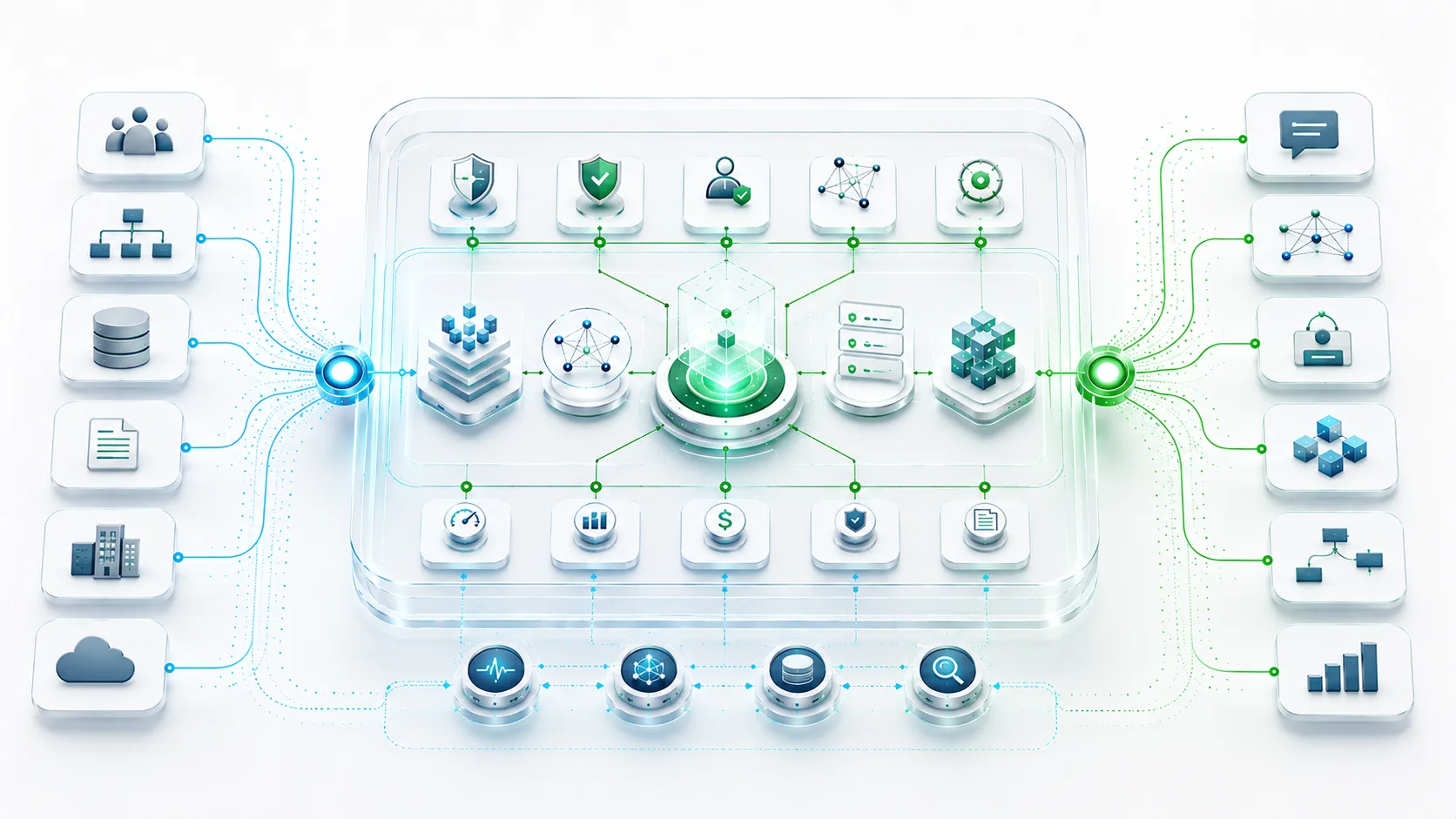
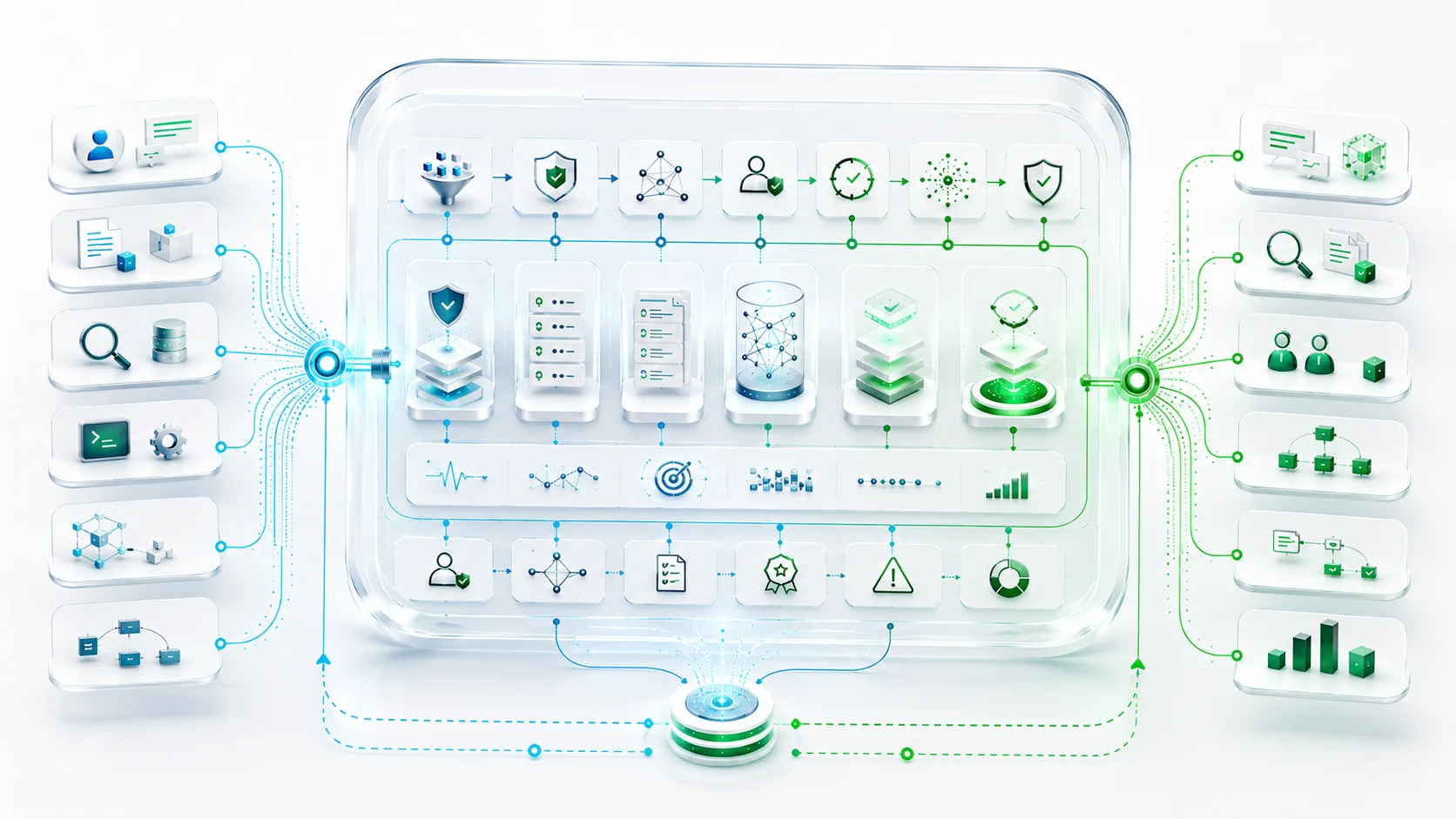
An enterprise AIOC is not a single product. It is a layered architecture integrating telemetry, topology, contextual data, intelligence services, policy enforcement, workflow orchestration, automation, and operator experience. Each layer must remain independently governable while participating in a common operational model.
Signal and Telemetry Fabric
Ingests metrics, logs, traces, events, security findings, deployment signals, workflow state, customer indicators, financial metrics, and external intelligence.
Enterprise Topology and Context
Maps services, applications, infrastructure, teams, customers, processes, vendors, regions, policies, and business dependencies.
Operational Intelligence
Performs correlation, anomaly detection, root-cause analysis, forecasting, impact estimation, risk scoring, and recommendation generation.
Agent and Workflow Orchestration
Coordinates specialized agents, human teams, tool calls, approvals, investigations, communications, and remediation workflows.
Policy and Governance Plane
Enforces identity, permissions, action limits, change controls, risk thresholds, evidence requirements, auditability, and escalation policies.
Command Experience
Provides role-specific views, natural-language interaction, operational timelines, decision records, collaboration, and executive impact summaries.
The AIOC operational loop
- 1 Observe: Continuously collect technical, business, security, and operational signals.
- 2 Interpret: Correlate signals with topology, recent changes, policies, ownership, and business context.
- 3 Decide: Assess impact, evaluate options, estimate risk, and select an approved response strategy.
- 4 Act: Trigger automation, coordinate teams, execute remediation, communicate status, or request approval.
- 5 Learn: Evaluate outcomes, update models and workflows, capture institutional knowledge, and improve future response quality.
From AIOps Tools to AI Operations Centers
AIOps platforms typically apply machine learning and automation to IT operations data. They can reduce alert noise, identify anomalies, correlate events, and support incident response. AI Operations Centers extend this foundation into a broader enterprise operating model.
The distinction is architectural and organizational. AIOps improves specific operational processes. An AIOC coordinates decisions across processes, teams, domains, and business outcomes.
| Capability | Traditional AIOps | AI Operations Center |
|---|---|---|
| Primary Scope | IT events and incident operations | Cross-enterprise operational decisions and execution |
| Context | Technical telemetry and service data | Technical, customer, financial, security, policy, and workflow context |
| Automation | Runbook and remediation automation | Multi-stage workflow orchestration with agents and human controls |
| Decision Model | Operational recommendations | Risk-aware options, approvals, execution, and learning |
| Primary Outcome | Faster detection and resolution | Enterprise resilience, coordinated execution, and operational autonomy |
How AI Agents Operate Inside an AIOC
AI agents can provide specialized operational capabilities within the AIOC, but they should not be deployed as unrestricted autonomous actors. Each agent requires a defined role, approved tools, accessible context, action limits, identity, evaluation criteria, and escalation policy.
Investigation Agent
Collects evidence, reconstructs timelines, compares recent changes, identifies dependencies, and develops root-cause hypotheses.
Response Planning Agent
Evaluates remediation options against service risk, change policy, customer impact, capacity, and available rollback strategies.
Execution Agent
Invokes approved automation, validates preconditions, monitors progress, and stops execution when safety thresholds are exceeded.
Communication Agent
Produces technical updates, executive summaries, customer notices, audit records, and role-specific incident communications.
Agents require explicit autonomy levels
- Level 1 — Assist: Analyze evidence, summarize conditions, and recommend next actions.
- Level 2 — Prepare: Build an executable plan and collect required approvals without initiating changes.
- Level 3 — Execute Within Bounds: Perform pre-approved actions inside strict policy, scope, and rollback limits.
- Level 4 — Adaptive Response: Select and execute response strategies while continuously evaluating risk and outcomes.
Autonomy should increase only when the organization can demonstrate reliable context, predictable execution, policy compliance, rollback capability, and measurable operational improvement.
Security and Governance for AI Operations Centers
An AIOC can access some of the most sensitive operational capabilities in the enterprise. It may observe security events, customer information, infrastructure controls, deployment systems, financial impact data, and executive decision processes. Governance must therefore be embedded into the architecture rather than added after automation is deployed.
Identity-Aware Execution
Every human, service, agent, and delegated workflow should have a verifiable identity and scoped permissions.
Policy-Based Action Limits
Automation must respect environment, service criticality, change windows, regulatory requirements, and risk thresholds.
Evidence and Approval
High-impact actions should require documented evidence, impact assessment, confidence thresholds, and appropriate approval.
Complete Auditability
Record context, recommendations, decisions, model versions, tool calls, approvals, changes, and outcomes.
Critical AIOC risk controls
- ✓Separate read-only investigation permissions from execution permissions.
- ✓Require deterministic guardrails around destructive or irreversible operations.
- ✓Protect agents from malicious telemetry, poisoned documents, prompt injection, and compromised tool responses.
- ✓Provide emergency stop mechanisms, rollback paths, and manual control for autonomous workflows.
- ✓Evaluate models and agents against operational scenarios before expanding production authority.
Enterprise Architecture Perspective
From an enterprise architecture perspective, the AIOC should be treated as a shared operational capability rather than another centralized application. It sits above multiple systems of engagement and execution while depending on authoritative platforms for telemetry, identity, service management, automation, workflow, security, and business data.
The AIOC is an orchestration layer, not a replacement layer
Existing observability platforms, SIEM systems, IT service-management tools, cloud consoles, deployment platforms, ticketing systems, communication channels, and business applications remain important. The AIOC should integrate them through contracts, events, APIs, policy gateways, and workflow adapters.
Operational topology becomes a strategic data asset
Effective command requires a reliable map of how services, teams, customers, processes, infrastructure, vendors, policies, and business outcomes relate. This topology must be continuously updated and connected to ownership, risk classification, service objectives, and recent change history.
The AIOC and AI control plane must operate together
The AI control plane manages models, prompts, agents, policies, evaluations, deployments, cost, and runtime governance. The AIOC consumes these capabilities to support operational decisions. Their integration ensures that every recommendation and action can be traced to the model configuration, enterprise context, policy decision, and tool execution that produced it.
Centralize command architecture, policy, shared intelligence, observability standards, agent governance, and response orchestration. Federate service ownership, domain expertise, operational authority, and local execution responsibility.
Implementation Strategy for AI Operations Centers
Enterprises should not begin by building a physical room, consolidating every dashboard, or purchasing a large command-center platform. The implementation should begin with a high-value operational decision that currently requires fragmented evidence, repeated coordination, and slow escalation.
Select a bounded command use case
Choose a scenario such as critical service degradation, cloud capacity risk, payment disruption, security incident coordination, or supply-chain interruption.
Map signals, decisions, owners, and actions
Document the telemetry, context, teams, systems, policies, approvals, communications, remediation steps, and business outcomes involved.
Build a shared operational context layer
Connect technical telemetry to service topology, recent changes, customer impact, business priority, and ownership information.
Introduce intelligence before autonomy
Deploy correlation, investigation, summarization, impact analysis, and response recommendations before enabling automated execution.
Add governed workflow orchestration
Coordinate teams, approvals, tools, communication, automation, and evidence capture through an explicit command workflow.
Expand through reusable operating patterns
Convert successful intelligence models, agent roles, response workflows, policy gates, and integrations into reusable enterprise capabilities.
Operational Metrics for AIOC Maturity
AIOC success should not be measured by the number of integrated dashboards or AI-generated summaries. The operating model should demonstrate measurable improvements in resilience, decision quality, automation safety, collaboration, and business continuity.
Detection and Understanding
Time to detect, time to classify, correlation accuracy, root-cause precision, and false-escalation rate.
Decision Quality
Recommendation acceptance, decision latency, evidence completeness, confidence calibration, and avoided impact.
Execution Performance
Time to remediate, workflow completion, automation success, rollback frequency, and operational error rate.
Business Resilience
Customer impact duration, revenue protected, compliance exposure, service-objective attainment, and continuity performance.
Common Mistakes
Building a dashboard consolidation project
A unified screen does not create unified operations. The architecture must connect signals to decisions, ownership, policy, workflow, and execution.
Starting with unrestricted autonomy
Agents should earn operational authority through controlled evaluation, observable execution, bounded permissions, and reliable rollback.
Ignoring business context
Technical severity alone cannot determine enterprise priority. Customer, revenue, compliance, brand, and continuity impact must inform response.
Centralizing operational ownership
The AIOC should coordinate domain teams, not remove accountability from service, security, platform, product, and business owners.
Automating unreliable processes
Poorly defined response workflows become faster sources of operational risk when automated. Process clarity must precede autonomous execution.
Measuring activity instead of outcomes
Alert volume, model calls, and agent actions matter less than reduced impact, faster recovery, safer change, and improved resilience.
Implementation Checklist
Key Takeaways
AI Operations Centers extend command centers from monitoring environments into intelligence, decision, and execution platforms.
AIOC architecture requires telemetry, topology, AI intelligence, agents, workflow orchestration, governance, and role-specific command experiences.
Autonomy should be introduced progressively, with measurable reliability, bounded permissions, rollback controls, and complete auditability.
The most effective implementation starts with one high-value command scenario and expands through reusable enterprise operating patterns.
How YggyTech Helps
YggyTech helps enterprises design AI Operations Centers that connect operational intelligence, AI infrastructure, cloud platforms, DevOps, cybersecurity, governance, and business operations into a unified command architecture. Our approach focuses on measurable resilience, reusable architecture, safe automation, and operating models built for enterprise scale.
AIOC Readiness Assessment
Assess telemetry fragmentation, operational workflows, command maturity, automation readiness, governance gaps, integration constraints, and high-value use cases.
Target Architecture and Roadmap
Design the signal fabric, topology model, intelligence services, agent architecture, governance plane, command experience, and phased implementation roadmap.
Agentic Operations Engineering
Build investigation agents, response planners, execution agents, communication workflows, evaluation systems, and policy-aware tool integrations.
Governance and Operationalization
Establish identity controls, autonomy boundaries, approval policies, observability, audit trails, rollback mechanisms, service ownership, and production operating models.
Frequently Asked Questions
What is an AI Operations Center?
An AI Operations Center is an enterprise command environment that combines operational telemetry, business context, AI intelligence, agents, workflow orchestration, governance, and automation. It helps organizations detect conditions, understand impact, coordinate decisions, execute responses, and learn from operational outcomes.
How are AI Operations Centers different from traditional command centers?
Traditional command centers primarily centralize monitoring and communication. AI Operations Centers add machine-assisted interpretation, cross-domain context, predictive analysis, agent-based investigation, workflow orchestration, governed automation, and continuous operational learning.
Is an AIOC the same as an AIOps platform?
No. AIOps platforms typically focus on applying machine learning and automation to IT operations. An AIOC uses AIOps capabilities as part of a broader architecture that coordinates technical, security, customer, financial, and operational decisions across the enterprise.
Can AI Operations Centers operate autonomously?
AI Operations Centers can support increasing levels of autonomy, but authority should be introduced progressively. Low-risk actions may be automated first, while high-impact changes require stronger evidence, deterministic controls, human approval, rollback capability, and complete auditability.
How should an enterprise begin implementing an AI Operations Center?
Begin with one high-value command scenario where evidence, ownership, and response are fragmented. Connect relevant telemetry and business context, introduce AI-assisted investigation, orchestrate the response workflow, define governance controls, measure outcomes, and expand through reusable operational patterns.

Sarah Anderson
Head of Content
Sarah leads the content strategy at Yggy Tech, bringing 10+ years of experience in technology writing and editorial direction.