Agent Lifecycle Management: Operating Enterprise AI Agents in Production
The enterprise AI landscape is shifting from applications to autonomous agents.
Organizations are increasingly deploying AI agents capable of reasoning, planning, coordinating workflows, interacting with systems, and executing actions with limited human intervention. What began as experimental copilots has rapidly evolved into production-grade agent ecosystems operating across customer service, software engineering, cybersecurity, operations, finance, and business intelligence.
However, as agent adoption accelerates, a new operational challenge is emerging.
How do organizations manage hundreds—or even thousands—of autonomous AI agents operating simultaneously across enterprise environments?
The answer lies in Agent Lifecycle Management.
Agent Lifecycle Management (ALM) provides the governance, operational controls, observability, security, and optimization capabilities required to manage AI agents throughout their entire lifecycle—from creation to retirement.
In 2026, ALM is becoming a foundational discipline for enterprise AI operations.
What Is Agent Lifecycle Management?
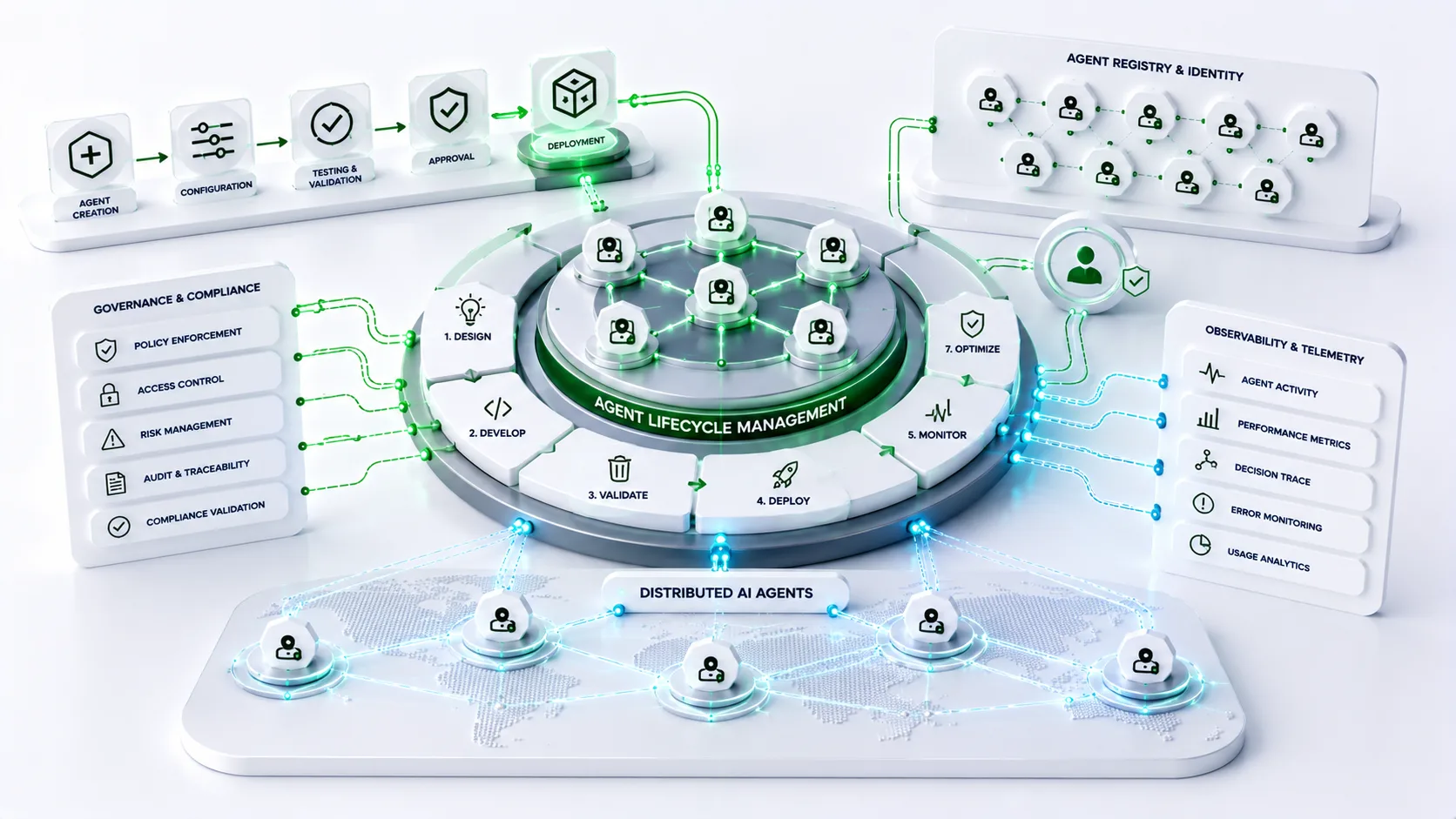
Agent Lifecycle Management is the structured process of governing, deploying, monitoring, securing, optimizing, and retiring AI agents operating within enterprise environments.
Similar to how Software Development Lifecycle (SDLC) governs applications, ALM governs autonomous AI systems.
It provides operational visibility across every stage of an agent's existence.
Core lifecycle stages include:
- Agent design
- Development
- Validation
- Deployment
- Monitoring
- Optimization
- Governance
- Retirement
Without lifecycle management, enterprise AI agents quickly become difficult to govern and scale.
Why Agent Lifecycle Management Matters
Traditional software remains largely deterministic.
AI agents are different.
They continuously make decisions based on:
- Context
- Policies
- Knowledge systems
- External tools
- Enterprise data
- Dynamic workflows
This autonomy introduces operational complexity that conventional IT management frameworks cannot adequately address.
Organizations need dedicated operational practices to manage:
- Agent sprawl
- Governance risks
- Security concerns
- Performance degradation
- Reliability challenges
- Compliance requirements
Agent Lifecycle Management addresses these challenges systematically.
The Eight Stages of the Agent Lifecycle
1. Agent Design
The lifecycle begins with defining an agent's purpose.
Organizations establish:
- Business objectives
- Responsibilities
- Decision boundaries
- Risk classifications
- Operational requirements
Clear design principles reduce governance risks later in the lifecycle.
2. Development and Configuration
During development, teams configure:
- Models
- Tools
- Knowledge sources
- Workflows
- Policies
- Permissions
This phase establishes the agent's operational capabilities.
3. Validation and Testing
Before production deployment, agents must undergo rigorous evaluation.
Testing typically includes:
- Accuracy validation
- Policy compliance checks
- Security testing
- Failure simulations
- Adversarial testing
- Workflow verification
Validation ensures operational readiness.
4. Production Deployment
Once approved, agents move into production environments.
Deployment frameworks often include:
- Approval workflows
- Governance checkpoints
- Runtime controls
- Identity management
- Observability instrumentation
Production deployment should never be treated as the end of the lifecycle.
5. Continuous Monitoring
Observability becomes critical once agents begin operating autonomously.
Organizations monitor:
- Agent behavior
- Decision quality
- Execution performance
- Tool usage
- Knowledge retrieval
- Policy adherence
Monitoring provides visibility into real-world agent operations.
6. Governance and Compliance
Autonomous agents must continuously operate within approved boundaries.
Governance frameworks validate:
- Policy compliance
- Access permissions
- Data usage controls
- Operational constraints
- Risk thresholds
Governance becomes an ongoing operational function.
7. Optimization and Evolution
Enterprise agents continuously learn from operational insights.
Teams optimize:
- Prompt strategies
- Knowledge sources
- Workflow logic
- Tool integrations
- Context quality
- Execution efficiency
Optimization ensures agents remain effective over time.
8. Retirement and Decommissioning
Not every agent should remain active indefinitely.
Organizations require structured retirement processes that address:
- Knowledge preservation
- Access removal
- Policy cleanup
- Audit retention
- Operational handoff
Retirement is a critical but often overlooked stage of the lifecycle.
Agent Registries: The Foundation of Scale
As agent ecosystems grow, enterprises need centralized visibility.
Agent registries provide a system of record for:
- Agent identities
- Capabilities
- Ownership
- Permissions
- Dependencies
- Risk classifications
- Operational status
Without registries, organizations quickly lose control over agent inventories.
The Role of AI Control Planes
AI control planes are emerging as the operational backbone of Agent Lifecycle Management.
Control planes provide centralized capabilities including:
- Agent orchestration
- Identity management
- Policy enforcement
- Observability
- Compliance validation
- Workflow governance
They enable organizations to manage agent ecosystems consistently across distributed environments.
Agent Observability and Reliability
Agent observability extends beyond traditional monitoring.
Organizations increasingly track:
- Reasoning pathways
- Decision outcomes
- Tool interactions
- Context utilization
- Execution traces
- Failure patterns
These insights help maintain reliability and operational trust.
Security Considerations for Enterprise Agents
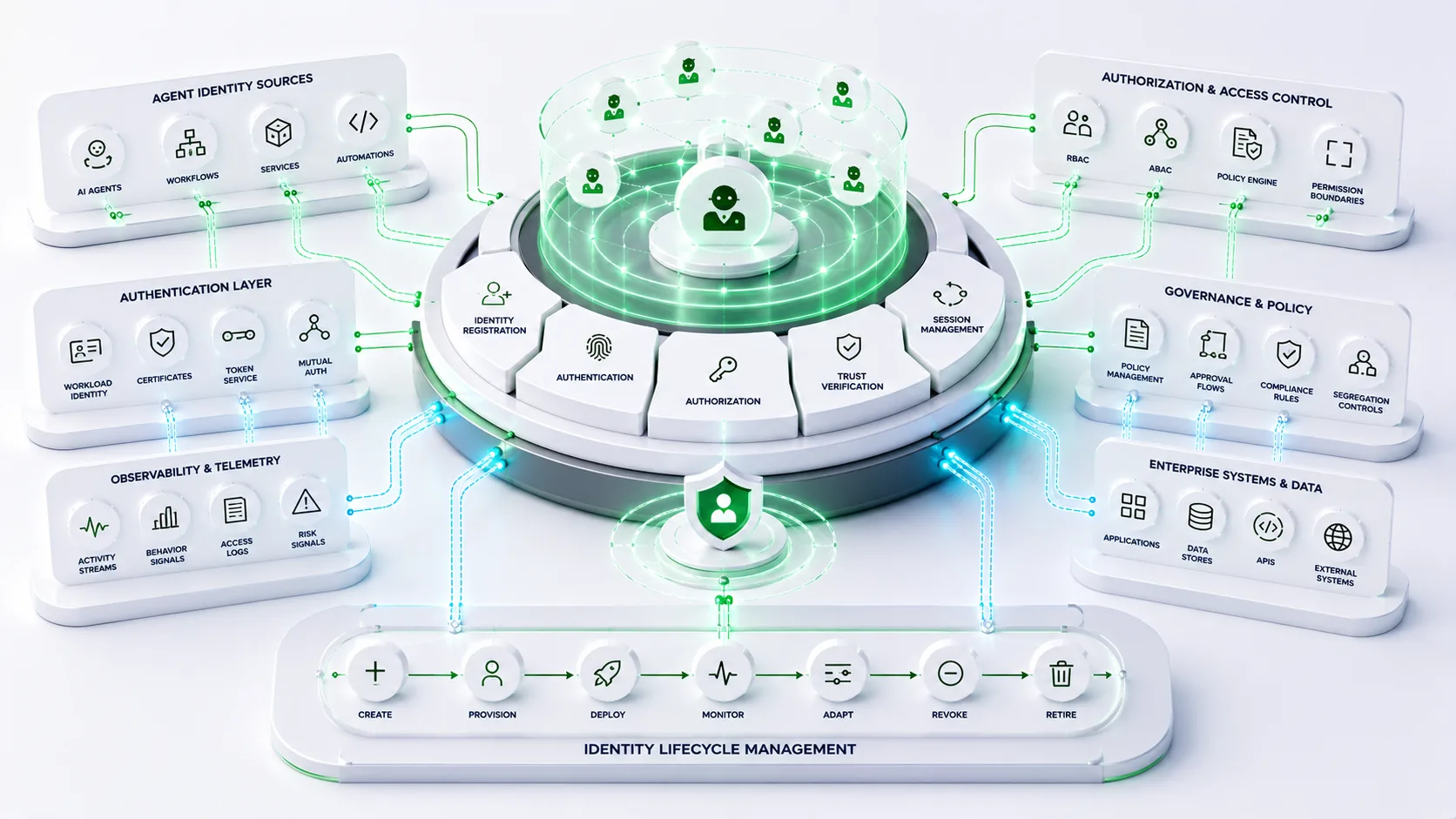
Every AI agent represents a new operational identity.
Organizations must secure:
- Agent credentials
- Knowledge access
- Tool permissions
- Data interactions
- Workflow execution rights
Zero Trust principles are increasingly becoming standard for agent management.
Key Metrics for Agent Lifecycle Management
Leading organizations monitor:
- Agent utilization rates
- Task completion rates
- Decision accuracy
- Policy violations
- Execution latency
- Operational reliability
- Governance compliance
- Agent retirement rates
These metrics provide visibility into agent effectiveness and operational health.
Challenges Organizations Must Overcome
- Agent sprawl
- Governance complexity
- Operational visibility gaps
- Security risks
- Policy management challenges
- Multi-agent coordination issues
- Scalability constraints
Successful Agent Lifecycle Management requires a combination of governance, automation, and operational discipline.
The Future of Agent Lifecycle Management
By 2027, enterprises may operate thousands of specialized AI agents across every business function.
Lifecycle management platforms will evolve into dedicated operating systems for agent ecosystems, providing intelligent governance, automated optimization, predictive reliability management, and autonomous operational oversight.
Organizations that establish lifecycle management frameworks today will be best positioned to scale AI responsibly tomorrow.
Key Takeaways
- Agent Lifecycle Management governs AI agents from creation to retirement.
- Enterprise agents require dedicated operational management practices.
- Observability, governance, security, and optimization are critical lifecycle functions.
- AI control planes provide centralized lifecycle management capabilities.
- ALM is becoming foundational infrastructure for enterprise AI operations.
How YggyTech Helps
YggyTech helps organizations build production-ready AI agent ecosystems through AI control planes, lifecycle management frameworks, governance automation, agent observability platforms, and operational intelligence solutions.
Our approach enables enterprises to deploy, govern, and scale autonomous AI agents with confidence, reliability, and operational transparency.
Conclusion
The future of enterprise AI will be powered by autonomous agents.
However, success will not depend solely on building agents—it will depend on operating them effectively.
Agent Lifecycle Management provides the operational foundation enterprises need to transform isolated AI experiments into scalable, governed, and reliable production ecosystems.
FAQs
What is Agent Lifecycle Management?
Agent Lifecycle Management is the process of governing, deploying, monitoring, optimizing, securing, and retiring enterprise AI agents.
Why is Agent Lifecycle Management important?
As organizations deploy increasing numbers of autonomous agents, lifecycle management ensures governance, reliability, security, and operational control.
How does Agent Lifecycle Management differ from MLOps?
MLOps focuses on managing machine learning models, while ALM focuses on managing autonomous agents and their operational behavior.
What role do AI control planes play?
AI control planes provide centralized governance, orchestration, observability, and policy enforcement for agent ecosystems.
What are the biggest challenges in managing AI agents?
Common challenges include agent sprawl, governance complexity, observability gaps, security risks, and multi-agent coordination.

Mason Carter
Cloud & Infrastructure Engineer
Mason focuses on scalable cloud ecosystems, DevOps modernization, and secure distributed infrastructure. His insights at YGGY Tech explore resilient architecture design, Kubernetes operations, cybersecurity strategy, and enterprise scalability.