Context Governance: Managing Enterprise Knowledge for AI at Scale
Enterprise AI is entering a new phase of maturity.
For the past several years, organizations focused heavily on selecting foundation models, optimizing infrastructure, and deploying AI-powered applications. However, many enterprises are now discovering a fundamental reality: AI systems are only as effective as the context they receive.
Models provide reasoning capabilities, but context provides business intelligence.
As organizations deploy Retrieval-Augmented Generation (RAG), knowledge graphs, semantic search platforms, AI copilots, and autonomous agents, governing enterprise knowledge has become just as important as governing AI models.
This emerging discipline is known as Context Governance.
In 2026, leading enterprises are investing in Context Governance frameworks to ensure AI systems operate using accurate, secure, compliant, and trusted organizational knowledge.
What Is Context Governance?
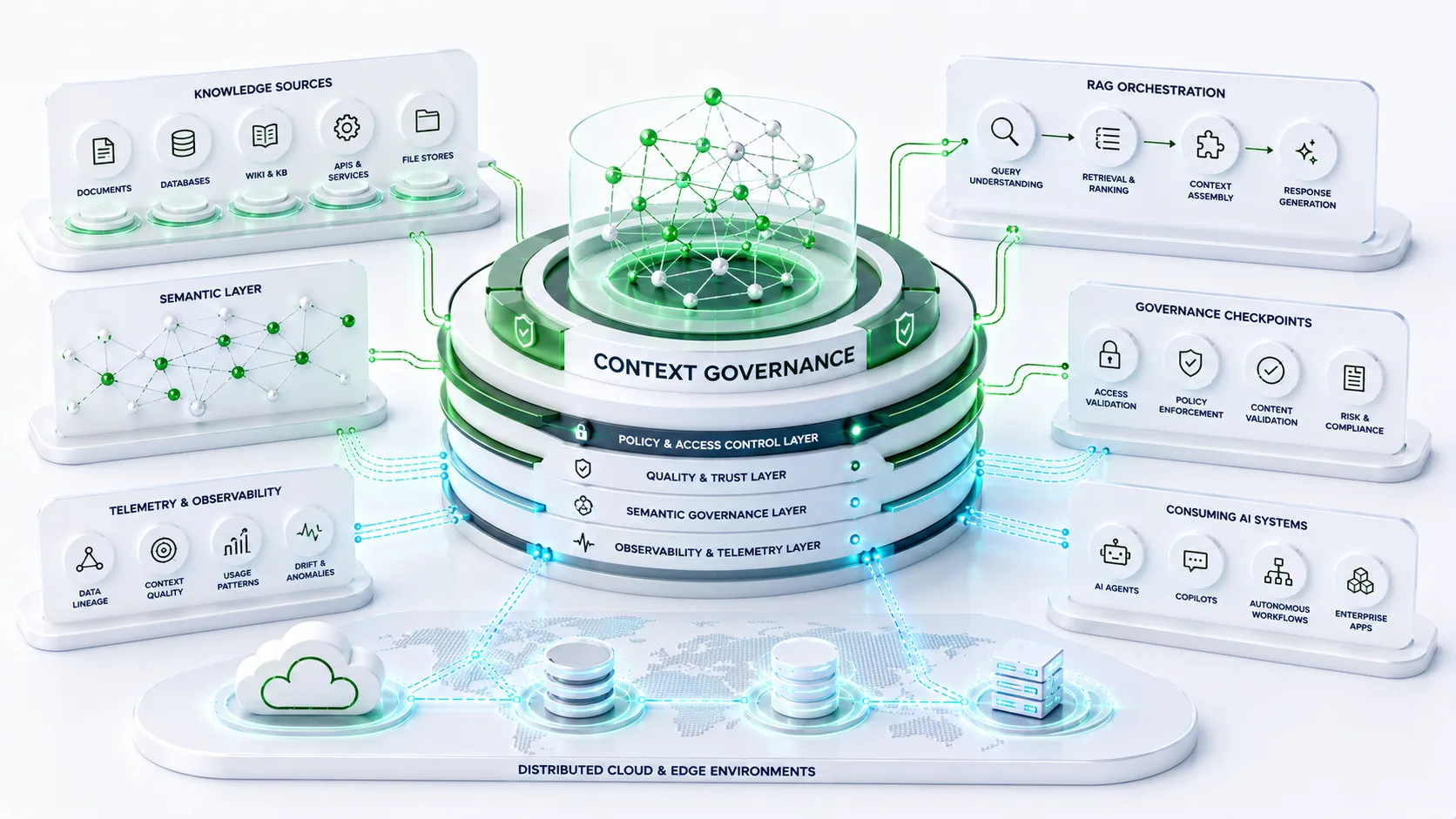
Context Governance is the practice of managing, controlling, validating, and monitoring the information, knowledge sources, relationships, and retrieval systems that provide context to AI systems.
Rather than focusing solely on model behavior, Context Governance focuses on the quality and integrity of the information flowing into AI decision-making processes.
This includes:
- Knowledge repositories
- Vector databases
- Semantic search systems
- Knowledge graphs
- RAG pipelines
- Context-routing systems
- Enterprise documentation
- Operational intelligence platforms
The objective is to ensure AI systems consistently receive trusted, relevant, and governed context.
Why Context Matters More Than Ever
Modern foundation models are increasingly capable of reasoning.
However, reasoning alone does not guarantee business accuracy.
An AI system making decisions without organizational context lacks access to:
- Business policies
- Operational procedures
- Compliance requirements
- Customer information
- Internal knowledge
- Domain expertise
- Real-time operational data
The result can be inaccurate recommendations, governance failures, hallucinations, and operational risks.
Context has become the operational intelligence layer of enterprise AI.
The Shift from Model Governance to Context Governance
Most AI governance programs began with model-focused controls.
Organizations concentrated on:
- Model risk management
- Bias monitoring
- Compliance reviews
- Security assessments
- Performance testing
While these remain important, enterprises are increasingly realizing that many AI failures originate from poor context rather than poor models.
Incorrect knowledge often produces incorrect outcomes regardless of model quality.
This shift is expanding governance beyond models to include the knowledge ecosystem itself.
The Core Components of Context Governance
1. Knowledge Quality Management
AI systems require accurate and trustworthy information.
Organizations must continuously validate:
- Data quality
- Content accuracy
- Knowledge freshness
- Source reliability
- Version control
Without quality controls, AI systems can amplify outdated or incorrect information.
2. Access Governance
Not every user, agent, or system should access the same knowledge.
Context Governance enforces:
- Role-based access controls
- Knowledge segmentation
- Identity-aware retrieval
- Permission enforcement
- Data protection requirements
This ensures sensitive information remains protected.
3. Context Lifecycle Management
Knowledge changes continuously.
Organizations need governance processes for:
- Knowledge creation
- Validation
- Publication
- Updates
- Archiving
- Retirement
Lifecycle governance prevents stale information from influencing AI decisions.
4. Semantic Governance
Modern AI systems rely on semantic relationships.
Context Governance must oversee:
- Knowledge graphs
- Entity relationships
- Semantic mappings
- Business taxonomies
- Operational ontologies
These structures help AI systems understand enterprise knowledge more effectively.
The Rise of RAG Governance
Retrieval-Augmented Generation has become a foundational architecture for enterprise AI.
However, retrieval introduces new governance challenges.
Organizations must validate:
- Retrieval quality
- Source selection
- Knowledge relevance
- Security policies
- Context accuracy
- Citation integrity
RAG Governance is rapidly becoming one of the most important components of Context Governance.
Knowledge Graphs and Context Intelligence
Knowledge graphs are increasingly being used to enhance enterprise AI decision-making.
They provide:
- Entity relationships
- Operational dependencies
- Business context
- Semantic intelligence
- Decision support structures
Context Governance ensures these knowledge structures remain accurate and aligned with business realities.
Context Governance for Autonomous Agents
Autonomous agents introduce new governance requirements.
Unlike traditional AI applications, agents actively retrieve information, reason over knowledge, and execute workflows.
Organizations must govern:
- Agent retrieval permissions
- Knowledge access controls
- Context validation
- Decision traceability
- Knowledge provenance
- Execution accountability
This ensures agents operate using trusted enterprise intelligence.
The Role of AI Control Planes
AI control planes are becoming critical governance layers for context management.
These platforms provide centralized oversight of:
- Knowledge retrieval
- Context routing
- Policy enforcement
- Access controls
- Observability
- Governance validation
Control planes help enterprises maintain consistency across distributed AI environments.
Key Metrics for Context Governance
Leading enterprises increasingly monitor:
- Knowledge freshness scores
- Retrieval accuracy rates
- Source trustworthiness metrics
- Context utilization rates
- Knowledge coverage percentages
- Access violation incidents
- Context quality indicators
These metrics provide operational visibility into knowledge health.
Challenges Organizations Must Address
- Knowledge fragmentation
- Information silos
- Rapid content growth
- Inconsistent metadata
- Legacy systems
- Governance complexity
- Multi-agent access management
Successfully governing context requires both technical and organizational alignment.
Building a Context Governance Framework
Organizations should establish six foundational capabilities:
- Knowledge quality management
- Semantic governance
- Access control frameworks
- RAG governance policies
- AI observability integration
- Context lifecycle management
Together, these capabilities create a scalable governance foundation for enterprise AI.
The Future of Context Governance
As enterprise AI evolves, context will become the primary differentiator between average AI systems and intelligent operational platforms.
Future governance systems will automatically evaluate context quality, optimize retrieval strategies, detect knowledge risks, and orchestrate information flows dynamically.
Organizations that master Context Governance will build AI systems that are not only intelligent but consistently trustworthy.
Key Takeaways
- Context is becoming as important as the AI model itself.
- Context Governance focuses on managing enterprise knowledge powering AI decisions.
- RAG, semantic search, and knowledge graphs require dedicated governance frameworks.
- Autonomous agents increase the need for context visibility and control.
- Strong Context Governance improves accuracy, compliance, trust, and operational intelligence.
How YggyTech Helps
YggyTech helps enterprises implement Context Governance frameworks through AI control planes, semantic intelligence architectures, RAG governance systems, knowledge graph solutions, and operational observability platforms.
Our governance-first approach ensures enterprise AI systems operate using trusted, compliant, and high-quality organizational knowledge.
Conclusion
The future of enterprise AI is not defined solely by models—it is defined by context.
As organizations scale AI across operations, customer experiences, and decision-making systems, governing knowledge becomes a strategic necessity.
Context Governance provides the framework enterprises need to transform fragmented information into trusted AI intelligence at scale.
FAQs
What is Context Governance?
Context Governance is the practice of managing and governing the knowledge, information sources, retrieval systems, and semantic structures used by AI systems.
Why is Context Governance important?
AI systems rely on context to generate accurate and trustworthy outputs. Poor context often leads to poor decisions regardless of model quality.
How does Context Governance relate to RAG?
RAG Governance is a subset of Context Governance focused on ensuring retrieval systems provide accurate, secure, and relevant information.
What role do knowledge graphs play?
Knowledge graphs provide semantic relationships and business context that improve AI reasoning and decision intelligence.
How can enterprises implement Context Governance?
Organizations should establish knowledge quality controls, semantic governance, access management, lifecycle policies, and AI observability capabilities.

Ethan Brooks
Senior AI Systems Strategist
Ethan specializes in enterprise AI architecture, scalable automation systems, and intelligent workflow optimization. At YGGY Tech, he writes about practical AI implementation, cloud-native systems, and how modern businesses can eliminate operational fragmentation through intelligent infrastructure.