AI Operations Centers (AIOCs): The Next Evolution of Enterprise Command Centers
Enterprise operations are undergoing a fundamental transformation. For decades, organizations relied on Network Operations Centers (NOCs), Security Operations Centers (SOCs), and Site Reliability Engineering (SRE) teams to maintain critical systems and infrastructure.
Today, a new operational layer has emerged: autonomous AI.
AI agents are now making decisions, orchestrating workflows, coordinating systems, interacting with customers, analyzing data, and driving business processes with increasing independence. As AI becomes embedded across enterprise operations, traditional command centers are no longer sufficient.
This shift is driving the rise of AI Operations Centers (AIOCs).
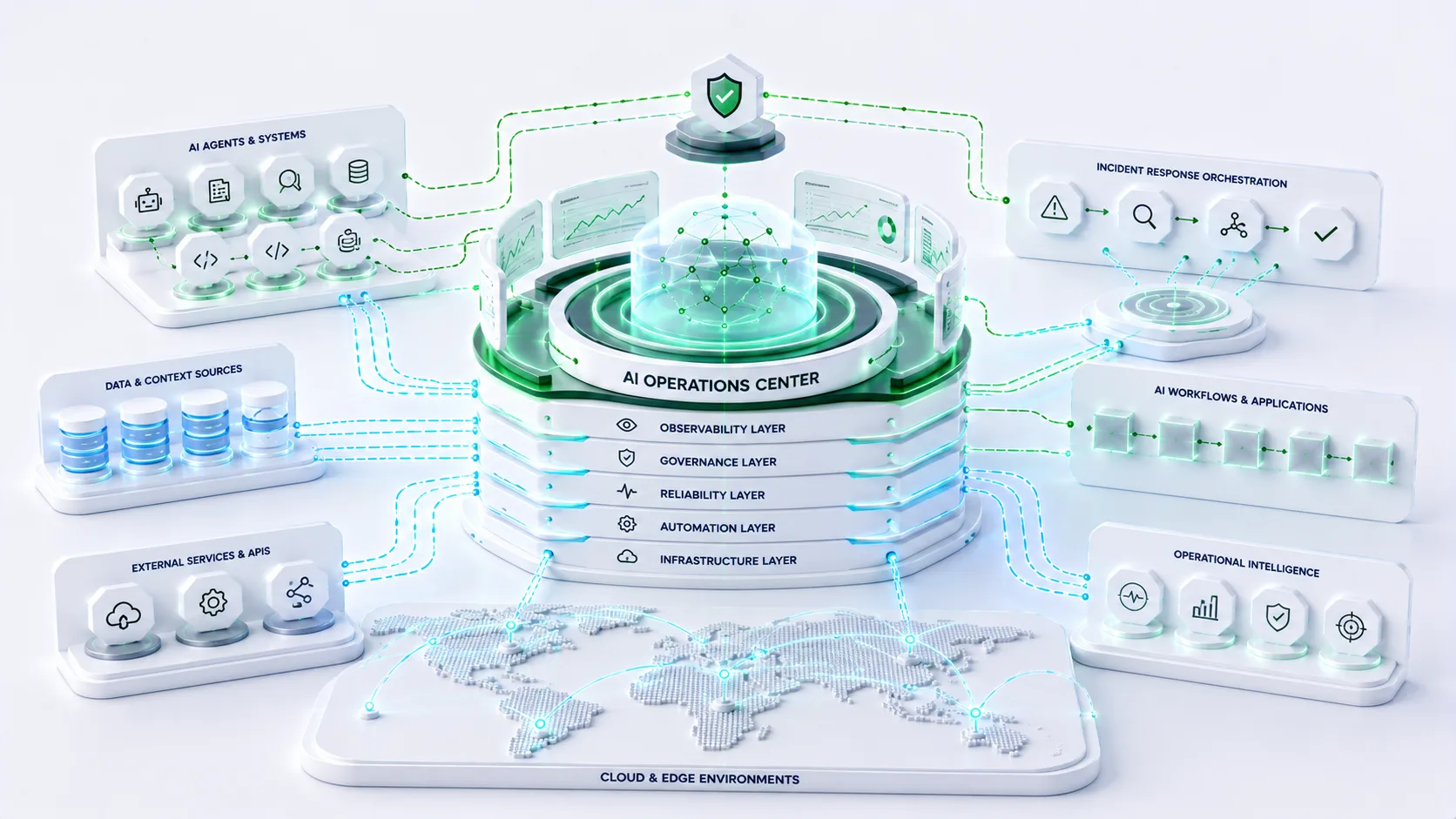
An AIOC serves as the centralized command center for enterprise AI ecosystems, providing visibility, governance, observability, reliability management, incident response, and operational intelligence across autonomous systems.
In 2026, leading organizations are beginning to view AIOCs as essential infrastructure for operating AI at scale.
What Is an AI Operations Center?
An AI Operations Center (AIOC) is a centralized operational function responsible for monitoring, governing, securing, and optimizing enterprise AI systems.
Much like a traditional NOC oversees infrastructure and a SOC oversees cybersecurity, an AIOC oversees the operational health of AI systems.
This includes:
- AI observability
- Agent monitoring
- Workflow orchestration oversight
- Governance enforcement
- AI incident management
- Compliance validation
- Performance optimization
- Operational intelligence
The objective is simple: ensure AI systems remain trustworthy, reliable, and aligned with business objectives.
Why Enterprises Need AIOCs
AI systems introduce operational complexity that traditional IT operations were never designed to manage.
Organizations increasingly operate:
- Multi-agent ecosystems
- Large language models
- Inference platforms
- Knowledge retrieval systems
- Event-driven AI workflows
- Autonomous decision engines
Failures in these environments often extend beyond infrastructure issues.
Organizations must also manage:
- Model drift
- Hallucinations
- Agent failures
- Policy violations
- Context degradation
- Workflow breakdowns
- Governance breaches
An AIOC provides the operational capabilities required to manage these new risks.
The Evolution of Enterprise Command Centers
The progression is becoming increasingly clear:
- NOCs managed infrastructure.
- SOCs managed cybersecurity.
- SRE teams managed reliability.
- AIOCs manage autonomous intelligence.
As AI systems become operational assets, enterprises require dedicated teams, tooling, and processes focused specifically on AI operations.
Core Functions of an AI Operations Center
1. AI Observability
Visibility is the foundation of AI operations.
AIOCs continuously monitor:
- Agent activity
- Model performance
- Prompt execution
- Inference latency
- Workflow execution
- Knowledge retrieval quality
- Decision outcomes
This creates comprehensive operational awareness.
2. AI Reliability Management
Reliability has become a mission-critical requirement for enterprise AI.
AIOCs track:
- Availability
- Accuracy
- Response quality
- Operational resilience
- Recovery performance
- Execution consistency
Reliability engineering principles are increasingly being adapted specifically for AI environments.
3. Governance Enforcement
Autonomous systems require governance.
AIOCs oversee:
- Policy enforcement
- Compliance validation
- Operational guardrails
- Runtime governance
- Risk management
- Audit readiness
This ensures AI systems operate within approved boundaries.
4. AI Incident Response
Not every AI failure is an infrastructure failure.
Organizations increasingly face incidents such as:
- Agent misbehavior
- Prompt injection attacks
- Model degradation
- Workflow disruptions
- Governance violations
- Decision anomalies
AIOCs coordinate detection, investigation, escalation, and remediation activities.
5. Operational Intelligence
AIOCs transform telemetry into actionable insights.
Teams gain visibility into:
- AI system health
- Operational trends
- Risk exposure
- Performance bottlenecks
- Resource utilization
- Business impact metrics
The Technology Stack Behind AIOCs
Modern AIOCs typically integrate multiple operational platforms.
These include:
- AI observability platforms
- AI control planes
- Model monitoring systems
- Governance engines
- Policy-as-Code frameworks
- Telemetry platforms
- Workflow orchestration systems
- Incident management platforms
Together, these technologies provide centralized operational visibility.
AI Control Planes and AIOCs
AI control planes are becoming foundational components of AI Operations Centers.
Control planes provide:
- Agent coordination
- Policy enforcement
- Workflow governance
- Identity management
- Telemetry aggregation
- Execution oversight
While the control plane governs AI execution, the AIOC governs AI operations.
Key Metrics Managed by AIOCs
Successful AI Operations Centers track a new generation of operational metrics.
- Agent success rate
- Inference latency
- Decision quality score
- Workflow completion rate
- Governance violations
- Escalation frequency
- Recovery time
- Model performance stability
- Compliance adherence
- Operational risk indicators
These metrics provide visibility into both technical and business performance.
Industry Applications
Financial Services
AIOCs oversee fraud detection agents, risk analysis systems, and autonomous compliance workflows.
Healthcare
Organizations monitor AI-assisted diagnostics, operational workflows, and patient support systems.
Manufacturing
AIOCs coordinate predictive maintenance systems, operational intelligence platforms, and automation networks.
SaaS Platforms
Software providers use AIOCs to govern customer-facing AI features, copilots, and autonomous service agents.
Building an Enterprise AIOC
Organizations should focus on six foundational capabilities:
- AI observability
- Governance automation
- Reliability engineering
- Incident management
- Operational intelligence
- AI control plane integration
These capabilities establish the foundation for scalable AI operations.
The Future of AI Operations Centers
Over the next several years, AIOCs will become standard components of enterprise operating models.
As organizations deploy hundreds—or even thousands—of autonomous agents, centralized operational oversight will become essential.
Future AIOCs will likely leverage AI themselves, using autonomous monitoring, predictive risk detection, automated remediation, and intelligent governance systems.
The result will be self-optimizing operational environments capable of managing increasingly complex AI ecosystems.
Key Takeaways
- AI Operations Centers provide centralized oversight for enterprise AI systems.
- AIOCs combine observability, governance, reliability engineering, and incident management.
- Traditional command centers are evolving to support autonomous AI operations.
- AI control planes play a critical role in operational governance.
- AIOCs will become foundational infrastructure for enterprise AI maturity.
How YggyTech Helps
YggyTech helps organizations build enterprise AI operations capabilities through AI control planes, observability platforms, governance automation, runtime intelligence systems, and reliability engineering frameworks.
Our solutions enable enterprises to scale autonomous AI operations while maintaining visibility, governance, resilience, and operational excellence.
Conclusion
The rise of autonomous AI is creating an entirely new operational discipline.
Just as enterprises built NOCs to manage infrastructure and SOCs to manage cybersecurity, they are now building AIOCs to manage intelligent systems.
Organizations that invest in AI operations today will be better positioned to govern, optimize, and scale the next generation of enterprise AI ecosystems.
FAQs
What is an AI Operations Center?
An AI Operations Center (AIOC) is a centralized function responsible for monitoring, governing, securing, and optimizing enterprise AI systems.
Why are AIOCs becoming important?
As autonomous AI systems scale, organizations require dedicated operational capabilities to manage reliability, governance, compliance, and performance.
How is an AIOC different from a NOC?
NOCs focus on infrastructure operations, while AIOCs focus on AI systems, agents, models, workflows, and governance.
What technologies support an AIOC?
Key technologies include AI observability platforms, control planes, governance systems, telemetry tools, and incident management platforms.
Will AIOCs become common in enterprises?
Yes. As AI becomes operationally critical, AIOCs are expected to become a standard component of enterprise technology organizations.

Sarah Anderson
Head of Content
Sarah leads the content strategy at Yggy Tech, bringing 10+ years of experience in technology writing and editorial direction.