Digital Twin Infrastructure: The Enterprise Operating Model for AI-Era Operations
Enterprise operations are entering a new phase where organizations can no longer rely only on static reports, disconnected dashboards, or retrospective analytics.
Modern businesses operate across distributed systems, cloud platforms, physical assets, supply chains, customer channels, workforce tools, and autonomous AI workflows. Every part of the enterprise generates operational signals continuously.
The challenge is no longer collecting data.
The challenge is understanding how complex systems behave, how changes ripple across operations, and how decisions can be tested before they affect production environments.
This is why digital twin infrastructure is becoming a strategic operating model for the AI era.
A digital twin provides a living, continuously updated representation of an enterprise system, process, asset, or operational environment. When combined with AI, telemetry, simulation, and orchestration, digital twins become powerful infrastructure for decision intelligence.
What Is Digital Twin Infrastructure?
Digital twin infrastructure is the technology foundation that creates, maintains, and operationalizes virtual representations of real-world enterprise systems.
These systems may represent:
- Cloud infrastructure
- Manufacturing environments
- Supply chains
- Customer journeys
- Financial operations
- Logistics networks
- Energy systems
- Business workflows
Unlike static models, digital twins continuously synchronize with real-time data and operational telemetry.
This allows enterprises to monitor current conditions, simulate future scenarios, and improve decision-making before acting.
Why Digital Twins Matter in the AI Era
AI systems are increasingly being used to make operational decisions.
However, intelligent decisions require operational context.
Digital twins provide that context by modeling relationships between systems, dependencies, constraints, and real-time conditions.
This enables AI systems to answer questions such as:
- What happens if demand spikes?
- Which system will fail first?
- How will a supply chain disruption affect delivery?
- What is the safest optimization path?
- Which operational decision creates the best outcome?
Digital twins transform AI from reactive automation into predictive operational intelligence.
The Evolution from Dashboards to Operational Models
Dashboards show what happened.
Digital twins help explain what is happening and what may happen next.
This represents a major shift in enterprise operations.
Traditional reporting focuses on visibility.
Digital twin infrastructure focuses on understanding, simulation, prediction, and coordination.
For AI-era enterprises, this shift is critical.
Core Components of Digital Twin Infrastructure
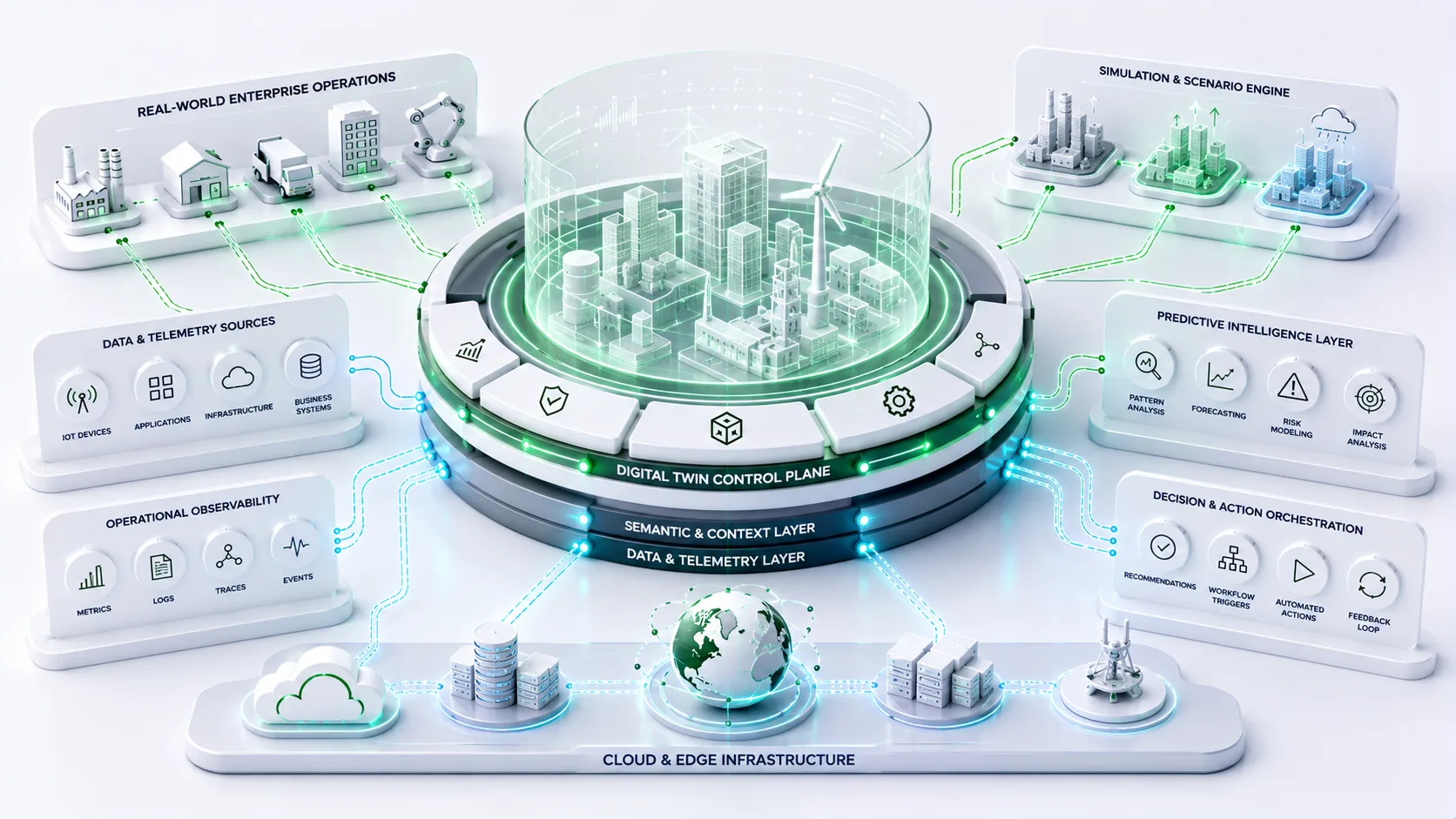
1. Real-Time Data Integration
Digital twins depend on continuous data flows from operational systems.
Sources may include:
- IoT devices
- Application telemetry
- Cloud infrastructure signals
- ERP systems
- CRM platforms
- Supply chain data
- Event streams
The digital twin must remain synchronized with operational reality.
2. Semantic Modeling
Digital twins require structured models of relationships and dependencies.
This includes:
- Assets
- Processes
- Systems
- Workflows
- Constraints
- Business rules
- Operational dependencies
Semantic modeling gives the digital twin meaning beyond raw data.
3. Simulation and Scenario Testing
One of the most powerful capabilities of digital twins is simulation.
Enterprises can test scenarios such as:
- Infrastructure failures
- Demand surges
- Supply chain disruptions
- Resource constraints
- Security incidents
- Process redesigns
This enables leaders to evaluate decisions before execution.
4. AI Decision Intelligence
AI systems use digital twins to reason over operational complexity.
They can identify patterns, recommend actions, predict failures, optimize workflows, and coordinate responses.
The digital twin becomes the intelligence environment where AI decisions are evaluated.
5. Operational Orchestration
Modern digital twins increasingly connect directly to operational systems.
This allows organizations to move from insight to action through:
- Workflow automation
- Resource allocation
- Incident response
- Infrastructure optimization
- Process coordination
Digital twins become active operating systems for enterprise environments.
Enterprise Use Cases for Digital Twin Infrastructure
Manufacturing Operations
Digital twins help manufacturers monitor production lines, predict equipment failures, optimize throughput, and reduce downtime.
Supply Chain Management
Enterprises use digital twins to simulate disruptions, evaluate logistics routes, predict inventory gaps, and improve resilience.
Cloud Infrastructure Operations
Digital twins can represent cloud environments, dependencies, workloads, and reliability conditions across distributed systems.
Energy and Utilities
Organizations use digital twins to monitor infrastructure, optimize energy distribution, and model operational risk.
Customer Experience Operations
Digital twins can map customer journeys, service interactions, demand patterns, and operational bottlenecks.
Digital Twins and AI Operations Centers
AI Operations Centers increasingly depend on operational models that provide real-time situational awareness.
Digital twins give AIOCs a structured view of enterprise systems, dependencies, and predicted outcomes.
This improves:
- Incident response
- Root-cause analysis
- Operational planning
- Risk evaluation
- Autonomous remediation
Instead of reacting to alerts, teams can evaluate system behavior through a living operational model.
Digital Twins and Enterprise Knowledge Graphs
Knowledge graphs and digital twins increasingly work together.
Knowledge graphs model semantic relationships.
Digital twins simulate operational behavior.
Together, they provide AI systems with both contextual understanding and dynamic operational intelligence.
This combination is especially powerful for autonomous enterprise operations.
Key Benefits of Digital Twin Infrastructure
- Improved operational visibility
- Predictive failure detection
- Better scenario planning
- Faster root-cause analysis
- Enhanced resource optimization
- Greater operational resilience
- More reliable AI decision-making
Challenges Enterprises Must Address
- Data integration complexity
- Model accuracy
- Real-time synchronization
- Governance requirements
- Cross-system dependencies
- Simulation reliability
- Operational adoption
Successful digital twin programs require both strong technology architecture and organizational alignment.
Building a Digital Twin Infrastructure Strategy
Enterprises should focus on six foundational capabilities:
- Real-time telemetry integration
- Semantic relationship modeling
- Simulation infrastructure
- AI decision intelligence
- Operational governance
- Orchestration integration
Together, these capabilities create the foundation for AI-era operations.
The Future of Digital Twin Infrastructure
Digital twins are evolving from specialized industrial tools into enterprise operating models.
Future digital twins will increasingly power:
- Autonomous operations
- AI decision intelligence
- Enterprise simulation environments
- Real-time risk management
- Operational resilience planning
As AI systems gain more responsibility, digital twins will provide the operational context required for safe and intelligent decision-making.
Key Takeaways
- Digital twin infrastructure provides a living model of enterprise operations.
- AI systems rely on digital twins for operational context and predictive intelligence.
- Digital twins shift enterprises from dashboards to simulation-driven operations.
- Knowledge graphs and digital twins together enable powerful decision intelligence.
- Digital twin infrastructure is becoming a core operating model for AI-era enterprises.
How YggyTech Helps
YggyTech helps organizations design digital twin infrastructure for AI-era operations through real-time telemetry platforms, semantic intelligence architectures, AI decision systems, cloud-native orchestration, and operational intelligence frameworks.
Our approach enables enterprises to simulate, monitor, predict, and optimize complex operational environments with confidence.
Conclusion
The next generation of enterprise operations will not be managed only through dashboards or static reports.
It will be managed through living operational models that continuously reflect business reality.
Digital twin infrastructure gives enterprises the ability to understand complex systems, test decisions, anticipate disruptions, and coordinate intelligent action.
For organizations preparing for AI-era operations, digital twins are no longer optional experiments. They are becoming the operating model for enterprise intelligence.
FAQs
What is digital twin infrastructure?
Digital twin infrastructure is the technology foundation used to create and maintain virtual representations of enterprise systems, assets, processes, or operations.
Why are digital twins important for AI?
Digital twins provide operational context, simulation capabilities, and predictive intelligence that help AI systems make better decisions.
How are digital twins different from dashboards?
Dashboards display current or historical data, while digital twins model system behavior, relationships, dependencies, and future scenarios.
What industries use digital twins?
Manufacturing, logistics, energy, healthcare, cloud infrastructure, finance, and enterprise operations all use digital twin technologies.
How do digital twins support enterprise resilience?
They allow organizations to simulate disruptions, predict failures, evaluate responses, and optimize operational recovery strategies.

Ava Mitchell
UX & Digital Experience Strategist
Ava combines product psychology, interface systems, and user-centered design to create digital experiences that feel intuitive and scalable. Her work at YGGY Tech focuses on high-conversion UX systems, enterprise interfaces, and design-driven growth.