AI Identity Management: Securing Autonomous Agents Across Enterprise Environments
Enterprise AI is rapidly evolving from isolated assistants and copilots into autonomous software entities capable of making decisions, executing workflows, accessing enterprise systems, and coordinating with other agents.
These AI agents increasingly operate with permissions that were once reserved exclusively for human employees and service accounts.
As organizations deploy hundreds or even thousands of AI agents across business functions, a critical question emerges:
How do you securely identify, authenticate, authorize, monitor, and govern autonomous AI agents?
The answer lies in AI Identity Management.
Just as identity became the foundation of modern cybersecurity for human users and applications, AI identity is becoming the foundational security layer for autonomous enterprise systems.
Organizations that fail to establish robust identity frameworks for AI agents risk unauthorized access, privilege escalation, compliance failures, operational disruptions, and uncontrolled autonomous behavior.
In this article, we explore why AI identity management is becoming a strategic security discipline and how enterprises are building secure identity architectures for autonomous AI environments.
Why AI Identity Management Matters
Traditional enterprise identity systems were designed around two primary entities:
- Human users
- Applications and services
Autonomous AI agents introduce an entirely new identity category.
Unlike applications, AI agents can reason, make decisions, initiate actions, coordinate workflows, and adapt behavior based on context.
This creates security challenges that conventional identity models were never designed to address.
For example:
- Which systems can an agent access?
- What actions can it perform?
- How are permissions revoked?
- Who approved its deployment?
- How is its behavior audited?
- Can it delegate authority to other agents?
Identity becomes the control mechanism that governs autonomous AI operations.
The Rise of Machine Identities
Machine identities already outnumber human identities in modern enterprises.
Cloud workloads, APIs, containers, microservices, and automation platforms all require identity mechanisms.
AI agents represent the next evolution of machine identities.
However, unlike traditional workloads, AI agents require:
- Dynamic permissions
- Context-aware access controls
- Behavioral monitoring
- Governance oversight
- Lifecycle management
- Decision accountability
This shifts identity management from static credential control to intelligent governance infrastructure.
Core Components of AI Identity Management
1. Agent Identity Registration
Every autonomous AI agent should have a unique enterprise identity.
Identity registration establishes:
- Agent ownership
- Purpose
- Deployment environment
- Operational scope
- Governance classification
Organizations should treat agent registration similarly to onboarding employees or critical applications.
2. Authentication Frameworks
Authentication verifies that an AI agent is who it claims to be.
Modern enterprises increasingly rely on:
- Workload identities
- Certificates
- Token-based authentication
- Cloud-native identity providers
- Cryptographic verification
Authentication prevents impersonation attacks and unauthorized system access.
3. Authorization and Access Control
Authentication determines identity.
Authorization determines permissions.
AI agents should operate using least-privilege principles.
This means granting only the permissions required for specific tasks.
Common controls include:
- Role-based access control (RBAC)
- Attribute-based access control (ABAC)
- Policy-based authorization
- Context-aware permissions
- Dynamic privilege management
Effective authorization reduces risk while enabling operational autonomy.
Identity as the Foundation of Zero Trust AI
Zero Trust assumes that no identity should be automatically trusted.
This principle applies equally to AI agents.
Every request should be validated continuously based on:
- Identity
- Context
- Device state
- Operational risk
- Governance policies
AI identity management enables enterprises to implement Zero Trust architectures for autonomous systems.
Trust becomes continuously verified rather than permanently granted.
Agent-to-Agent Identity Security
Many enterprise environments are moving toward multi-agent architectures.
In these systems, agents collaborate with one another to complete complex tasks.
This introduces a new security challenge:
How do agents trust other agents?
Organizations must establish:
- Agent authentication protocols
- Identity verification mechanisms
- Trust relationships
- Delegation controls
- Inter-agent governance policies
Without these controls, autonomous ecosystems become difficult to secure.
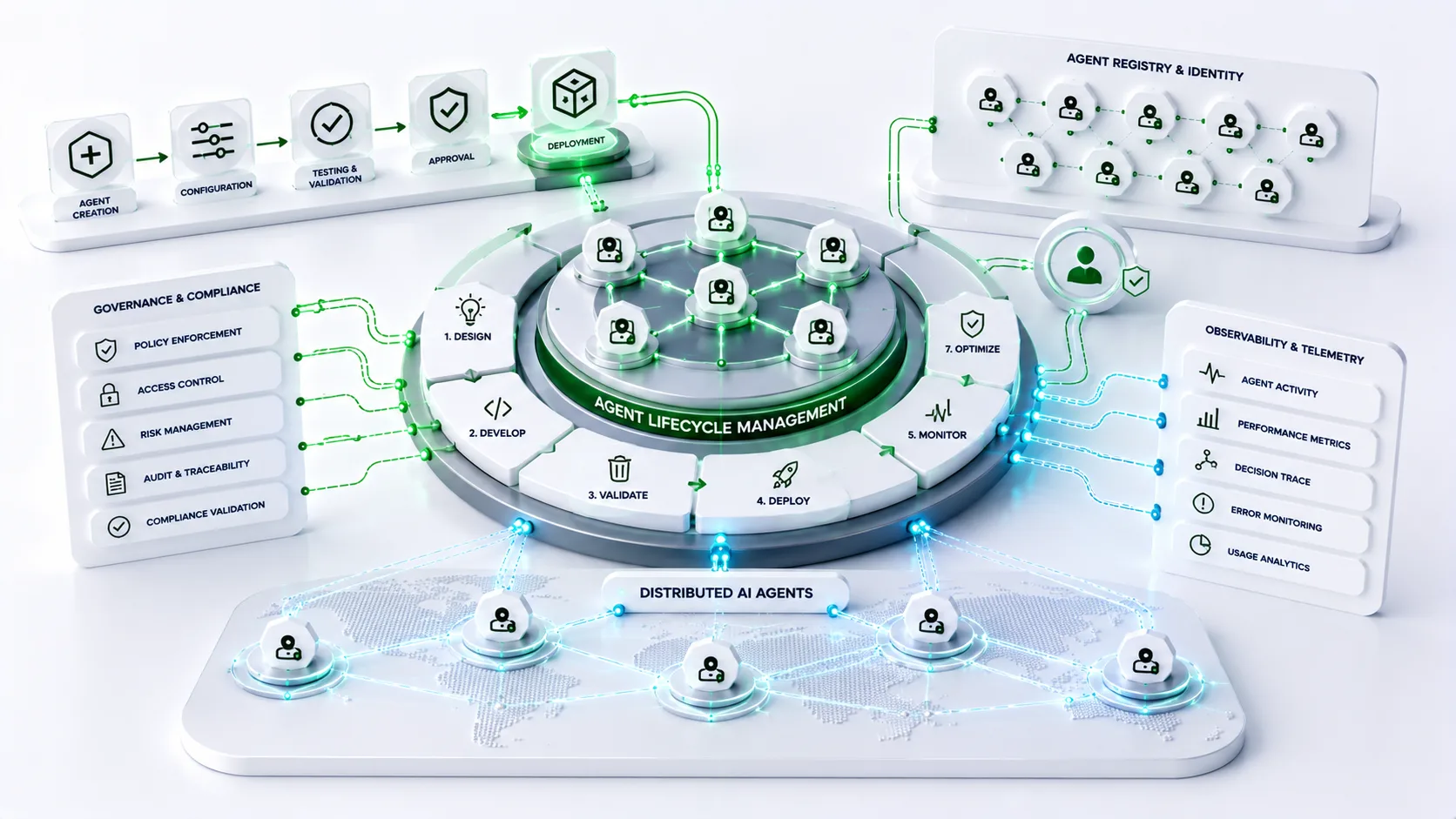
AI Identity Lifecycle Management
Identity management extends beyond creation.
AI agents require full lifecycle governance.
Typical stages include:
- Registration
- Provisioning
- Deployment
- Monitoring
- Updating
- Retirement
- Decommissioning
Lifecycle management ensures that dormant or unauthorized agents do not persist within enterprise environments.
Governance and Auditability
Identity serves as the foundation for accountability.
Every autonomous action should be traceable back to:
- The agent identity
- The governing policy
- The authorization decision
- The operational context
- The resulting action
This audit trail supports compliance, investigations, and governance requirements.
As regulatory scrutiny around AI increases, identity-driven auditability will become essential.
Observability for Autonomous Identities
Identity management and observability are increasingly converging.
Enterprises need visibility into:
- Agent activities
- Permission usage
- Access patterns
- Operational decisions
- Authentication events
- Policy violations
Modern AI Operations Centers (AIOCs) increasingly use identity telemetry as a core operational signal.
This visibility helps detect abnormal behavior before incidents escalate.
Common Enterprise Use Cases
Customer Service Agents
Agents accessing CRM systems must authenticate securely and operate under approved permissions.
Finance Operations Agents
Financial AI agents require strict authorization controls and auditable decision histories.
IT Operations Agents
Infrastructure automation agents need identity-aware access controls to prevent unauthorized system changes.
Knowledge Intelligence Agents
Enterprise knowledge agents must authenticate before accessing sensitive documents or proprietary information.
Multi-Agent Business Workflows
Organizations deploying agent ecosystems require secure identity frameworks that support trusted collaboration.
Key Benefits of AI Identity Management
- Stronger security posture
- Improved governance
- Reduced operational risk
- Better compliance readiness
- Enhanced accountability
- Safer autonomous operations
- Scalable AI deployment frameworks
Challenges Enterprises Must Address
- Identity sprawl
- Agent proliferation
- Complex authorization models
- Cross-platform integration
- Agent-to-agent trust management
- Governance enforcement
- Real-time monitoring requirements
Successful AI identity strategies require close collaboration between security, governance, platform engineering, and AI operations teams.
Building an Enterprise AI Identity Architecture
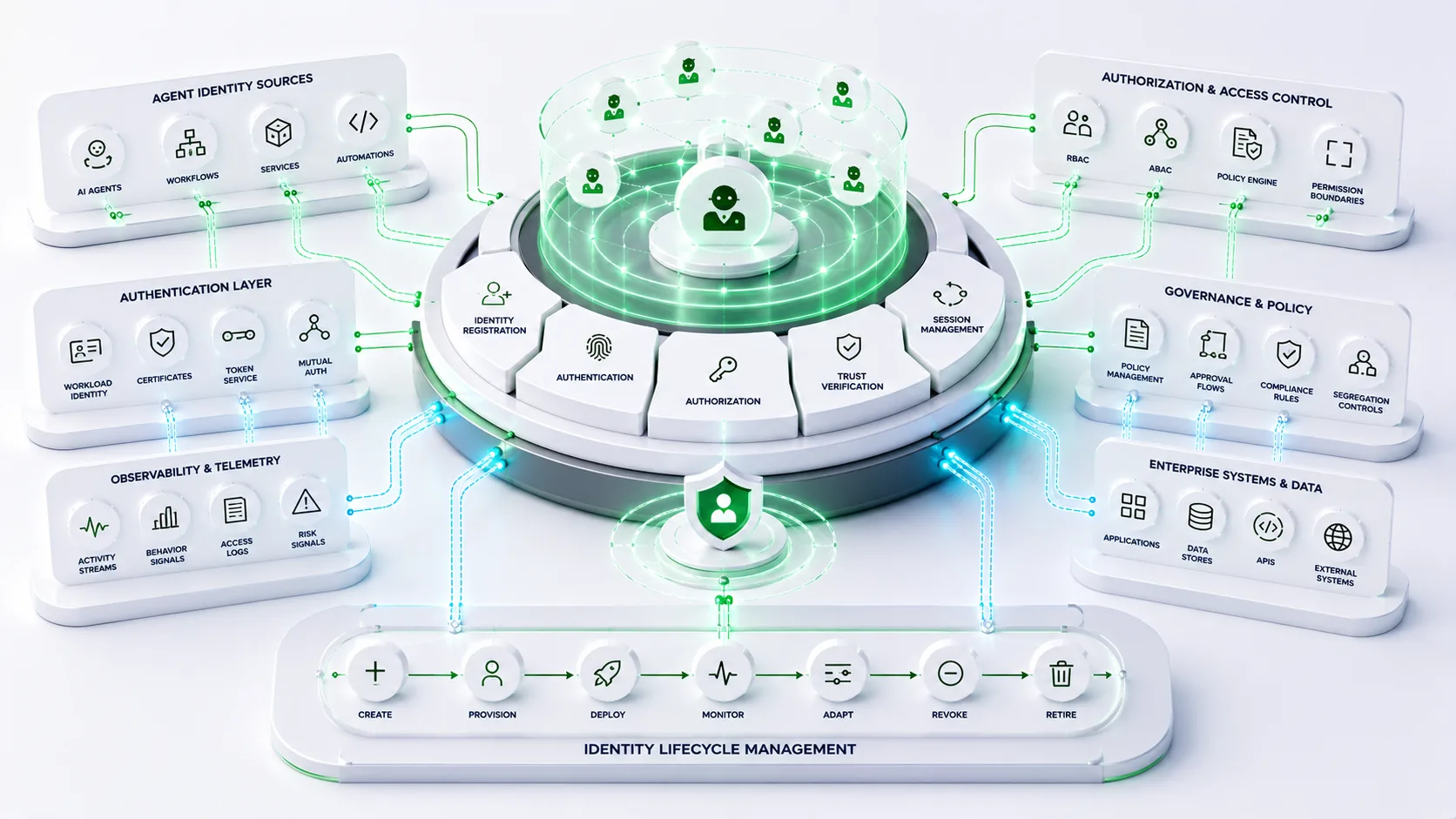
Leading organizations are building AI identity platforms around five foundational pillars:
- Identity registration and ownership
- Authentication and verification
- Authorization and access control
- Observability and monitoring
- Governance and compliance
Together, these capabilities establish a secure operating model for autonomous enterprise AI.
The Future of AI Identity Management
As enterprises deploy increasingly sophisticated autonomous systems, identity will become the primary governance layer for AI operations.
Future platforms will support:
- Agent identity marketplaces
- Dynamic trust scoring
- Autonomous authorization systems
- Cross-enterprise identity federation
- Agent reputation frameworks
- Continuous behavioral validation
The organizations that master AI identity management today will be better positioned to scale autonomous operations safely tomorrow.
Key Takeaways
- AI agents require dedicated identity frameworks.
- Identity is becoming the foundation of autonomous AI security.
- Zero Trust principles are critical for agent governance.
- Lifecycle management is essential for agent security.
- Observability and auditability depend on strong identity controls.
- AI identity management enables scalable and trustworthy autonomous operations.
How YggyTech Helps
YggyTech helps enterprises build secure AI identity architectures through Zero Trust frameworks, autonomous agent governance platforms, policy-driven authorization systems, observability solutions, and enterprise AI security programs.
Our approach enables organizations to deploy autonomous agents confidently while maintaining governance, compliance, and operational control.
Conclusion
Autonomous AI agents are rapidly becoming core participants in enterprise operations.
As their responsibilities expand, traditional security models are no longer sufficient.
AI identity management provides the foundation for secure authentication, authorization, governance, accountability, and trust across autonomous ecosystems.
For enterprises building the next generation of AI-powered operations, identity is no longer just a security feature—it is the control plane for autonomous intelligence.
FAQs
What is AI identity management?
AI identity management is the practice of establishing, securing, monitoring, and governing identities for autonomous AI agents operating within enterprise environments.
Why do AI agents need identities?
Identities allow organizations to authenticate agents, control permissions, track actions, and maintain accountability.
How does Zero Trust apply to AI agents?
Zero Trust requires continuous verification of agent identities, permissions, and operational context before granting access.
What is agent lifecycle management?
It is the process of managing AI agents from registration and deployment through monitoring, updates, retirement, and decommissioning.
How does AI identity management improve security?
It reduces unauthorized access, enables governance enforcement, improves auditability, and creates a scalable framework for secure autonomous operations.

Liam Walker
Product & AI Research Analyst
Liam researches emerging AI tools, automation workflows, and next-generation digital products. He contributes fresh perspectives on startup technology trends, AI productivity systems, and modern SaaS innovation for fast-growing companies.