AI Assurance Engineering: How Enterprises Test, Validate, and Trust AI Systems Before Production
AI assurance engineering gives enterprises the discipline to test, validate, monitor, and trust AI systems before they reach production. As organizations move from experiments to operational AI, assurance becomes the bridge between innovation, governance, reliability, and business confidence.
Why AI Assurance Engineering Matters
Enterprise AI systems are no longer limited to simple prediction models or internal productivity pilots. Organizations are deploying LLM applications, retrieval-augmented generation systems, AI agents, automated support flows, code generation tools, risk analysis assistants, knowledge copilots, and autonomous workflow systems. These systems do not behave like traditional deterministic software. Their outputs can vary based on prompts, retrieved context, user behavior, model changes, tool access, data quality, and operational conditions.
That shift creates a new enterprise engineering requirement: AI systems need assurance before production. A standard QA checklist is not enough. Teams must validate accuracy, reliability, safety, privacy, security, latency, cost, fairness, explainability, retrieval quality, hallucination risk, tool-use behavior, and human escalation paths. AI assurance engineering turns that complexity into a repeatable operating model.
Key Insight
AI assurance engineering is not about proving that an AI system is perfect. It is about proving that the system is reliable enough, controlled enough, monitored enough, and aligned enough for its intended business risk.
What AI Assurance Engineering Actually Is
AI assurance engineering is the practice of designing, testing, validating, monitoring, and continuously improving AI systems so they can operate safely and effectively in enterprise environments. It combines software testing, model evaluation, data validation, security engineering, risk management, observability, governance, and human review into a single production-readiness discipline.
For traditional software, teams can usually define expected inputs and outputs. For AI systems, especially generative AI and agentic workflows, correctness is more complex. A response may be fluent but inaccurate. A retrieval system may cite the wrong source. An agent may choose a reasonable tool but apply it to the wrong account. A model may perform well in testing but degrade when business context changes. AI assurance engineering addresses these realities before production risk becomes customer risk.
Evaluation
Measures model behavior, output quality, task success, retrieval performance, safety, and alignment with business expectations.
Validation
Confirms that AI systems meet defined requirements for reliability, risk, security, privacy, usability, and operational readiness.
Monitoring
Tracks behavior after deployment, including drift, failures, latency, cost, policy violations, user feedback, and incident signals.
Governance
Connects assurance evidence to approval gates, risk ownership, audit trails, compliance review, and production release decisions.
Why Traditional QA Is Not Enough for AI Systems
Traditional QA assumes that software behavior can be tested against predictable requirements. AI systems introduce probabilistic behavior, context sensitivity, model dependency, data dependency, and emergent failure modes. The same input may produce different outputs after a model update, retrieval index change, prompt revision, or tool integration change. This makes AI testing less like checking static functionality and more like validating a living system.
Enterprises need a broader validation model. AI assurance engineering includes test sets, evaluation benchmarks, human review, adversarial testing, red-team scenarios, data quality checks, retrieval tests, agent simulation, policy tests, and production observability. It gives technical leaders a way to answer a practical question: can this AI system be trusted in this specific workflow, for this specific user group, under this specific level of risk?
Enterprise Signal
AI assurance becomes business-critical when AI systems produce customer-facing answers, influence decisions, access enterprise data, trigger workflows, or operate inside regulated environments.
From Functional Testing to Behavioral Testing
Functional testing checks whether software performs a defined action. Behavioral testing checks how an AI system behaves across many realistic situations. For example, an LLM support assistant must be tested for factual accuracy, tone, escalation behavior, refusal handling, source grounding, privacy protection, and resilience against misleading user input.
From Release Testing to Continuous Assurance
AI assurance cannot end at launch. Models change, data changes, user behavior changes, and workflows evolve. Continuous assurance ensures that AI systems remain reliable after production deployment through monitoring, regression evaluation, incident review, feedback loops, and periodic risk reassessment.
Core Domains of Enterprise AI Assurance
AI assurance engineering should cover the full system, not only the model. Enterprise AI applications depend on prompts, retrieval pipelines, data sources, integrations, APIs, user permissions, orchestration logic, security controls, human review paths, and monitoring systems. Testing only the foundation model leaves major production risks unexamined.
1. Model Behavior
Evaluate accuracy, reasoning quality, response consistency, hallucination rate, safety behavior, refusal quality, and task completion.
2. Data and Context
Validate data quality, source freshness, access permissions, context relevance, metadata integrity, and data classification rules.
3. Retrieval Quality
Test whether RAG systems retrieve relevant, authorized, current, and complete context before generation.
4. Agent Actions
Validate planning, tool selection, tool arguments, permission boundaries, escalation behavior, and rollback requirements.
5. Security and Privacy
Test prompt injection resistance, data leakage risk, unauthorized retrieval, sensitive output exposure, and insecure tool access.
6. Operational Reliability
Measure latency, cost, uptime, failure handling, fallback paths, monitoring coverage, and support readiness.
Enterprise Architecture for AI Assurance Engineering
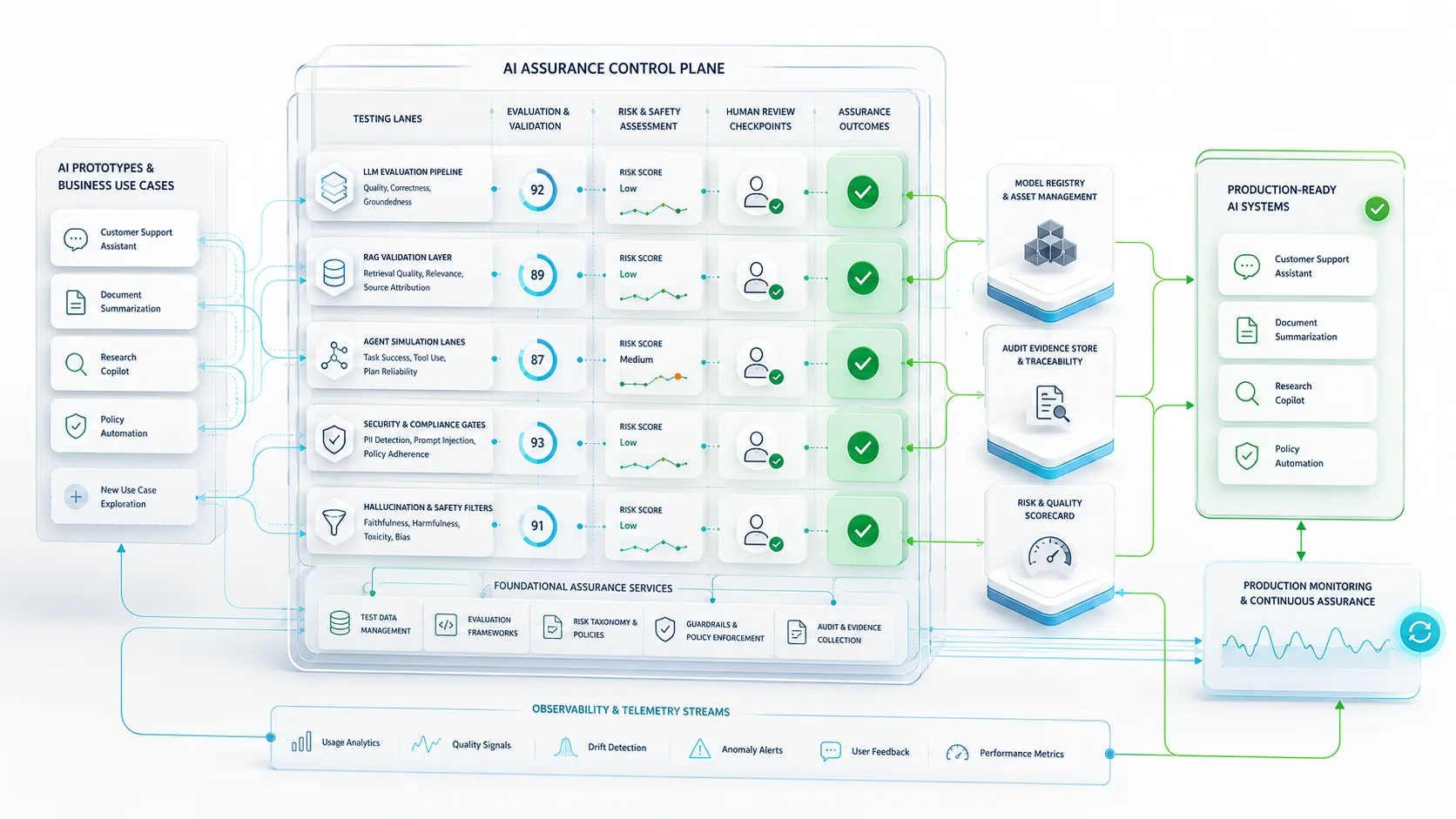
AI assurance should be designed as an enterprise architecture capability. It should not depend on ad hoc spreadsheets, informal human review, or one-time manual testing. A mature architecture connects AI development workflows with evaluation pipelines, model registries, prompt management, test datasets, risk controls, approval gates, observability platforms, and incident response processes.
Reference Architecture Layers
Assurance Evidence Should Follow the System
Every production AI system should have a clear evidence trail: what was tested, which dataset was used, what the model passed, what it failed, which risks remain, who approved deployment, and how the system will be monitored. This evidence should live close to the model registry, deployment pipeline, and governance workflow.
LLMOps Is the Operational Backbone
LLMOps provides the operational foundation for AI assurance engineering. It supports prompt versioning, model comparison, evaluation automation, dataset management, monitoring, cost control, rollback strategy, and continuous improvement. Without LLMOps, assurance becomes manual, inconsistent, and difficult to scale across teams.
Key Takeaways
- ✓ AI assurance engineering helps enterprises validate AI systems before production and continuously monitor them after launch.
- ✓ Enterprise AI testing must cover models, prompts, data, retrieval, agent actions, security, privacy, observability, and governance.
- ✓ Traditional QA is not enough because AI systems are probabilistic, context-sensitive, and dependent on changing data and model behavior.
- ✓ LLM evaluation, RAG testing, agent simulation, red-team testing, and production observability should operate as one assurance lifecycle.
- ✓ Assurance evidence should support governance decisions, risk approvals, auditability, and executive confidence in production AI systems.
LLM Evaluation: Testing Language Model Behavior
LLM evaluation is one of the central practices of AI assurance engineering. Enterprises must test whether a language model system can follow instructions, answer accurately, avoid unsafe outputs, handle ambiguity, refuse inappropriate requests, maintain tone, and operate within business rules. The evaluation should be specific to the workflow, not limited to generic benchmark scores.
Golden Test Sets
A golden test set contains representative prompts, expected behaviors, edge cases, failure examples, and business-specific scenarios. For a customer support assistant, this might include refund questions, angry users, policy ambiguity, multilingual requests, account-specific constraints, and escalation triggers.
Human and Automated Scoring
Automated evaluation can score consistency, grounding, format, policy compliance, toxicity, and factual alignment. Human review remains important for nuanced judgment, brand tone, high-risk use cases, legal interpretation, and customer impact. Mature assurance programs combine both.
Operational Advantage
LLM evaluation should run before release, after prompt changes, after model upgrades, after retrieval updates, and whenever production incidents reveal new failure modes.
RAG Testing: Validating Retrieval and Grounding
RAG systems add another layer of assurance complexity. A model may generate a poor answer because the retrieval pipeline selected the wrong document, missed a critical source, retrieved outdated context, or exposed information the user should not access. Testing only the final answer is not enough. Enterprises must test retrieval quality directly.
Retrieval Relevance
The retrieval system should return sources that are relevant to the user’s question, complete enough to support an answer, and prioritized according to authority and freshness. Poor retrieval creates confident but unsupported AI outputs.
Permission-Aware Retrieval
Enterprise RAG systems must respect access controls. A user should not receive an answer based on documents they are not authorized to view. AI assurance testing should include role-based retrieval checks, data classification checks, and sensitive-source exclusion tests.
RAG Assurance Guardrail
A grounded answer is only trustworthy if the retrieved context is relevant, authorized, current, and complete enough for the task.
Agentic AI Testing: Validating Autonomous Actions
AI agents introduce action risk. An LLM response may be incorrect, but an agent can also take the wrong action. It may call the wrong tool, update the wrong record, trigger the wrong workflow, skip an approval step, or fail to escalate when uncertainty is high. Agentic AI testing must validate planning, tool use, permission boundaries, and recovery behavior.
Planning Tests
Validate whether agents break tasks into appropriate steps, identify dependencies, and avoid unnecessary actions.
Tool-Use Tests
Check whether agents select the correct tool, pass safe arguments, respect permissions, and handle tool failures.
Escalation Tests
Ensure agents escalate high-risk actions, missing context, unclear instructions, and policy conflicts to humans.
Simulation Before Production
Before agents operate in production, teams should run simulations using realistic workflow scenarios, synthetic records, sandboxed tools, and failure conditions. This allows teams to validate agent behavior without exposing customers, systems, or sensitive data to unnecessary risk.
Security, Privacy, and Red-Team Testing
AI systems create security and privacy risks that traditional application testing may miss. Prompt injection, indirect prompt attacks, data leakage, unauthorized retrieval, insecure tool use, sensitive output exposure, and unsafe agent autonomy must be part of enterprise AI risk testing.
Prompt Attack Testing
Test whether the system resists attempts to override instructions, reveal hidden context, bypass policies, or misuse tools.
Privacy Testing
Validate that prompts, retrieval, logs, outputs, memory, and analytics systems do not expose sensitive information.
Policy Boundary Testing
Test whether the AI system respects role-based permissions, workflow limits, approval gates, and forbidden actions.
Security Principle
AI assurance should be integrated with DevSecOps. Security testing should happen before production and continue through runtime monitoring, incident review, and control improvement.
Common Mistakes
Many enterprises underestimate AI assurance because early demos feel convincing. The system appears fluent, useful, and fast. But production reliability is not proven by a good demo. It is proven through structured validation, evidence, monitoring, and risk management.
- Testing only happy paths. AI systems must be tested against ambiguity, edge cases, adversarial prompts, missing context, and operational failures.
- Evaluating only the model. Enterprise AI risk often comes from retrieval, prompts, tools, permissions, memory, and workflow orchestration.
- Relying only on human review. Human evaluation is important, but it must be supported by automated regression testing and runtime monitoring.
- Skipping RAG validation. If retrieval is wrong, the final answer can look confident while being unsupported or unauthorized.
- Ignoring production drift. AI behavior can degrade as data, usage patterns, prompts, models, and business rules change.
- Treating assurance as a release checklist. AI assurance is a lifecycle discipline, not a one-time pre-launch review.
Enterprise Architecture Perspective
From an enterprise architecture perspective, AI assurance engineering is the quality and trust control plane for production AI. It connects AI strategy, software delivery, model lifecycle operations, data governance, security, risk management, observability, and business ownership. Without this control plane, AI systems may reach production without clear evidence of readiness.
The strongest architecture treats assurance as part of the AI platform. Evaluation pipelines, risk gates, test datasets, prompt registries, model registries, monitoring dashboards, and audit evidence should be reusable across teams. This reduces duplication and gives executives a consistent view of AI system maturity.
Architecture Principle
Production AI should not be approved because it performs well in a demo. It should be approved because its behavior, risks, controls, and monitoring strategy have been validated against enterprise requirements.
Implementation Strategy for AI Assurance Engineering
Enterprises should implement AI assurance engineering in phases. The goal is to create a practical, repeatable validation model that supports AI adoption without creating unnecessary delivery friction. Assurance should be risk-based: low-risk systems can move faster, while high-risk systems require stronger evaluation and governance evidence.
Phase 1: Define AI Risk Tiers
Classify AI use cases based on data sensitivity, user impact, autonomy, regulatory exposure, business criticality, and customer visibility. Risk tiers determine the depth of assurance required before production.
Phase 2: Build Evaluation Assets
Create golden test sets, adversarial prompts, retrieval test cases, agent simulations, evaluation rubrics, security tests, and business acceptance criteria. These assets become reusable assurance infrastructure.
Phase 3: Integrate Assurance into LLMOps
Connect evaluations to prompt changes, model updates, retrieval changes, deployment pipelines, and approval workflows. Assurance should run automatically where possible and route exceptions to human reviewers.
Phase 4: Monitor Production Continuously
Track AI behavior after deployment through observability, feedback capture, incident review, drift analysis, cost telemetry, and periodic regression testing. Production monitoring closes the assurance loop.
Implementation Checklist
Foundation
- Inventory production AI use cases
- Classify AI risk tiers
- Define acceptance criteria
- Assign business and technical owners
Validation
- Create golden test sets
- Run LLM evaluations
- Test RAG retrieval quality
- Simulate agent actions safely
Operations
- Enable AI observability
- Track policy violations
- Review incidents and drift
- Improve tests from production feedback
Measuring AI Assurance Maturity
AI assurance should be measured as an operational capability. Executives need to know which AI systems are production-ready, which risks remain, which controls are working, and whether AI behavior is improving over time. Engineering teams need metrics that help them improve quality without slowing delivery unnecessarily.
Metrics to Track
How YggyTech Helps
YggyTech helps enterprises design, implement, and scale AI assurance engineering capabilities with architecture-first discipline. We help organizations move from AI experimentation to production-ready AI systems that are tested, governed, observable, and aligned with enterprise risk requirements.
AI Assurance Strategy
We define risk tiers, validation frameworks, evaluation criteria, production readiness gates, and governance workflows for enterprise AI systems.
LLMOps and Evaluation Architecture
We design evaluation pipelines, golden test sets, model registries, prompt versioning, RAG testing, agent simulations, and AI observability systems.
Implementation and Scale
We help teams operationalize assurance across LLM applications, RAG systems, AI agents, internal copilots, and autonomous workflows.
Our expertise spans enterprise AI, LLMOps, DevSecOps, cloud architecture, cybersecurity, software architecture, RAG systems, AI agents, and digital transformation. That systems-level perspective matters because production AI trust depends on the entire architecture, not just the model.
Build Production AI Systems You Can Validate, Monitor, and Trust
YggyTech helps technology leaders build AI assurance engineering capabilities that test AI behavior, validate risk controls, improve reliability, and create confidence before production deployment.
Talk to YggyTechFAQs About AI Assurance Engineering
What is AI assurance engineering?
AI assurance engineering is the practice of testing, validating, monitoring, and governing AI systems so they can operate safely, reliably, and responsibly in production enterprise environments.
Why is AI assurance important before production?
AI assurance is important before production because AI systems can generate inaccurate outputs, retrieve the wrong context, expose sensitive data, misuse tools, behave unpredictably, or degrade after deployment if they are not properly validated.
How is AI testing different from software testing?
AI testing is different because AI systems are probabilistic and context-sensitive. Teams must evaluate behavior, data quality, retrieval accuracy, model outputs, safety, tool use, privacy, drift, and human escalation instead of only checking fixed functionality.
What should an AI validation framework include?
An AI validation framework should include risk tiers, acceptance criteria, golden test sets, LLM evaluation, RAG testing, agent simulations, security testing, privacy validation, human review, release gates, monitoring, and incident response.
How can enterprises start with AI assurance engineering?
Enterprises should start by inventorying AI systems, classifying risk, defining production readiness criteria, creating evaluation datasets, testing model and retrieval behavior, validating security controls, and enabling continuous AI observability after deployment.

Liam Walker
Product & AI Research Analyst
Liam researches emerging AI tools, automation workflows, and next-generation digital products. He contributes fresh perspectives on startup technology trends, AI productivity systems, and modern SaaS innovation for fast-growing companies.