AI Control Planes for Multi-Agent Enterprise Systems
Enterprise AI is rapidly evolving from isolated copilots into interconnected ecosystems of autonomous agents operating across infrastructure, workflows, customer operations, security systems, and business decision layers. As organizations scale these environments, a new architectural layer is becoming essential: the AI control plane.
Key Strategic Insight
Multi-agent AI systems without centralized orchestration and governance eventually create operational fragmentation, policy drift, observability blind spots, and uncontrolled execution behavior. AI control planes solve this by introducing runtime coordination, visibility, governance, and operational discipline across autonomous enterprise AI systems.
What Is an AI Control Plane?
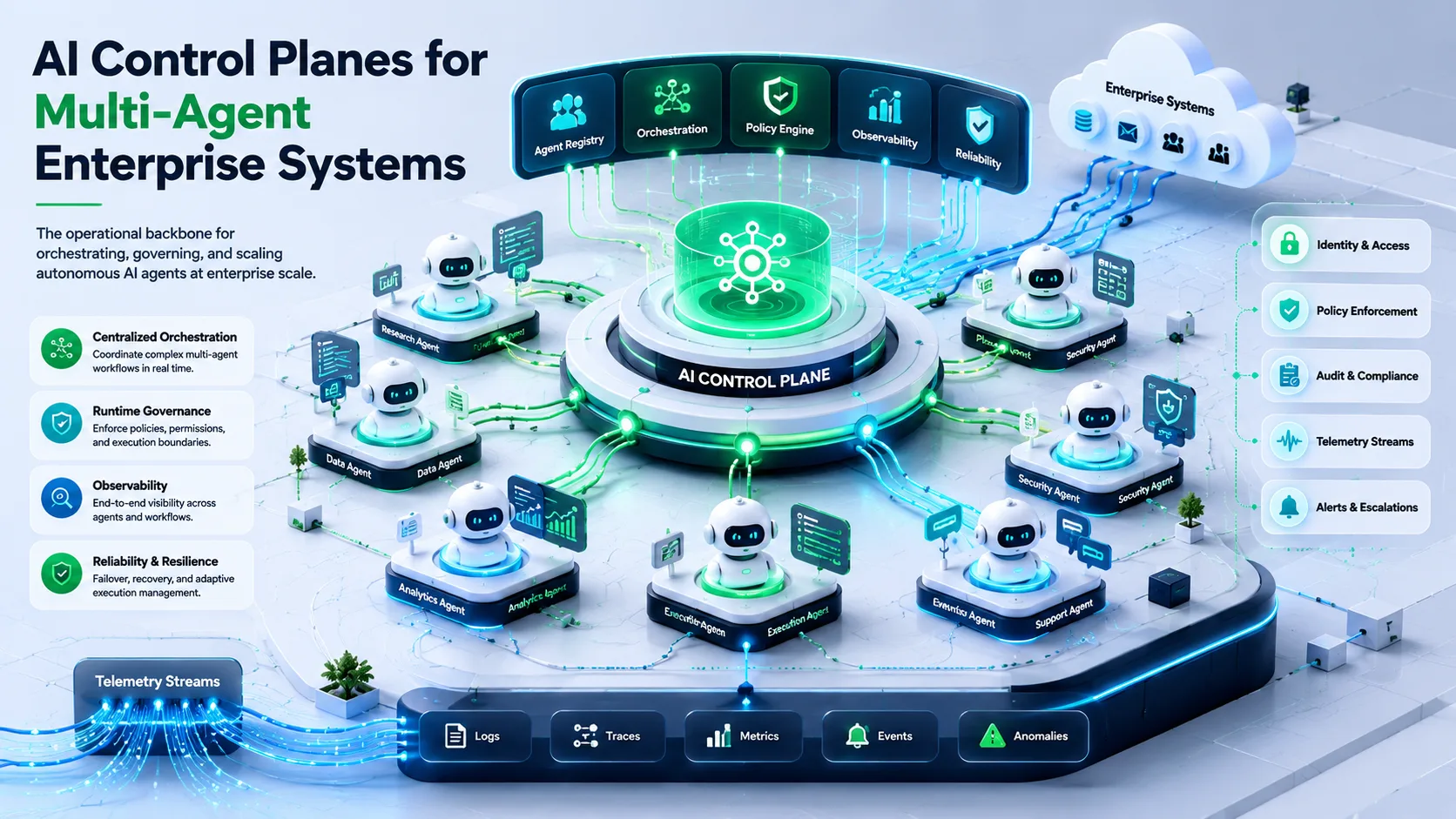
An AI control plane is a centralized operational layer responsible for coordinating, governing, monitoring, and orchestrating distributed AI agents and AI-powered workflows across enterprise environments.
Much like Kubernetes transformed infrastructure orchestration for cloud-native applications, AI control planes are emerging as the governance and coordination backbone for enterprise AI ecosystems.
Agent Coordination
Manages communication, task routing, escalation paths, and operational dependencies between autonomous AI agents.
Runtime Governance
Applies operational policies, permissions, execution boundaries, and compliance controls in real time.
Observability
Provides visibility into AI execution paths, telemetry streams, failures, and operational behavior.
Operational Reliability
Introduces failover systems, workflow recovery orchestration, and resilient execution management.
Why Multi-Agent AI Systems Need Control Planes
Early enterprise AI systems typically involved isolated models responding to narrowly scoped prompts. Modern enterprise AI environments are fundamentally different.
Organizations are now deploying:
- Autonomous AI agents
- Distributed orchestration systems
- AI workflow pipelines
- Runtime decision systems
- Cross-functional AI automation layers
- Multi-model operational infrastructure
The Enterprise Scaling Problem
As the number of AI agents increases, orchestration complexity grows exponentially. Without centralized coordination layers, enterprises lose visibility into execution behavior, operational dependencies, and governance enforcement.
Operational Fragmentation
Distributed AI systems frequently create disconnected operational silos where teams deploy autonomous agents independently without unified orchestration policies.
Policy Drift
Different AI services begin operating under inconsistent governance rules, introducing compliance exposure and runtime unpredictability.
Observability Blind Spots
Organizations struggle to understand how decisions are routed, how workflows evolve, or which systems contributed to execution outcomes.
Core Components of an Enterprise AI Control Plane
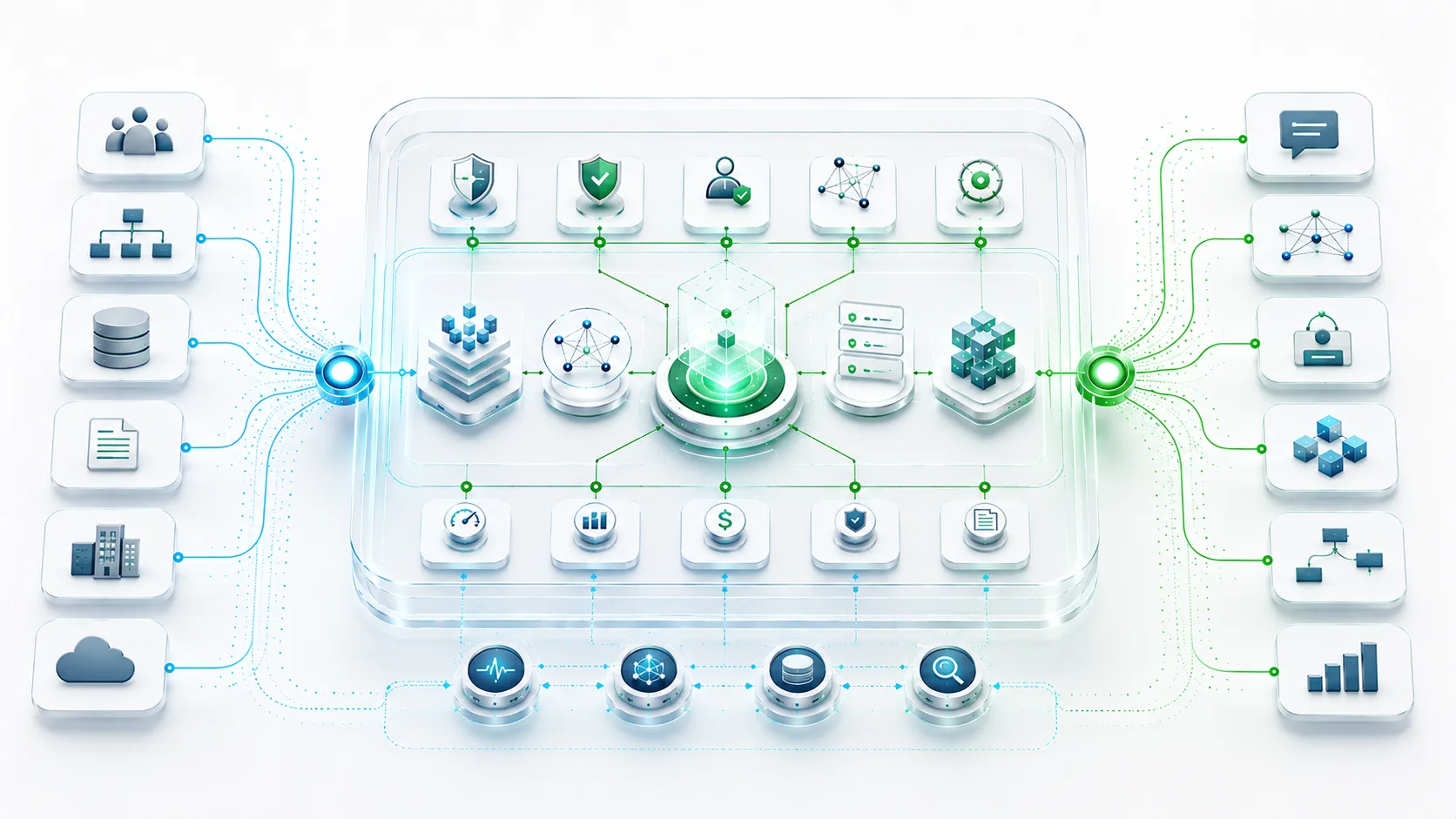
Agent Registry
Maintains visibility into available AI agents, operational capabilities, execution permissions, and dependency relationships.
Workflow Orchestration
Coordinates multi-agent execution flows, task handoffs, retries, escalation paths, and operational sequencing.
Policy Engine
Applies runtime governance rules for security, compliance, operational boundaries, and execution validation.
Telemetry Layer
Collects operational metrics, execution traces, inference telemetry, latency data, and anomaly signals.
Enterprise Architecture Perspective
AI control planes should not be viewed as isolated orchestration tools. They represent a foundational enterprise operating layer responsible for governing intelligent systems across the organization.
Recommended Enterprise Control Plane Layers
- Identity and authorization orchestration
- Agent lifecycle management
- Distributed workflow coordination
- Operational telemetry aggregation
- Runtime policy enforcement
- Execution traceability systems
- Infrastructure resilience automation
- Cross-agent observability pipelines
Security and Governance Considerations
Enterprise AI control planes become high-value operational targets. Security architecture must therefore be deeply integrated into orchestration design.
Zero Trust Agent Communication
All AI agent interactions should require authenticated and policy-validated communication pathways.
Runtime Policy Validation
Every execution path should be validated against operational governance rules before action execution occurs.
Traceable Decision Intelligence
Enterprises must maintain visibility into how decisions were formed, routed, and executed across multiple agents.
Governance Maturity Requirement
Multi-agent AI governance cannot rely solely on static policies. Modern enterprise environments require adaptive runtime governance systems capable of evaluating operational behavior continuously.
Implementation Strategy for Enterprise Teams
Start with Operational Visibility
Before enterprises automate complex orchestration workflows, they must first establish observability and telemetry visibility.
Build Modular Orchestration Layers
Control plane architecture should remain modular rather than tightly coupled to individual AI models or workflows.
Separate Governance from Execution
Operational governance should remain centralized even when AI execution systems remain distributed.
Phase 1
Telemetry collection and observability integration.
Phase 2
Workflow orchestration and runtime coordination.
Phase 3
Adaptive governance and operational automation.
Common Mistakes
- Treating orchestration as merely workflow automation
- Deploying autonomous agents without runtime governance
- Ignoring operational telemetry architecture
- Building tightly coupled orchestration systems
- Failing to establish AI execution traceability
- Over-centralizing inference execution logic
- Lacking escalation pathways for operational failures
Implementation Checklist
- Establish centralized AI telemetry pipelines
- Deploy agent identity and permission systems
- Implement distributed orchestration visibility
- Introduce runtime governance checkpoints
- Build operational recovery workflows
- Create execution traceability architecture
- Design resilient workflow escalation paths
- Integrate observability across AI workflows
- Continuously validate governance compliance
Key Takeaways
- AI control planes are becoming essential enterprise orchestration infrastructure.
- Multi-agent systems require centralized runtime governance and coordination.
- Operational visibility and telemetry are foundational architectural requirements.
- Governance and orchestration must evolve together.
- Enterprise AI maturity increasingly depends on operational discipline rather than model capability alone.
How YggyTech Helps
YggyTech helps enterprises design and operationalize scalable AI control plane architectures for autonomous multi-agent systems.
AI Orchestration Architecture
Designing scalable coordination layers for distributed AI workflows and autonomous systems.
Runtime Governance Systems
Building adaptive governance frameworks for operational AI environments.
Operational Observability
Implementing telemetry visibility, tracing, and operational intelligence systems.
Build Enterprise-Grade AI Control Infrastructure
Modern multi-agent AI systems require orchestration maturity, governance discipline, and operational visibility. YggyTech helps organizations architect scalable AI control planes designed for enterprise resilience and operational intelligence.
Talk to YggyTechFAQs
What is an AI control plane?
An AI control plane is a centralized orchestration and governance layer responsible for managing distributed AI systems, workflows, policies, and operational visibility.
Why are AI control planes important for enterprises?
They provide governance, runtime coordination, observability, and operational discipline for complex multi-agent AI environments.
How do AI control planes support governance?
They apply runtime policies, execution validation, identity management, and operational oversight across distributed AI systems.
What role does observability play in multi-agent systems?
Observability enables enterprises to monitor execution flows, understand operational dependencies, detect anomalies, and improve system reliability.
Are AI control planes similar to Kubernetes?
Conceptually yes. Both provide centralized orchestration and operational coordination layers, though AI control planes focus specifically on intelligent autonomous systems and AI workflow governance.

Liam Walker
Product & AI Research Analyst
Liam researches emerging AI tools, automation workflows, and next-generation digital products. He contributes fresh perspectives on startup technology trends, AI productivity systems, and modern SaaS innovation for fast-growing companies.