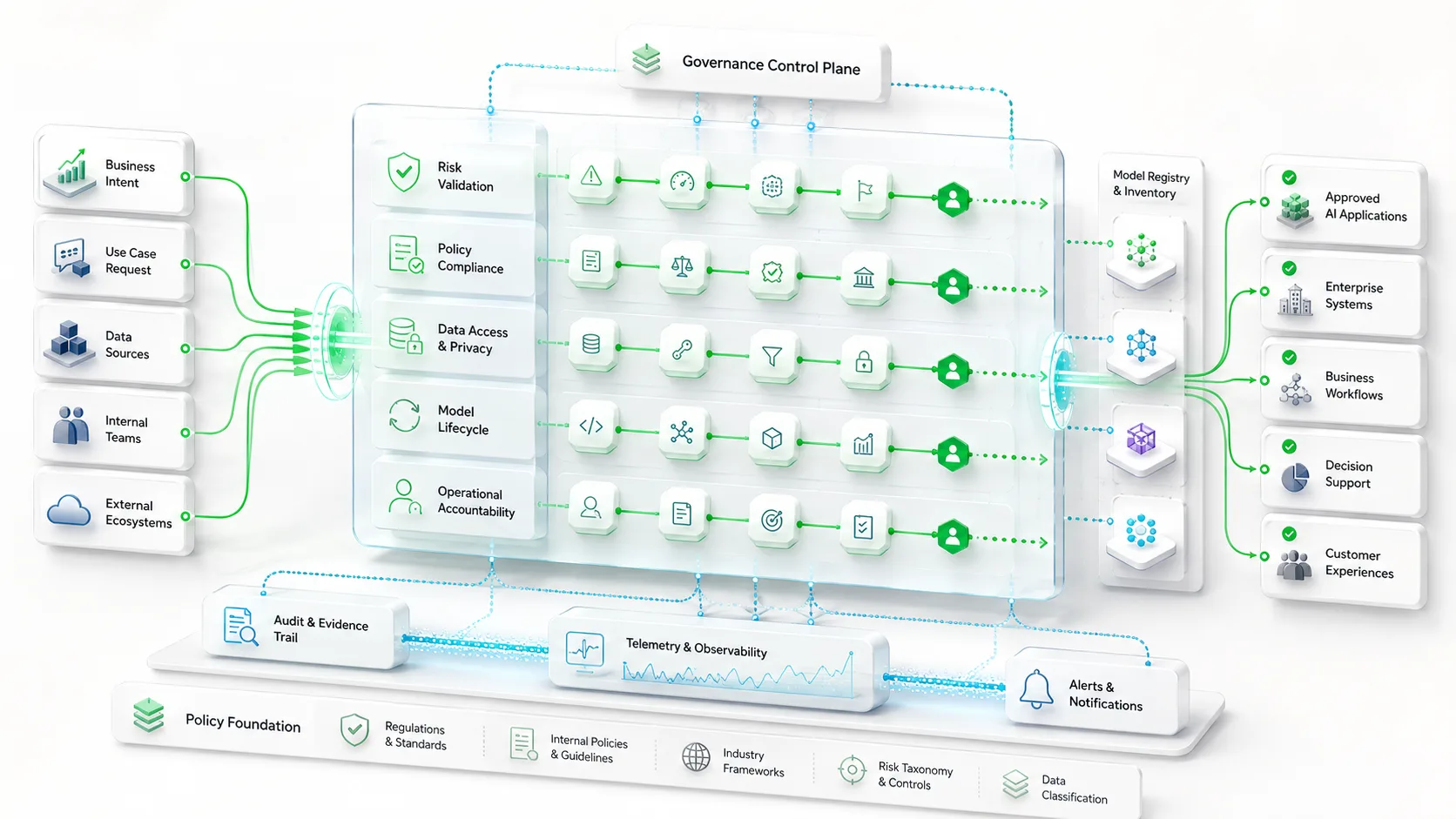
AI Governance Framework: How Enterprises Control Risk, Compliance, and Scalable AI Adoption
An AI governance framework gives enterprises the operating structure to adopt artificial intelligence with confidence. It defines how AI systems are approved, designed, secured, monitored, audited, and improved so innovation can scale without exposing the organization to unmanaged risk.
Why Enterprises Need an AI Governance Framework
Enterprise AI is moving from controlled experimentation into operational systems. Teams are using AI to summarize knowledge, support decisions, automate workflows, generate code, assist customers, detect risk, personalize experiences, and coordinate autonomous digital processes. That expansion creates a new governance challenge: AI is no longer a single tool inside one department. It is becoming a cross-functional technology layer that touches data, security, compliance, product delivery, customer experience, and business operations.
Without an AI governance framework, organizations often end up with fragmented AI adoption. Different teams use different tools, sensitive data is sent into unmanaged systems, model outputs are trusted without validation, policies are unclear, and executives lack visibility into where AI is being used. This creates risk across privacy, cybersecurity, intellectual property, regulatory compliance, operational reliability, fairness, brand trust, and business accountability.
Key Insight
The purpose of an AI governance framework is not to slow innovation. The purpose is to make AI adoption repeatable, secure, auditable, and scalable enough for enterprise use.
What an AI Governance Framework Actually Is
An AI governance framework is a structured operating model for managing AI systems across their lifecycle. It defines policies, roles, controls, approval workflows, monitoring standards, risk classifications, documentation requirements, and accountability structures. In practical terms, it answers enterprise-critical questions: which AI use cases are allowed, which data can be used, who approves deployment, how outputs are validated, what risks must be monitored, and how the organization responds when an AI system behaves unexpectedly.
A mature AI governance framework connects business strategy with technical execution. It is not just a policy document. It must be embedded into product development, data platforms, LLMOps, cybersecurity, vendor management, legal review, risk management, and operational monitoring.
Policy Control
Defines acceptable AI usage, data boundaries, risk tiers, human oversight requirements, and approval paths.
Lifecycle Governance
Controls AI systems from ideation and design through deployment, monitoring, change management, and retirement.
Risk Management
Evaluates security, privacy, compliance, bias, accuracy, operational impact, and business-critical failure modes.
Auditability
Creates traceability for model decisions, prompt changes, data access, tool calls, user actions, and governance approvals.
Why AI Governance Matters Now
AI governance matters now because enterprise AI systems are becoming more autonomous, more integrated, and more influential. A simple internal chatbot may only retrieve knowledge. A production AI agent may create tickets, update records, trigger workflows, generate customer responses, modify code, summarize sensitive data, or recommend operational decisions. As AI gains access to more tools and context, the governance model must become more sophisticated.
The risk profile changes when AI moves from advisory output to operational action. Enterprises need governance that can classify use cases by risk, define decision boundaries, control tool access, evaluate model behavior, monitor performance, and preserve human accountability. The goal is not to eliminate risk entirely. The goal is to make risk visible, controlled, and proportionate to business value.
Enterprise Signal
AI governance becomes urgent when AI systems begin influencing business decisions, accessing sensitive data, using tools, interacting with customers, or operating inside regulated workflows.
From AI Experimentation to AI Operations
Many organizations begin with AI experiments because experimentation is fast and low-friction. But enterprise value comes from repeatable AI operations. That transition requires approved data pipelines, identity controls, model evaluation, deployment standards, monitoring, incident response, compliance review, and ownership. Governance is what turns AI experimentation into a durable capability.
From Generic Policies to Embedded Controls
AI policies are useful only when they are operationalized. A policy that says “protect sensitive data” must translate into data classification, access controls, vendor review, prompt logging, redaction workflows, encryption standards, and monitoring. An AI governance framework connects policy language with technical enforcement.
Core Pillars of an Enterprise AI Governance Framework
A strong AI governance framework should be practical enough for engineering teams and strategic enough for executive leadership. It should define how AI initiatives move from idea to production while keeping risk, accountability, and operational quality under control.
1. AI Strategy Alignment
Every AI initiative should connect to a defined business goal, measurable outcome, operating model, and ownership structure.
2. Risk Classification
Use cases should be tiered by sensitivity, autonomy, user impact, regulatory exposure, data access, and operational criticality.
3. Data Governance
AI systems require clear controls for data quality, lineage, access permissions, retention, masking, redaction, and usage boundaries.
4. Model Lifecycle Control
Govern model selection, prompt workflows, training data, retrieval systems, evaluations, deployments, updates, and retirement.
5. Security and Access
AI systems must be protected through identity controls, permission boundaries, secrets management, monitoring, and secure tool access.
6. Monitoring and Accountability
Track performance, drift, incidents, escalations, costs, user feedback, policy violations, and business impact over time.
Enterprise Architecture for AI Governance
AI governance should be designed as an enterprise architecture capability, not a compliance afterthought. The architecture must connect AI use cases, data systems, model platforms, orchestration layers, security controls, audit logs, monitoring dashboards, and approval workflows. This creates a governance operating system that can scale across departments and technologies.
Reference Architecture Layers
Governance Must Be Close to the Workflow
The most effective governance controls live inside the workflows where AI is built and used. If developers, data scientists, product teams, and business users must leave their normal systems to follow governance requirements, adoption will be inconsistent. Enterprises should embed governance into intake forms, model registries, CI/CD pipelines, AI gateways, developer platforms, service catalogs, and monitoring tools.
LLMOps Is the Technical Backbone
For generative AI and language model systems, LLMOps provides the operational discipline behind governance. It supports prompt versioning, evaluation sets, retrieval quality checks, model comparison, cost monitoring, safety testing, latency tracking, feedback capture, and controlled deployment. Without LLMOps, AI governance remains too manual to scale.
Key Takeaways
- ✓ An AI governance framework gives enterprises the structure to scale AI safely, securely, and responsibly.
- ✓ Governance should cover strategy, risk classification, data controls, model lifecycle management, security, monitoring, and accountability.
- ✓ AI governance must be embedded into workflows, not managed through static policy documents alone.
- ✓ LLMOps, DevSecOps, identity controls, audit logging, and model monitoring are critical technical foundations.
- ✓ The goal is governed innovation: faster AI adoption with stronger control, visibility, and business alignment.
AI Risk Management: What Enterprises Must Control
AI risk management is one of the most important parts of an AI governance framework. Different AI systems create different risk profiles. A marketing assistant that drafts internal copy is not the same as an AI agent that updates customer records or a model that influences financial decisions. Enterprises should classify AI systems based on autonomy, sensitivity, user impact, data exposure, and operational criticality.
Data Risk
Sensitive data may be exposed through prompts, training sets, logs, third-party tools, retrieval systems, or agent memory.
Output Risk
AI systems may generate inaccurate, biased, incomplete, unsafe, or misleading outputs if not properly evaluated.
Operational Risk
AI agents can trigger workflows, update systems, or influence decisions without sufficient oversight.
Compliance Risk
AI use may affect privacy, explainability, record retention, industry standards, accessibility, and audit obligations.
Operational Advantage
Risk classification helps enterprises avoid one-size-fits-all governance. Low-risk AI use cases can move quickly, while high-risk systems receive stronger review, monitoring, and approval controls.
Data Governance for Enterprise AI
AI governance depends heavily on data governance. Models are only as reliable, safe, and compliant as the data they use. Enterprises need to know where data comes from, who can access it, whether it is appropriate for AI use, how long it is retained, how it is protected, and whether it can be shared with external systems.
Data Classification and Access Control
Data should be classified by sensitivity and usage rights. Public content, internal documents, customer data, regulated records, source code, credentials, financial information, and personal information require different controls. AI systems should receive only the minimum data required for the task.
Retrieval Governance
Many enterprise AI systems use retrieval-augmented generation to access internal knowledge. That creates governance requirements around indexing, permissions, freshness, source ranking, citation behavior, and access filtering. A user should not receive AI-generated answers based on documents they are not authorized to view.
Data Governance Guardrail
Enterprise AI should follow the principle of least context. Give each AI system enough information to perform the task, but not enough to create unnecessary privacy, security, or compliance exposure.
Security Governance for AI Systems
AI systems introduce security concerns that overlap with traditional cybersecurity but also require new controls. Prompt injection, data leakage, insecure tool use, unauthorized retrieval, model misuse, unsafe outputs, and uncontrolled agent actions can create real enterprise exposure. Security governance must be built into the AI architecture from the beginning.
Identity and Permissions
AI systems should use scoped identities, role-based access, service accounts, and permission boundaries aligned with business purpose.
Tool Access Controls
Agents and AI workflows should only call approved tools with input validation, action limits, audit logs, and rollback paths.
Threat Monitoring
Monitor prompt attacks, abnormal tool calls, unusual retrieval patterns, sensitive data exposure, and policy bypass attempts.
DevSecOps for AI Governance
AI governance should integrate with DevSecOps so security controls are part of delivery pipelines. This includes scanning code, validating dependencies, checking infrastructure configuration, testing prompts, reviewing model connections, enforcing approval gates, and monitoring production behavior. Governance should not appear only after deployment.
Common Mistakes
Many AI governance programs fail because they are too abstract, too centralized, or too disconnected from how AI is actually built and used. Governance must be practical, enforceable, and aligned with delivery realities.
- Treating governance as a document. Policies matter, but they must be translated into workflows, controls, monitoring, and accountability.
- Ignoring shadow AI usage. Employees may use unmanaged AI tools if approved options are too slow, unclear, or unavailable.
- Applying the same controls to every use case. Low-risk productivity use cases and high-risk operational systems need different governance intensity.
- Skipping lifecycle ownership. Every AI system needs accountable owners for design, deployment, monitoring, incidents, and retirement.
- Underestimating data exposure. Prompts, logs, retrieval systems, memory stores, and third-party APIs can all expose sensitive information.
- Failing to monitor after launch. AI systems can drift, degrade, hallucinate, become costly, or behave differently as data and usage patterns change.
Enterprise Architecture Perspective
From an enterprise architecture perspective, an AI governance framework is the control plane for responsible AI adoption. It defines how AI capabilities connect to business processes, data systems, cloud infrastructure, developer platforms, security operations, compliance controls, and executive oversight. Without this architecture, AI adoption becomes fragmented and difficult to scale.
Governance should not sit outside the AI platform. It should be integrated into the architecture through AI gateways, model registries, policy engines, access controls, observability pipelines, audit logs, workflow approvals, and risk dashboards. The result is an environment where teams can innovate quickly while the enterprise maintains control over how AI systems behave.
Architecture Principle
AI governance should be designed as a reusable enterprise capability. The same governance foundation should support internal copilots, LLM applications, AI agents, automated workflows, analytics models, and future AI systems.
Implementation Strategy for an AI Governance Framework
Enterprises should implement AI governance in phases. The most effective approach is to start with visibility, define practical policies, build technical controls, pilot governance workflows, and then scale through platforms and operating models. Governance must mature alongside AI adoption.
Phase 1: Inventory AI Usage
Identify where AI is already being used across the organization. Include approved tools, shadow AI usage, vendor AI features, internal prototypes, production models, AI agents, automation workflows, and data science systems. Governance begins with visibility.
Phase 2: Define Risk Tiers and Policies
Create risk categories based on data sensitivity, autonomy, user impact, regulatory exposure, operational criticality, and decision influence. Define what each risk tier requires for approval, testing, monitoring, and human oversight.
Phase 3: Build Governance Workflows
Create intake, review, approval, documentation, model evaluation, deployment, monitoring, and incident response workflows. Keep them lightweight enough for adoption but strong enough for accountability.
Phase 4: Integrate Controls into AI Platforms
Embed governance into AI gateways, model registries, LLMOps pipelines, cloud infrastructure, access control systems, observability platforms, and developer workflows. This is how governance scales from policy to practice.
Implementation Checklist
Foundation
- Inventory AI systems and tools
- Define business ownership
- Classify data sensitivity
- Map regulatory and compliance needs
Controls
- Create risk-based approval gates
- Enforce identity and access policies
- Define model evaluation standards
- Enable audit logging and monitoring
Scale
- Integrate governance into platforms
- Measure AI performance and risk
- Review incidents and policy exceptions
- Continuously improve governance maturity
Measuring AI Governance Maturity
AI governance should be measured like an operational capability. Executives need visibility into adoption, risk, performance, compliance, cost, incidents, and business impact. Teams should know whether governance is helping them ship trusted AI systems faster or creating unnecessary friction.
Metrics to Track
How YggyTech Helps
YggyTech helps enterprises design, implement, and scale AI governance frameworks with architecture-first discipline. We do not treat governance as a static compliance exercise. We build governance systems that connect enterprise AI strategy, cloud architecture, cybersecurity, LLMOps, DevSecOps, software engineering, data platforms, and operational workflows.
AI Governance Strategy
We define governance models, risk tiers, AI policies, ownership structures, approval workflows, and adoption roadmaps.
Technical Control Architecture
We design AI gateways, LLMOps pipelines, model registries, audit logging, access controls, monitoring, and security guardrails.
Implementation and Scale
We help teams operationalize governance across AI agents, LLM applications, internal copilots, analytics models, and autonomous workflows.
Our systems-level expertise across enterprise AI, cloud architecture, cybersecurity, DevSecOps, LLMOps, and software architecture allows us to build governance that supports innovation instead of blocking it. The result is a scalable AI operating model that gives leaders visibility, teams clarity, and systems the controls they need to operate safely.
Build AI Governance That Scales with Enterprise AI
YggyTech helps technology leaders move from AI experimentation to governed, secure, and scalable AI adoption with frameworks designed for real enterprise operations.
Talk to YggyTechFAQs About AI Governance Frameworks
What is an AI governance framework?
An AI governance framework is a structured operating model that defines how an organization approves, builds, deploys, monitors, secures, audits, and improves AI systems across their lifecycle.
Why is AI governance important for enterprises?
AI governance is important because enterprise AI can affect sensitive data, customer interactions, business decisions, security posture, compliance obligations, and operational workflows. Governance creates control, accountability, and trust.
What should an AI governance framework include?
An AI governance framework should include AI policies, risk classification, data governance, model lifecycle controls, security standards, approval workflows, human oversight, monitoring, audit logging, incident response, and continuous improvement.
How does AI governance support innovation?
AI governance supports innovation by giving teams clear rules, approved tools, reusable patterns, faster review paths, and trusted technical controls. This reduces uncertainty and helps AI adoption scale safely.
How should enterprises start building an AI governance framework?
Enterprises should start by inventorying AI usage, defining risk tiers, assigning ownership, creating practical policies, building approval workflows, integrating technical controls, and monitoring AI systems after deployment.

Maheer Alishba
Data & Automation Consultant
Maheer writes about data engineering, AI-powered analytics, and intelligent business automation. Her content helps organizations understand how to transform fragmented operational data into measurable business intelligence and predictive systems.