AI Observability: The Enterprise Operating Layer for Reliable Production AI
AI observability gives enterprises the visibility to monitor, debug, govern, and continuously improve production AI systems. As AI moves from pilots into operational workflows, observability becomes the foundation for reliability, trust, accountability, and scalable AI operations.
Why AI Observability Matters in Enterprise AI Operations
Enterprise AI systems are no longer isolated experiments. Organizations are deploying LLM applications, retrieval-augmented generation systems, autonomous agents, AI copilots, internal knowledge assistants, software engineering accelerators, security automation systems, and customer-facing AI workflows. These systems depend on prompts, model behavior, retrieval quality, tool calls, data permissions, orchestration logic, runtime context, and human escalation paths. Without observability, teams cannot understand how production AI behaves after deployment.
AI observability is the operational discipline that turns AI from a black box into an inspectable system. It captures telemetry across model responses, user inputs, retrieval sources, latency, cost, hallucination risk, drift, tool execution, agent decisions, policy violations, and business outcomes. This visibility helps enterprises detect failures earlier, improve quality faster, and prove that AI systems are operating within defined risk boundaries.
Key Insight
The enterprise challenge is no longer only building AI systems. It is operating AI systems reliably, securely, and measurably after they enter production.
What AI Observability Actually Is
AI observability is the practice of collecting, analyzing, and acting on telemetry from AI systems in production. It extends traditional observability beyond logs, metrics, and traces by adding AI-specific signals: prompt behavior, model output quality, retrieval grounding, embedding performance, hallucination patterns, evaluation scores, agent tool calls, human feedback, safety events, and governance evidence.
Traditional application monitoring can tell teams whether a service is available, slow, or throwing errors. AI observability tells teams whether the system is answering correctly, retrieving the right context, following policy, escalating when required, protecting sensitive information, staying within cost limits, and delivering business value. That makes it an operating layer for production AI, not just a monitoring dashboard.
Model Visibility
Tracks response quality, consistency, hallucination risk, refusal behavior, latency, token usage, and model performance patterns.
Retrieval Visibility
Monitors source relevance, context freshness, permission filtering, citation quality, and grounding effectiveness in RAG systems.
Agent Visibility
Captures planning steps, tool calls, workflow decisions, retries, escalations, permissions, and execution outcomes.
Governance Visibility
Connects telemetry to audit trails, policy enforcement, risk scoring, approvals, compliance evidence, and accountability.
Why Production AI Needs a New Observability Model
Production AI behaves differently from traditional software. A conventional backend service either returns the expected response, fails, or degrades in measurable infrastructure terms. AI systems can appear healthy while producing low-quality, misleading, ungrounded, unsafe, or policy-violating outputs. The API may return a successful response while the answer is wrong, the retrieved context is outdated, or the agent takes an action that violates workflow rules.
This is why AI observability must include behavioral, operational, and governance signals. Enterprises need to know not only whether the AI system is running, but whether it is behaving correctly for the use case. Production AI monitoring must connect technical telemetry with business trust.
Enterprise Signal
A production AI system can be technically available and still operationally unsafe. AI observability closes that gap by measuring behavior, quality, and risk alongside infrastructure health.
From System Uptime to Answer Quality
Traditional observability asks whether the system is up. AI observability asks whether the system is useful, accurate, grounded, safe, efficient, and aligned with policy. This requires tracking qualitative signals that traditional monitoring tools were not designed to capture.
From One-Time Testing to Runtime Assurance
Pre-production testing is essential, but AI behavior can shift after launch as models, prompts, documents, users, workflows, and business rules change. AI observability provides runtime assurance by continuously measuring whether the system remains reliable under real operating conditions.
Core Signals in Enterprise AI Observability
A mature AI observability strategy captures signals across the full AI system. Monitoring only infrastructure metrics or model latency leaves major production risks hidden. Enterprises need visibility into the model, data, retrieval, orchestration, security, governance, and business impact layers.
1. Prompt and Response Telemetry
Capture prompt versions, user intent patterns, response quality, safety events, refusals, hallucination signals, and user feedback.
2. Retrieval and Context Signals
Monitor retrieved documents, ranking quality, source freshness, permission filtering, context precision, and citation behavior.
3. Cost and Latency Metrics
Track token usage, model selection, response time, retry behavior, inference cost, cache efficiency, and workload patterns.
4. Agent Execution Traces
Record agent plans, tool choices, API calls, workflow transitions, permission checks, failed steps, and human escalations.
5. Safety and Policy Events
Detect sensitive data exposure, prompt injection attempts, unsupported requests, policy violations, and unsafe outputs.
6. Business Outcome Signals
Measure resolution quality, task completion, user satisfaction, escalation rate, adoption, workflow cycle time, and operational value.
Enterprise Architecture for AI Observability
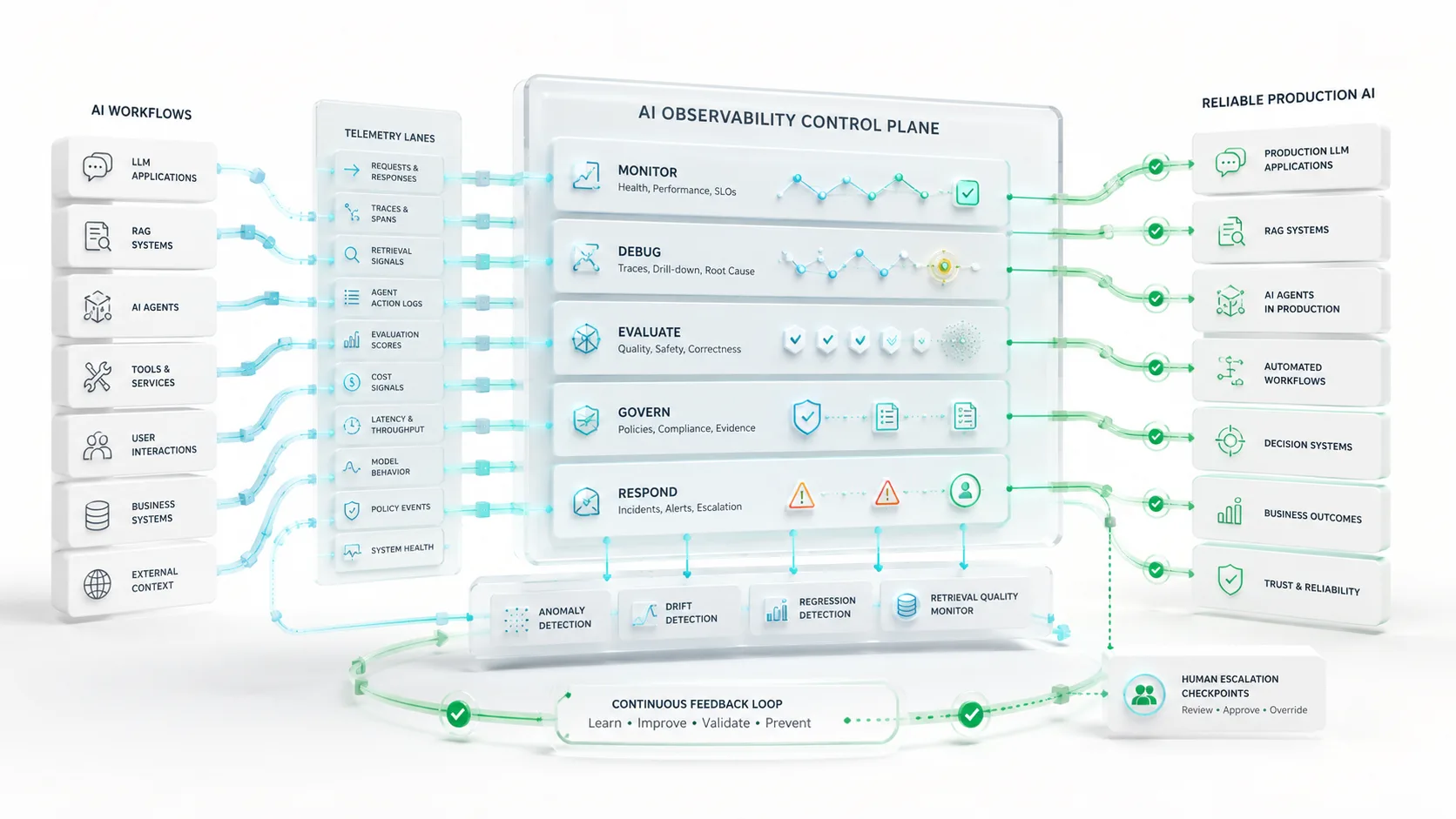
AI observability should be designed as a platform capability, not an afterthought added to individual AI projects. A strong architecture connects AI gateways, LLMOps pipelines, model registries, prompt management, RAG systems, agent orchestration, application logs, security monitoring, data governance, and business analytics into a unified operating model.
Reference Architecture Layers
AI Telemetry Should Follow the Workflow
AI telemetry should not be limited to isolated model calls. It should follow the full workflow from user intent to retrieval, generation, tool execution, human review, final output, and feedback. This end-to-end traceability helps teams debug failures and understand the true operating behavior of production AI systems.
LLMOps and AIOps Must Converge
LLMOps provides model lifecycle discipline, while AIOps focuses on operational intelligence and incident response. AI observability connects both. It gives teams the data required to manage model changes, production behavior, system health, cost, incidents, and governance obligations as one operating system.
Key Takeaways
- ✓ AI observability helps enterprises operate production AI systems with visibility into quality, reliability, cost, risk, and business impact.
- ✓ Production AI monitoring must go beyond uptime and latency to include model behavior, retrieval quality, agent actions, and policy compliance.
- ✓ LLM observability, RAG monitoring, agent tracing, AI incident response, and governance evidence should operate as one connected AI operations layer.
- ✓ AI telemetry should follow the full workflow from user intent to final output and feedback, not just individual model calls.
- ✓ The goal of AI observability is continuous operational trust: knowing how AI systems behave, where they fail, and how to improve them safely.
LLM Observability: Monitoring Model Behavior in Production
LLM observability focuses on how language model systems behave in real-world usage. Enterprises need to monitor the relationship between user inputs, prompt versions, model responses, evaluation scores, latency, token usage, and user feedback. This creates the evidence required to improve prompts, compare models, tune workflows, and manage quality over time.
Prompt Version Monitoring
Prompt changes can significantly affect output quality, safety behavior, and cost. Observability should track which prompt version produced each output, how it performed, and whether quality changed after deployment. This makes prompt engineering measurable instead of subjective.
Quality and Feedback Loops
AI systems should capture explicit feedback, implicit user behavior, escalation patterns, correction events, and evaluation outcomes. These signals help teams understand whether users trust the system and where the model needs improvement.
Operational Advantage
LLM observability allows enterprises to move from “the model seems good” to measurable evidence about response quality, risk, cost, and reliability in production.
RAG Observability: Monitoring Retrieval, Context, and Grounding
RAG systems depend on the quality of retrieved context. If the system retrieves the wrong source, misses relevant documents, uses outdated content, or violates access controls, the final answer can be misleading even when the language model behaves correctly. RAG observability helps enterprises debug these failures.
Retrieval Relevance and Source Quality
Teams should monitor which documents are retrieved, how they are ranked, whether the retrieved content is relevant, and whether the final answer is grounded in the provided context. This helps identify indexing issues, ranking problems, stale documents, and weak chunking strategies.
Permission-Aware Retrieval Monitoring
Enterprise RAG systems must respect user permissions and data classification. Observability should detect unauthorized retrieval attempts, sensitive-source exposure, missing access filters, and answers generated from sources the user should not see.
RAG Monitoring Guardrail
A production RAG system should be monitored at both levels: what it retrieves and what it generates from that retrieved context.
AI Agent Monitoring: Observing Autonomous Actions
AI agents require deeper observability because they do more than generate responses. They plan steps, call tools, update systems, trigger workflows, and coordinate tasks across applications. Agent monitoring must show not just the final outcome, but the reasoning path, tool sequence, permission checks, and operational events that led to that outcome.
Planning Traces
Capture task decomposition, reasoning steps, workflow routing, retries, dependencies, and escalation decisions.
Tool-Call Visibility
Monitor which tools agents call, what arguments they pass, whether calls succeed, and whether permissions are respected.
Human Escalation Signals
Track when agents escalate, why they escalate, how humans respond, and whether escalation quality improves over time.
Autonomy Requires Inspectability
The more autonomy an agent has, the more observability it needs. Enterprises should not allow AI agents to operate across business systems unless their decisions, actions, errors, and escalations can be inspected and governed.
AI Incident Response and Reliability Engineering
AI observability becomes most valuable when something goes wrong. A customer receives an incorrect answer. A RAG system cites an outdated policy. An agent calls the wrong tool. Token costs spike unexpectedly. A prompt injection attempt bypasses weak controls. AI incident response gives teams a structured way to detect, investigate, contain, and resolve production AI failures.
Detection
Use alerts, anomaly detection, user feedback, policy events, and evaluation failures to identify production AI issues early.
Investigation
Trace prompts, retrieved sources, model versions, tool calls, workflow state, and user context to understand root cause.
Remediation
Improve prompts, update retrieval indexes, adjust policies, modify tool permissions, retrain workflows, or roll back model changes.
Reliability Principle
AI incident response should produce better tests, stronger monitoring, clearer policies, and more reliable systems after every failure.
Common Mistakes
Many enterprise AI operations programs fail because they treat observability as a basic monitoring dashboard rather than a production AI operating layer. Reliable AI requires visibility into behavior, risk, cost, quality, and business outcomes together.
- Monitoring only latency and uptime. AI systems can be fast and available while producing inaccurate, unsafe, or ungrounded outputs.
- Ignoring retrieval telemetry. Many AI failures start with poor context, stale sources, weak ranking, or unauthorized retrieval.
- Treating agent actions as invisible. Autonomous workflows need traces for planning, tool calls, permission checks, errors, and escalations.
- Separating observability from governance. AI telemetry should support auditability, risk review, policy enforcement, and compliance evidence.
- Skipping cost observability. Token usage, model selection, retries, and inefficient prompts can create unpredictable operating costs.
- Failing to learn from incidents. AI operations should turn production failures into better evaluations, guardrails, and monitoring rules.
Enterprise Architecture Perspective
From an enterprise architecture perspective, AI observability is the control plane for production AI operations. It connects AI applications, model providers, retrieval pipelines, vector databases, agent orchestration, cloud infrastructure, security systems, compliance workflows, and business analytics. Without this control plane, enterprises cannot operate AI at scale with confidence.
AI observability should be reusable across teams and systems. The same observability foundation should support internal copilots, customer support assistants, RAG systems, AI agents, software development copilots, security automation, and autonomous workflows. This creates consistency in how the enterprise monitors quality, risk, reliability, and value.
Architecture Principle
Production AI systems should be designed to be observable from the beginning. If teams cannot inspect how an AI system makes decisions, retrieves context, uses tools, and fails, they cannot operate it responsibly.
Implementation Strategy for AI Observability
Enterprises should implement AI observability in phases. The goal is to create a practical operating model that supports reliability, governance, and continuous improvement without overwhelming teams with disconnected telemetry. Observability should start with the highest-risk and highest-value AI systems, then become a reusable platform capability.
Phase 1: Define Production AI Signals
Identify the signals that matter for each use case: response quality, retrieval relevance, escalation rate, latency, cost, policy events, user feedback, and business outcomes. Do not start with dashboards. Start with operating questions.
Phase 2: Instrument the AI Workflow
Capture telemetry across prompts, model calls, retrieval events, tool calls, agent decisions, permissions, errors, and final outputs. The workflow trace should make it possible to debug a production issue end to end.
Phase 3: Connect Observability to Governance
Map telemetry to risk tiers, policy controls, audit requirements, release gates, and incident response. Observability should create governance evidence automatically instead of relying on manual reporting.
Phase 4: Build Continuous Improvement Loops
Use production telemetry to improve prompts, retrieval indexes, evaluation datasets, agent workflows, cost controls, and reliability practices. AI observability should make every production signal part of the improvement loop.
Implementation Checklist
Foundation
- Inventory production AI systems
- Define AI operations ownership
- Identify critical telemetry signals
- Classify systems by risk and impact
Instrumentation
- Capture prompt and response logs
- Trace RAG retrieval sources
- Monitor agent tool calls
- Track latency, cost, and quality signals
Operations
- Create AI incident workflows
- Connect alerts to risk tiers
- Review drift and policy events
- Improve AI systems from telemetry
Measuring AI Observability Maturity
AI observability maturity should be measured by how well the enterprise can detect, explain, improve, and govern production AI behavior. A mature organization does not only know that AI systems are running. It knows whether they are reliable, cost-efficient, trusted, safe, and improving.
Metrics to Track
How YggyTech Helps
YggyTech helps enterprises design, implement, and scale AI observability as part of a mature AI operations architecture. We do not treat observability as a dashboard-only problem. We help organizations build production AI operating layers that connect telemetry, governance, reliability, security, cost control, and continuous improvement.
AI Operations Strategy
We define AI operations models, observability requirements, reliability metrics, ownership structures, and production maturity roadmaps.
LLMOps and Observability Architecture
We design telemetry pipelines, model monitoring, RAG observability, agent tracing, evaluation loops, dashboards, and alerting systems.
Governance and Reliability Integration
We connect observability with AI governance, incident response, DevSecOps, cloud operations, risk management, and enterprise reporting.
Our expertise spans enterprise AI, LLMOps, AIOps, cloud architecture, DevSecOps, cybersecurity, AI governance, software architecture, and digital transformation. That systems-level perspective matters because production AI reliability depends on the entire operating architecture, not only the model.
Operate Production AI with Visibility, Reliability, and Control
YggyTech helps technology leaders build AI observability systems that monitor LLM behavior, RAG quality, agent actions, governance signals, cost, incidents, and reliability across production AI operations.
Talk to YggyTechFAQs About AI Observability
What is AI observability?
AI observability is the practice of monitoring, tracing, evaluating, and analyzing production AI systems so teams can understand model behavior, retrieval quality, agent actions, cost, latency, risk, and business outcomes.
Why is AI observability important for enterprises?
AI observability is important because production AI systems can fail in ways traditional monitoring does not detect. They may produce inaccurate answers, retrieve poor context, expose sensitive data, misuse tools, exceed cost limits, or violate policy while still appearing technically healthy.
How is AI observability different from traditional observability?
Traditional observability focuses on infrastructure and application health. AI observability adds signals for model quality, prompt behavior, hallucination risk, retrieval grounding, agent tool use, safety events, policy compliance, user feedback, and AI-specific cost patterns.
What should an AI observability platform monitor?
An AI observability platform should monitor prompts, responses, model versions, token usage, latency, cost, retrieval sources, grounding quality, agent actions, tool calls, policy violations, safety events, drift, incidents, feedback, and business outcomes.
How should enterprises start with AI observability?
Enterprises should start by inventorying production AI systems, defining critical telemetry signals, instrumenting AI workflows, monitoring model and retrieval behavior, connecting alerts to incident response, and using observability data to improve reliability and governance over time.

Mason Carter
Cloud & Infrastructure Engineer
Mason focuses on scalable cloud ecosystems, DevOps modernization, and secure distributed infrastructure. His insights at YGGY Tech explore resilient architecture design, Kubernetes operations, cybersecurity strategy, and enterprise scalability.