AI Security Operations: How Enterprises Detect, Investigate, and Respond to AI Threats in Production
AI security operations gives enterprises the operating model to protect production AI systems after deployment. As LLM applications, RAG pipelines, AI agents, and autonomous workflows enter business-critical environments, security must evolve from static control design into continuous detection, investigation, response, and improvement.
Why AI Security Operations Matters
Enterprise AI security cannot end at architecture review. Production AI systems operate in dynamic environments where user prompts, retrieved documents, model behavior, tool calls, data permissions, workflows, and business rules change continuously. A system that was validated before launch can still experience prompt injection attempts, unauthorized retrieval, sensitive output exposure, agent misfires, model degradation, cost anomalies, or suspicious usage patterns after deployment.
AI security operations is the discipline of monitoring, detecting, investigating, responding to, and learning from AI-specific security events. It extends traditional security operations into the AI operating layer by collecting telemetry across prompts, responses, retrieval systems, model endpoints, agent workflows, tool calls, policy decisions, user feedback, and governance records. The result is a security model that is active, observable, and operationally mature.
Key Insight
AI security operations is not only about preventing AI risks. It is about detecting when AI systems behave unexpectedly, understanding why it happened, containing impact, and improving controls before the next incident.
What AI Security Operations Actually Is
AI security operations is the operational layer that protects production AI systems through continuous monitoring, detection engineering, incident response, policy enforcement, security observability, and governance feedback. It combines cybersecurity operations, AI observability, secure LLMOps, DevSecOps, data protection, model risk management, and enterprise governance.
For traditional systems, a security operations center monitors infrastructure, endpoints, identities, applications, logs, network events, and cloud activity. AI systems add new telemetry sources and new threat patterns. Security teams need visibility into prompts, retrieved context, model outputs, embeddings, vector queries, tool-call arguments, agent decisions, refusal events, sensitive data exposure, policy violations, and human approval workflows.
Detection
Identifies prompt attacks, policy violations, unsafe outputs, suspicious retrieval, abnormal agent actions, and misuse signals.
Investigation
Traces prompts, model versions, retrieved sources, tool calls, user identity, policies, and workflow state to explain incidents.
Response
Contains risk through blocking, escalation, rollback, permission changes, workflow shutdown, model fallback, or human review.
Improvement
Converts incidents into better prompts, retrieval controls, evaluation tests, agent permissions, and governance policies.
Why Traditional SOC Models Need AI-Specific Telemetry
Traditional SOC workflows are designed around logs, endpoint events, identity signals, cloud activity, network telemetry, application errors, and known indicators of compromise. These remain important, but AI systems introduce events that traditional tools may not understand. A model can produce a harmful answer without throwing an error. A RAG system can retrieve unauthorized content while the application appears healthy. An agent can call the correct API with the wrong arguments and still return a successful status code.
This is why AI security operations must capture AI-native signals. The enterprise needs to understand not only whether the system was attacked, but whether the AI system interpreted instructions safely, retrieved authorized context, followed policy, used tools correctly, and escalated uncertainty when required.
Enterprise Signal
A production AI incident may look like a normal user interaction unless the enterprise is monitoring prompts, context, retrieval, model behavior, tool execution, and policy decisions together.
From Log Monitoring to Behavior Monitoring
AI security teams must monitor behavior, not just technical events. This includes output quality, refusal patterns, prompt manipulation attempts, unexpected tool sequences, retrieval anomalies, and changes in user interaction patterns.
From Static Rules to Adaptive Detection
AI threats often evolve through language, context, and workflow manipulation. Detection logic must adapt as attackers test prompt boundaries, hide malicious instructions in documents, exploit agent permissions, or probe sensitive knowledge sources.
Core Signals for AI Security Operations
A strong AI security operations program depends on high-quality telemetry. The right signals help teams detect abuse, diagnose system behavior, validate policy enforcement, and prove operational accountability. These signals should be collected across the full AI workflow, not only at the model endpoint.
1. Prompt Risk Signals
Monitor jailbreak attempts, instruction override patterns, extraction requests, policy bypass language, and repeated adversarial prompts.
2. Retrieval Security Signals
Track unauthorized retrieval attempts, unusual vector queries, sensitive source exposure, stale context, and suspicious document influence.
3. Output Safety Signals
Detect sensitive data disclosure, unsupported claims, unsafe recommendations, policy violations, and low-confidence responses.
4. Agent Action Signals
Record tool choices, arguments, permissions, failed actions, approval requests, retries, escalations, and workflow outcomes.
5. Identity and Access Signals
Correlate AI requests with user identity, service identity, role, session context, data access, and approval authority.
6. Governance Signals
Track risk tier, policy decisions, model version, prompt version, human approvals, audit evidence, and incident history.
Enterprise Architecture for AI Security Operations
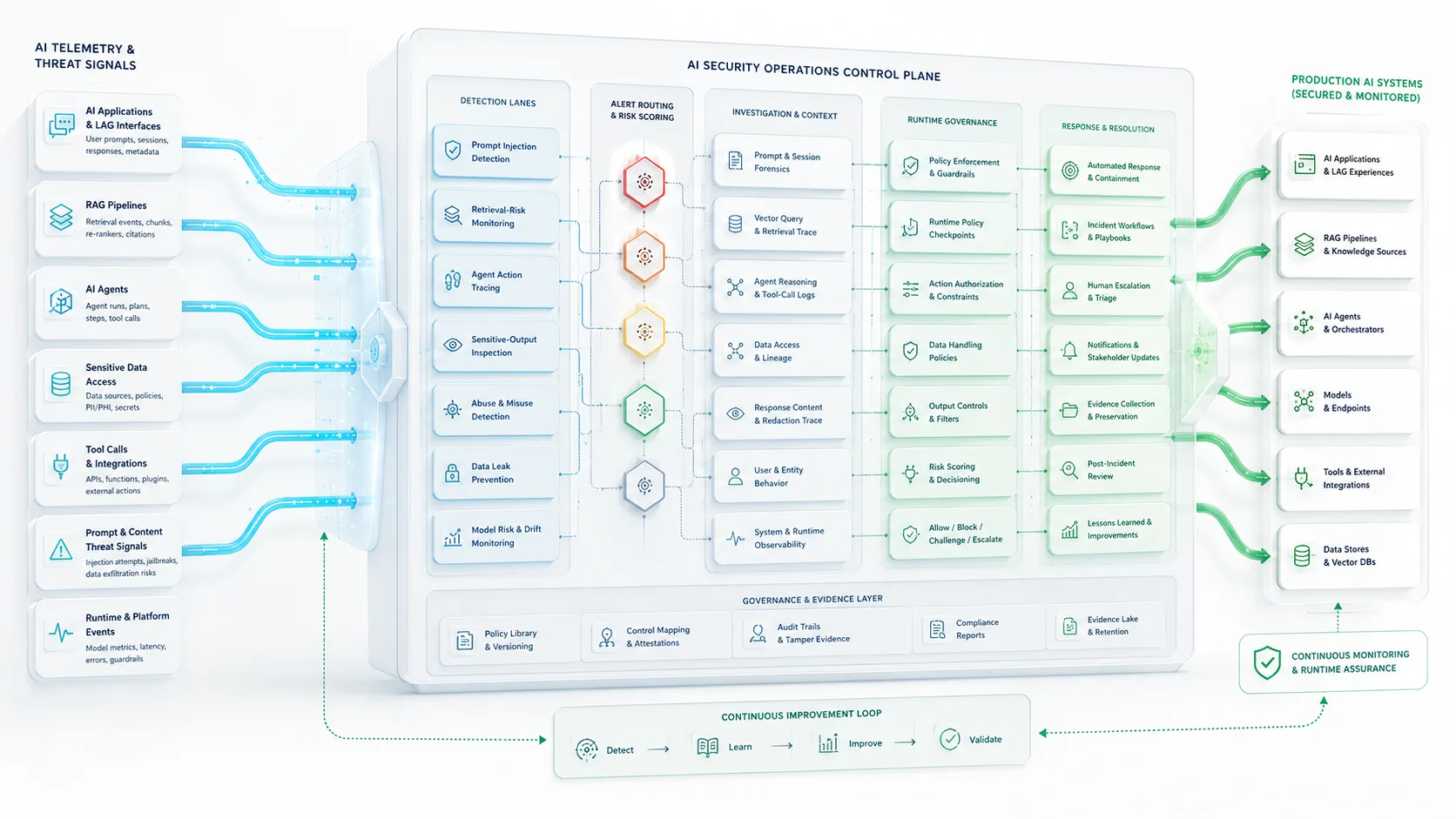
AI security operations should be designed as part of the enterprise AI infrastructure, not as a separate reporting layer. The architecture should connect AI gateways, model endpoints, RAG pipelines, vector databases, agent orchestration, identity systems, SIEM platforms, observability tools, governance workflows, and incident response processes.
Reference AI Security Operations Layers
AI Events Should Map to Business Risk
Not every AI security signal has the same severity. A failed jailbreak attempt against a low-risk internal assistant is different from an unauthorized retrieval event in a regulated customer workflow. AI security operations should classify alerts by data sensitivity, user impact, autonomy level, business function, and compliance exposure.
AI Security Must Integrate With Existing SOC Workflows
AI security operations should not create an isolated AI-only control room. The right architecture feeds AI-native events into existing security operations workflows while preserving enough AI-specific context for investigation and response.
Key Takeaways
- ✓ AI security operations gives enterprises continuous visibility into AI threats, misuse, policy violations, and production AI risk.
- ✓ Traditional SOC telemetry is not enough because AI systems introduce prompt, retrieval, model behavior, and agent action risks.
- ✓ Effective AI threat detection requires signals from prompts, responses, retrieval, identities, model versions, tool calls, policies, and user feedback.
- ✓ AI incident response must reconstruct the full AI workflow from user intent to retrieved context, model output, tool action, and business impact.
- ✓ AI security operations should improve controls continuously through better evaluation, governance, observability, and secure LLMOps practices.
Prompt Injection Detection in Production
Prompt injection detection is a core capability of AI security operations. Attackers may attempt to override instructions, reveal hidden prompts, extract sensitive context, bypass policy, manipulate retrieval, or force tools to execute unsafe actions. These attempts can arrive through direct user prompts or indirect content inside documents, emails, tickets, web pages, or knowledge bases.
Direct Prompt Attack Monitoring
Direct prompt attacks occur when users explicitly attempt to bypass system rules. Detection should monitor language patterns associated with instruction override, hidden prompt extraction, role manipulation, refusal bypass, and policy evasion.
Indirect Prompt Attack Monitoring
Indirect prompt attacks occur when malicious instructions are embedded inside retrieved or external content. RAG systems and agents are especially exposed because they consume documents and context from multiple sources. AI security operations should inspect retrieved context before it influences model behavior.
Detection Principle
Prompt injection detection should monitor both what users ask and what retrieved content instructs the model to do.
RAG Security Monitoring and Retrieval Risk
RAG systems create powerful enterprise AI experiences, but they also introduce retrieval risk. If retrieval is not monitored, AI systems may expose restricted documents, use stale policies, retrieve low-authority sources, or generate answers from context that should never have been included. AI security operations must treat retrieval as a security-critical layer.
Unauthorized Context Detection
Security teams should monitor whether users are receiving answers based on documents they are not authorized to access. This requires correlating retrieval events with identity, role, data classification, document permissions, and final response generation.
Suspicious Retrieval Patterns
Repeated broad queries, attempts to enumerate sensitive records, unusual semantic searches, or retrieval spikes from specific users can indicate abuse. AI security operations should detect these patterns before they become data exposure incidents.
RAG Security Guardrail
A secure RAG system must prove not only that its answers are useful, but that the sources behind those answers are authorized, relevant, current, and safe to use.
Agentic AI Security Operations
AI agents require stronger security operations because they can take actions, not just generate responses. An agent may call APIs, update records, send messages, create tickets, trigger workflows, or coordinate with other systems. Every agent action should be observable, governed, and recoverable.
Tool-Call Monitoring
Track which tools agents call, what arguments they pass, whether permissions were checked, and whether the action was approved.
Autonomy Boundary Alerts
Detect when agents attempt actions outside approved scope, skip approval gates, repeat failed tasks, or escalate incorrectly.
Human Review Routing
Route high-risk actions to human reviewers with context, evidence, risk level, and recommended containment options.
Autonomous Systems Need Operational Guardrails
The more autonomy an AI system has, the more security operations it needs. Enterprises should monitor planning quality, tool choice, permission checks, state transitions, fallback behavior, and rollback requirements for every production agent workflow.
AI Incident Response Playbooks
AI incident response requires specialized playbooks because AI failures are not always infrastructure failures. An incident may involve unsafe output, sensitive data disclosure, retrieval poisoning, prompt injection, unauthorized tool use, model drift, cost spikes, or harmful automation. Each scenario requires a different response path.
Sensitive Data Exposure
Contain output, identify exposed sources, review access controls, notify stakeholders, and update retrieval filters.
Prompt Injection Attempt
Preserve evidence, classify attack path, block pattern, test controls, and update evaluation datasets.
Unsafe Agent Action
Pause workflow, review tool-call trace, reverse action where possible, tighten permissions, and add approval gates.
Model Behavior Degradation
Compare model versions, review prompt changes, run regression evaluations, and roll back if reliability falls.
Common Mistakes
Many enterprises secure AI systems at design time but fail to operate them securely after launch. AI security operations closes that gap by making AI risk visible, measurable, and actionable in production.
- Monitoring only application logs. AI incidents require prompt, retrieval, model, tool-call, policy, and user-context telemetry.
- Treating prompt injection as a one-time test. Prompt attacks evolve continuously and must be monitored in production.
- Ignoring RAG security signals. Retrieval can expose sensitive data even when the model and application infrastructure appear healthy.
- Giving agents broad tool access. Agents should operate with scoped permissions, approval gates, and detailed execution traces.
- Separating AI security from governance. Alerts should connect to risk tiers, ownership, compliance evidence, and executive reporting.
- Failing to learn from AI incidents. Every incident should improve evaluations, prompts, policies, retrieval filters, and response playbooks.
Enterprise Architecture Perspective
From an enterprise architecture perspective, AI security operations is the runtime defense layer for enterprise AI. It connects security operations, AI observability, LLMOps, DevSecOps, governance, data protection, model lifecycle management, incident response, and business ownership. This operating model ensures that AI systems remain secure after deployment, not only during approval.
The strongest architecture treats AI security operations as part of the AI platform. Detection logic, telemetry pipelines, incident response workflows, policy enforcement, and governance evidence should be reusable across AI applications, RAG systems, agents, copilots, and autonomous workflows.
Architecture Principle
AI systems should be built so every meaningful security event can be traced, explained, contained, and converted into stronger controls.
Implementation Strategy for AI Security Operations
Enterprises should implement AI security operations in phases. The goal is not to overwhelm teams with more dashboards. The goal is to create a practical AI defense model that detects meaningful risk, supports fast investigations, and continuously improves production AI security.
Phase 1: Inventory Production AI Systems
Identify AI systems in production, including LLM applications, RAG systems, agents, model APIs, internal copilots, and third-party AI tools. Map owners, data access, model providers, user groups, risk tiers, and business impact.
Phase 2: Instrument AI Security Telemetry
Capture prompts, responses, retrieval events, model versions, tool calls, permissions, policy decisions, safety events, and feedback. Ensure sensitive telemetry is protected with retention controls, access limits, and redaction where required.
Phase 3: Build AI Detection and Response Playbooks
Define detection rules and response paths for prompt injection, unauthorized retrieval, sensitive output exposure, unsafe agent actions, suspicious usage, cost anomalies, and model behavior degradation.
Phase 4: Feed Incidents Back Into Assurance and Governance
Use security incidents to update evaluation datasets, prompt rules, retrieval filters, approval gates, tool permissions, risk tiers, and governance records. AI security operations should improve the AI control plane over time.
Implementation Checklist
Foundation
- Inventory production AI systems
- Classify AI systems by risk tier
- Map data, model, and tool dependencies
- Assign AI security ownership
Detection
- Monitor prompt injection attempts
- Trace retrieval and sensitive context events
- Capture agent tool-call telemetry
- Detect policy, safety, and output violations
Response
- Create AI incident playbooks
- Define escalation and containment paths
- Connect alerts to governance workflows
- Improve controls from incident reviews
Measuring AI Security Operations Maturity
AI security operations maturity should be measured by how well the enterprise can see, understand, respond to, and reduce AI-specific risk. A mature organization does not only define AI policy. It operates AI security with measurable telemetry, alert quality, response discipline, and continuous improvement.
Metrics to Track
How YggyTech Helps
YggyTech helps enterprises design and implement AI security operations for production AI environments. We help organizations move from static AI security policies to operational defense systems that detect, investigate, respond to, and continuously reduce AI-specific risk.
AI Security Operations Strategy
We define operating models, risk tiers, telemetry requirements, detection logic, incident response workflows, and governance integration.
AI Observability and Detection Architecture
We design prompt monitoring, retrieval security telemetry, agent traces, policy event streams, dashboards, alerts, and investigation workflows.
Secure LLMOps and Governance Integration
We connect AI security operations with LLMOps, DevSecOps, AI assurance, governance evidence, compliance reporting, and executive risk visibility.
Our expertise spans enterprise AI, cybersecurity, DevSecOps, cloud architecture, AI observability, LLMOps, AI governance, software architecture, and digital transformation. That systems-level perspective matters because AI security operations must protect the entire production AI workflow, not only the model endpoint.
Build AI Security Operations for Production-Scale AI
YggyTech helps technology leaders build AI security operations that monitor LLMs, RAG pipelines, AI agents, sensitive data, tool calls, governance events, and production AI threats with enterprise-grade visibility and control.
Talk to YggyTechFAQs About AI Security Operations
What is AI security operations?
AI security operations is the practice of continuously monitoring, detecting, investigating, responding to, and improving security across production AI systems, including LLMs, RAG pipelines, AI agents, data access, tool calls, and governance workflows.
Why do enterprises need AI security operations?
Enterprises need AI security operations because AI systems can be manipulated, misused, or degraded after deployment. Production AI requires ongoing visibility into prompts, retrieval, model behavior, agent actions, policy events, and sensitive data exposure.
How is AI security operations different from traditional SOC monitoring?
Traditional SOC monitoring focuses on infrastructure, endpoints, networks, identities, and applications. AI security operations adds AI-native telemetry such as prompts, model outputs, retrieved context, vector queries, tool calls, agent decisions, safety events, and AI governance evidence.
What should AI security operations monitor?
AI security operations should monitor prompt injection attempts, sensitive output events, unauthorized retrieval, suspicious vector queries, agent tool calls, permission checks, policy violations, model changes, unusual usage patterns, and AI incident response workflows.
How can enterprises start building AI security operations?
Enterprises should start by inventorying production AI systems, defining risk tiers, instrumenting AI telemetry, creating AI threat detection rules, building incident response playbooks, and connecting AI security signals to governance and SOC workflows.

Mason Carter
Cloud & Infrastructure Engineer
Mason focuses on scalable cloud ecosystems, DevOps modernization, and secure distributed infrastructure. His insights at YGGY Tech explore resilient architecture design, Kubernetes operations, cybersecurity strategy, and enterprise scalability.