Enterprise AI Infrastructure: The Architecture Foundation for Scalable Production AI
Enterprise AI infrastructure gives organizations the technical foundation to build, deploy, govern, monitor, and scale AI systems beyond experimentation. As AI moves into critical workflows, infrastructure becomes the difference between isolated pilots and reliable production AI.
Why Enterprise AI Infrastructure Matters
Most enterprises are no longer asking whether AI can create value. They are asking whether AI can operate securely, reliably, and economically across real business systems. That shift changes the role of infrastructure. AI infrastructure is not only about GPUs or model APIs. It includes data pipelines, model serving, retrieval layers, orchestration systems, observability, governance, access control, security, cost management, and operational reliability.
Enterprise AI infrastructure is the architecture layer that turns AI capability into production capacity. Without it, teams build disconnected proofs of concept that are difficult to secure, monitor, scale, or govern. With it, enterprises can deliver AI systems that are repeatable, compliant, observable, and aligned with business outcomes.
Key Insight
Enterprise AI does not scale because a model is powerful. It scales when the infrastructure around the model can manage data, security, governance, latency, cost, reliability, and continuous improvement.
What Enterprise AI Infrastructure Actually Is
Enterprise AI infrastructure is the collection of cloud, data, compute, security, orchestration, monitoring, and governance systems required to run AI workloads in production. It supports multiple AI patterns: predictive models, generative AI applications, RAG systems, AI agents, internal copilots, workflow automation, computer vision, recommendation systems, and decision-support platforms.
The infrastructure must serve both engineering and executive needs. Engineering teams need repeatable deployment pipelines, reliable model serving, scalable retrieval, robust observability, and secure integrations. Executives need governance, cost visibility, risk control, compliance readiness, and measurable business impact. A mature enterprise AI infrastructure brings these needs into one architecture.
Compute Foundation
Provides scalable GPU, CPU, inference, batch-processing, and workload orchestration capacity for AI systems.
Data Foundation
Connects structured, unstructured, streaming, vector, and governed data sources to AI applications.
Operational Foundation
Supports monitoring, incident response, deployment control, reliability engineering, and lifecycle management.
Governance Foundation
Enforces access control, auditability, model risk management, policy checks, and compliance evidence.
Why Traditional Cloud Infrastructure Is Not Enough
Cloud infrastructure gives enterprises compute, storage, networking, security primitives, and deployment services. AI infrastructure builds on that foundation but adds requirements that traditional application platforms were not designed to handle. AI systems depend on model behavior, prompt versions, embeddings, retrieval quality, data freshness, inference cost, vector search, evaluation pipelines, and unpredictable user interaction patterns.
A standard web application may fail through downtime, latency, or errors. An AI system can fail while appearing technically healthy. It may return a fluent but incorrect answer, retrieve unauthorized data, exceed token budgets, drift in quality, or allow an agent to take an unsafe action. Enterprise AI infrastructure must be designed for these failure modes from the beginning.
Enterprise Signal
AI infrastructure becomes business-critical when AI systems access enterprise data, influence decisions, interact with customers, trigger workflows, or operate inside regulated environments.
From Application Hosting to AI Workload Orchestration
Traditional cloud platforms host applications. Enterprise AI infrastructure orchestrates workloads across models, prompts, retrieval systems, evaluation services, data pipelines, security gates, and human review. This requires a more connected operating architecture.
From Static Systems to Adaptive AI Operations
AI systems change as models evolve, data changes, prompts are improved, users behave differently, and business rules shift. Infrastructure must support continuous validation, versioning, monitoring, and improvement rather than one-time deployment.
Core Layers of Enterprise AI Infrastructure
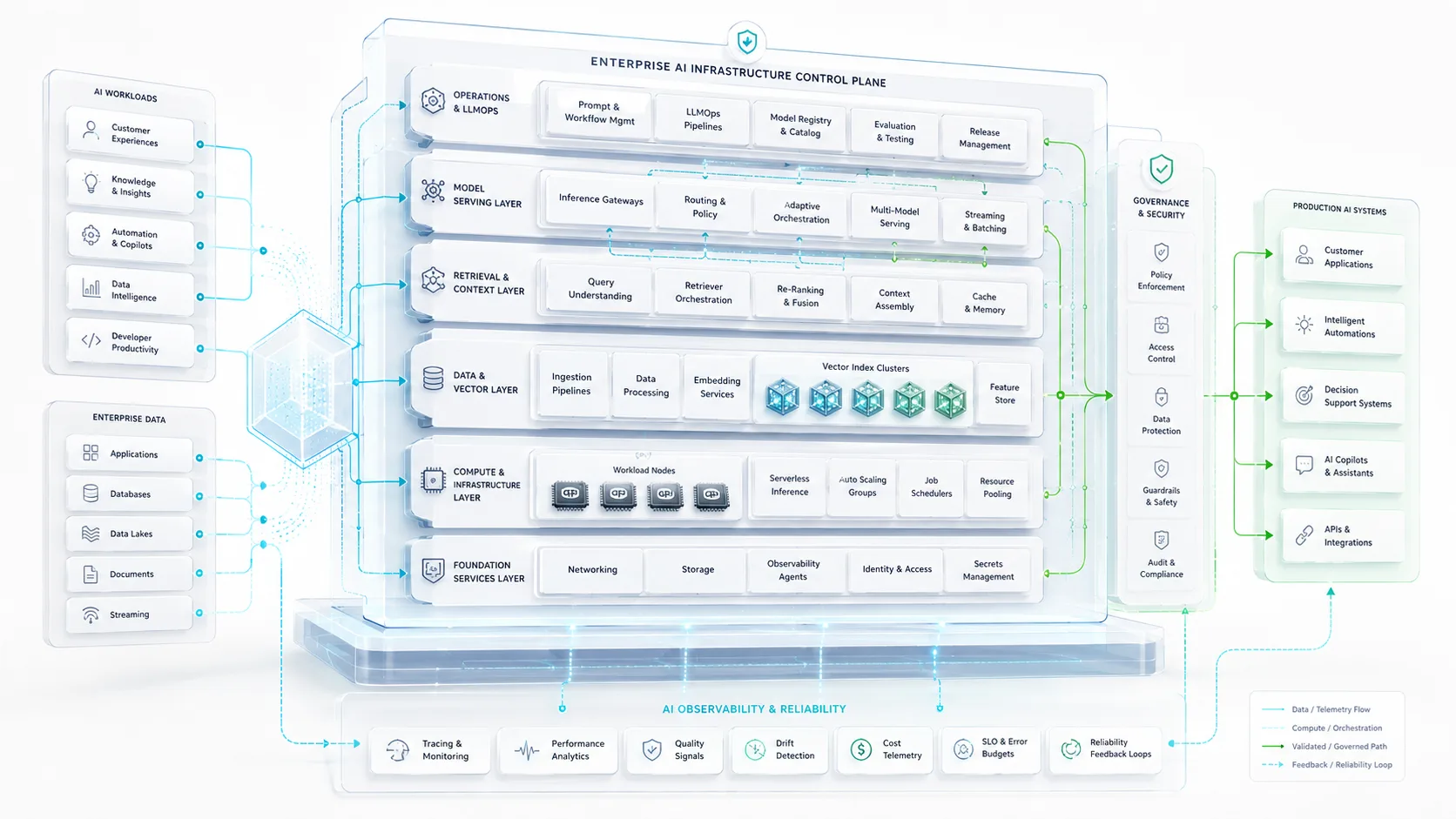
Enterprise AI infrastructure must be designed as a layered architecture. Each layer has a clear purpose, but the value comes from how they work together. Compute without governance is risky. Data without retrieval quality is unreliable. Model serving without observability is difficult to operate. Agent orchestration without permission boundaries is unsafe.
Reference Architecture Layers
Infrastructure Must Be Productized
Enterprise AI infrastructure should be delivered as a platform capability, not a collection of custom one-off systems. Teams need reusable patterns for model deployment, RAG pipelines, evaluation, governance, observability, and secure integration.
Infrastructure Must Be Governable
Every AI infrastructure layer should support control and accountability. That means access control, audit trails, approval gates, model version tracking, data lineage, and operational ownership must be built into the architecture.
Compute, Model Serving, and AI Workload Orchestration
Compute is the most visible part of AI infrastructure, but it is only one part of the system. Enterprises need infrastructure that can route workloads intelligently across different models, environments, latency requirements, and cost profiles. Some use cases need low-latency inference. Others can run asynchronously. Some require private models. Others can use managed model APIs. A mature architecture supports all of these patterns without creating operational fragmentation.
Inference Routing
Route requests based on latency, cost, privacy, model capability, availability, and workload priority.
Autoscaling and Scheduling
Scale GPU, CPU, batch, and inference workloads while controlling queue depth, concurrency, and utilization.
Cost-Aware Operations
Track token usage, model choice, cache efficiency, compute utilization, and inference economics by use case.
Operational Principle
Enterprise AI compute should be treated as a managed operating layer, not an unlimited resource. Cost, latency, availability, and workload priority must be visible and controllable.
Data Infrastructure for Enterprise AI Systems
AI infrastructure is only as useful as the data foundation behind it. Enterprises need to connect AI systems to trusted, governed, fresh, and contextually relevant data. This includes structured data from business systems, unstructured documents, knowledge bases, logs, events, customer records, code repositories, policies, and operational telemetry.
Vector Database Infrastructure
RAG systems and semantic search applications often depend on vector databases or vector-capable retrieval infrastructure. The challenge is not only storing embeddings. Enterprises must manage chunking strategies, metadata, permissions, freshness, source authority, re-indexing, retrieval evaluation, and observability.
Data Governance and Access Control
AI systems should not retrieve or generate answers from data users are not allowed to access. Permission-aware retrieval, field-level filtering, data classification, redaction, encryption, and audit logging are essential for enterprise AI infrastructure.
Data Infrastructure Guardrail
The most advanced model cannot compensate for weak data infrastructure. Production AI requires trusted data, governed access, reliable retrieval, and continuous context quality monitoring.
LLMOps, MLOps, and AI Platform Engineering
Enterprise AI infrastructure needs operational discipline across the AI lifecycle. MLOps supports model lifecycle management for traditional machine learning. LLMOps extends that discipline to prompts, retrieval systems, model APIs, evaluation datasets, agent workflows, and generative AI behavior. AI platform engineering brings these capabilities into reusable internal platforms.
Prompt and Model Versioning
Track prompt changes, model versions, evaluation results, deployment history, and rollback paths.
Evaluation Pipelines
Test model behavior, retrieval quality, safety, hallucination risk, task success, and agent actions before release.
Deployment Governance
Use approval gates, risk tiers, release policies, and audit evidence to control production AI changes.
Reusable AI Services
Provide internal teams with approved patterns for RAG, agents, model serving, evaluation, and observability.
Key Takeaways
- ✓ Enterprise AI infrastructure is the foundation that enables scalable, secure, governed, and reliable production AI systems.
- ✓ AI infrastructure includes compute, data, model serving, retrieval, LLMOps, observability, security, governance, and cost control.
- ✓ Traditional cloud infrastructure is necessary but not sufficient because AI systems introduce model behavior, retrieval, evaluation, and governance challenges.
- ✓ Data infrastructure must be governed, permission-aware, fresh, observable, and optimized for retrieval quality.
- ✓ Mature enterprises productize AI infrastructure as reusable internal platform capabilities instead of building isolated AI projects.
Security and Governance in Enterprise AI Infrastructure
AI infrastructure must be secure by design. AI systems often access sensitive data, internal tools, customer records, source code, operational systems, and business workflows. This creates a broader attack surface than traditional applications. Security must cover identity, data access, prompt injection, model endpoints, tool calls, APIs, secrets, logs, outputs, and third-party model providers.
Identity and Access
Control which users, services, models, and agents can access data, tools, workflows, and environments.
Policy Enforcement
Apply rules for data use, model behavior, tool calls, human approval, logging, retention, and compliance.
Auditability
Record model versions, prompts, retrieval sources, tool calls, approvals, outputs, and operational events.
Security Principle
AI infrastructure should treat models, agents, prompts, retrieval systems, and tool integrations as production software components with identity, permissions, monitoring, and governance.
AI Observability and Reliability Engineering
Enterprise AI infrastructure must include observability from the beginning. Teams need to monitor not only infrastructure health but also model behavior, retrieval quality, cost, latency, hallucination risk, policy violations, safety events, and business outcomes. AI observability allows organizations to detect issues, debug workflows, improve quality, and create governance evidence.
Production AI Reliability
Reliability in AI infrastructure means more than uptime. It includes response quality, retrieval consistency, safe tool execution, predictable cost, controlled latency, incident response, and continuous evaluation. A technically available AI system can still be operationally unreliable if it produces weak or unsafe outputs.
Feedback Loops
AI infrastructure should convert production signals into improvement loops. User feedback, incidents, evaluation failures, retrieval errors, and cost anomalies should inform prompt updates, model selection, data indexing, security controls, and workflow design.
Common Mistakes
Many enterprise AI initiatives struggle because infrastructure decisions are made after the prototype succeeds. Teams move quickly to prove value, but without a strong infrastructure strategy they create fragile systems that are difficult to scale or govern.
- Treating AI infrastructure as only GPU capacity. Compute matters, but production AI also needs data, governance, observability, security, and lifecycle operations.
- Building isolated AI projects. Every team creating its own stack leads to duplicated cost, inconsistent controls, and operational complexity.
- Ignoring data readiness. AI systems fail when enterprise data is stale, ungoverned, poorly indexed, or inaccessible through reliable retrieval patterns.
- Skipping AI observability. Without telemetry, teams cannot debug hallucinations, retrieval failures, cost spikes, unsafe actions, or quality drift.
- Adding governance too late. Risk controls, approvals, access policies, and audit trails must be part of the infrastructure, not manual review after launch.
- Underestimating operating cost. Model selection, token usage, retrieval design, caching, and compute utilization directly affect AI economics.
Enterprise Architecture Perspective
From an enterprise architecture perspective, AI infrastructure is a business operating platform. It connects cloud architecture, data engineering, security, DevSecOps, platform engineering, governance, observability, and product delivery. The goal is not to create a separate AI island. The goal is to integrate AI capabilities into the enterprise technology operating model.
The strongest AI infrastructure strategies balance standardization and flexibility. Teams should have approved patterns, reusable services, and governance controls, while still being able to select the right model, retrieval approach, workflow pattern, and deployment model for each use case.
Architecture Principle
Enterprise AI infrastructure should be designed as a governed platform layer that gives teams speed without sacrificing security, reliability, cost control, or operational accountability.
Implementation Strategy for Enterprise AI Infrastructure
Enterprises should build AI infrastructure in phases. The right path is not to build every capability at once. The right path is to create a reliable foundation, prioritize high-value use cases, standardize reusable patterns, and mature the platform as adoption grows.
Phase 1: Inventory AI Use Cases and Infrastructure Gaps
Map current AI pilots, production systems, data dependencies, security risks, model providers, tooling, compute usage, and governance gaps. This gives leaders visibility into where infrastructure is fragmented.
Phase 2: Define the Enterprise AI Platform Blueprint
Design target architecture across compute, model serving, RAG, vector infrastructure, LLMOps, MLOps, observability, security, governance, and developer workflows. Define which capabilities are centralized and which remain team-specific.
Phase 3: Build Reusable Infrastructure Patterns
Create approved patterns for common AI workloads: internal copilots, RAG assistants, AI agents, model APIs, evaluation pipelines, prompt management, monitoring, and secure tool integrations.
Phase 4: Operationalize Governance and Observability
Connect AI infrastructure to monitoring, cost telemetry, incident response, audit trails, risk reviews, and executive reporting. This turns infrastructure from a technical platform into an enterprise operating capability.
Implementation Checklist
Foundation
- Inventory AI workloads and pilots
- Map compute and data dependencies
- Define AI infrastructure ownership
- Classify AI use cases by risk and scale
Platform
- Build model serving patterns
- Standardize RAG infrastructure
- Create evaluation pipelines
- Implement AI observability and telemetry
Governance
- Enforce access control and audit logs
- Define release and approval gates
- Track cost, risk, and reliability
- Review incidents and improve controls
Measuring Enterprise AI Infrastructure Maturity
AI infrastructure maturity should be measured by the organization’s ability to deploy, scale, govern, monitor, and improve AI systems consistently. A mature enterprise does not only have model access. It has repeatable infrastructure capabilities that reduce delivery friction and operational risk.
Metrics to Track
How YggyTech Helps
YggyTech helps enterprises design, implement, and scale enterprise AI infrastructure with architecture-first discipline. We help organizations move from fragmented AI pilots to production-ready AI platforms that are secure, observable, governed, cost-aware, and ready for operational scale.
AI Infrastructure Strategy
We assess AI readiness, map infrastructure gaps, define platform blueprints, and create enterprise AI architecture roadmaps.
Platform and LLMOps Architecture
We design model serving, RAG infrastructure, vector search, prompt management, evaluation pipelines, agent orchestration, and AI observability.
Governance and Scale
We integrate AI infrastructure with security, DevSecOps, cloud operations, governance, monitoring, cost control, and executive reporting.
Our expertise spans enterprise AI, cloud architecture, LLMOps, MLOps, DevSecOps, cybersecurity, AI governance, software architecture, platform engineering, and digital transformation. That systems-level perspective matters because scalable AI infrastructure is not built around a single model. It is built around the enterprise operating system for production AI.
Build the Infrastructure Foundation for Production AI
YggyTech helps technology leaders build enterprise AI infrastructure that connects compute, data, model serving, LLMOps, governance, observability, security, and scalable AI operations into one production-ready architecture.
Talk to YggyTechFAQs About Enterprise AI Infrastructure
What is enterprise AI infrastructure?
Enterprise AI infrastructure is the architecture foundation required to build, deploy, secure, govern, monitor, and scale AI systems in production. It includes compute, data, model serving, LLMOps, MLOps, observability, security, governance, and cost control.
Why is enterprise AI infrastructure important?
Enterprise AI infrastructure is important because AI systems need more than model access. They need secure data access, reliable retrieval, scalable deployment, monitoring, evaluation, governance, cost visibility, and operational ownership to work in production.
What should enterprise AI infrastructure include?
It should include compute orchestration, model serving, data pipelines, vector databases, RAG infrastructure, prompt management, model registries, evaluation pipelines, AI observability, access control, security, governance, and incident response.
How is AI infrastructure different from cloud infrastructure?
Cloud infrastructure provides the general compute, storage, networking, and security foundation. AI infrastructure adds model lifecycle management, inference routing, vector search, retrieval quality, prompt management, evaluation, AI observability, governance, and AI-specific cost controls.
How should enterprises start building AI infrastructure?
Enterprises should start by inventorying AI use cases, mapping data and compute dependencies, defining governance requirements, standardizing deployment patterns, building observability, and creating reusable AI platform capabilities for production teams.

Ethan Brooks
Senior AI Systems Strategist
Ethan specializes in enterprise AI architecture, scalable automation systems, and intelligent workflow optimization. At YGGY Tech, he writes about practical AI implementation, cloud-native systems, and how modern businesses can eliminate operational fragmentation through intelligent infrastructure.