Enterprise AI Reference Architecture: How Organizations Design Governed, Scalable, Production-Ready AI Systems
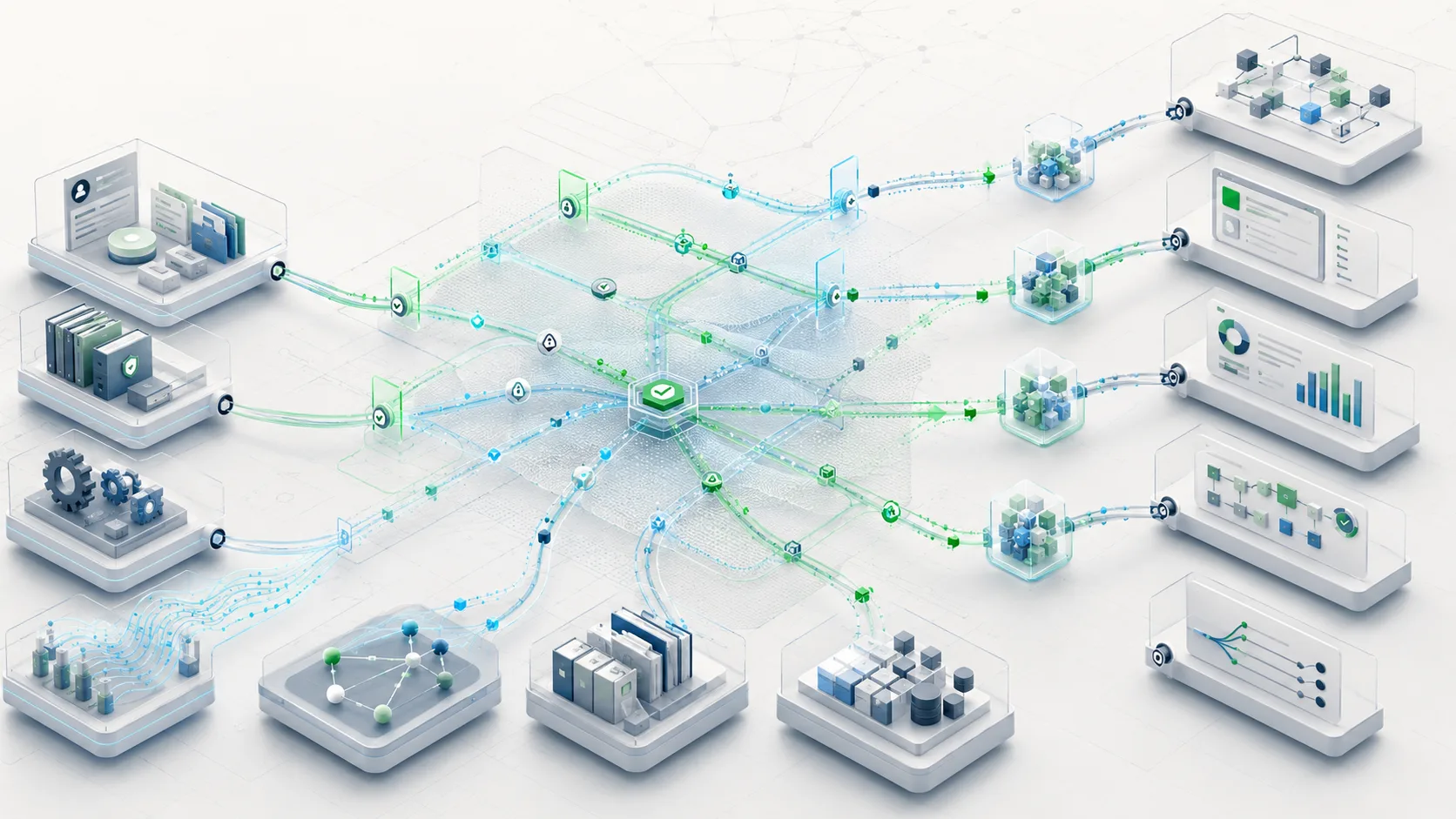
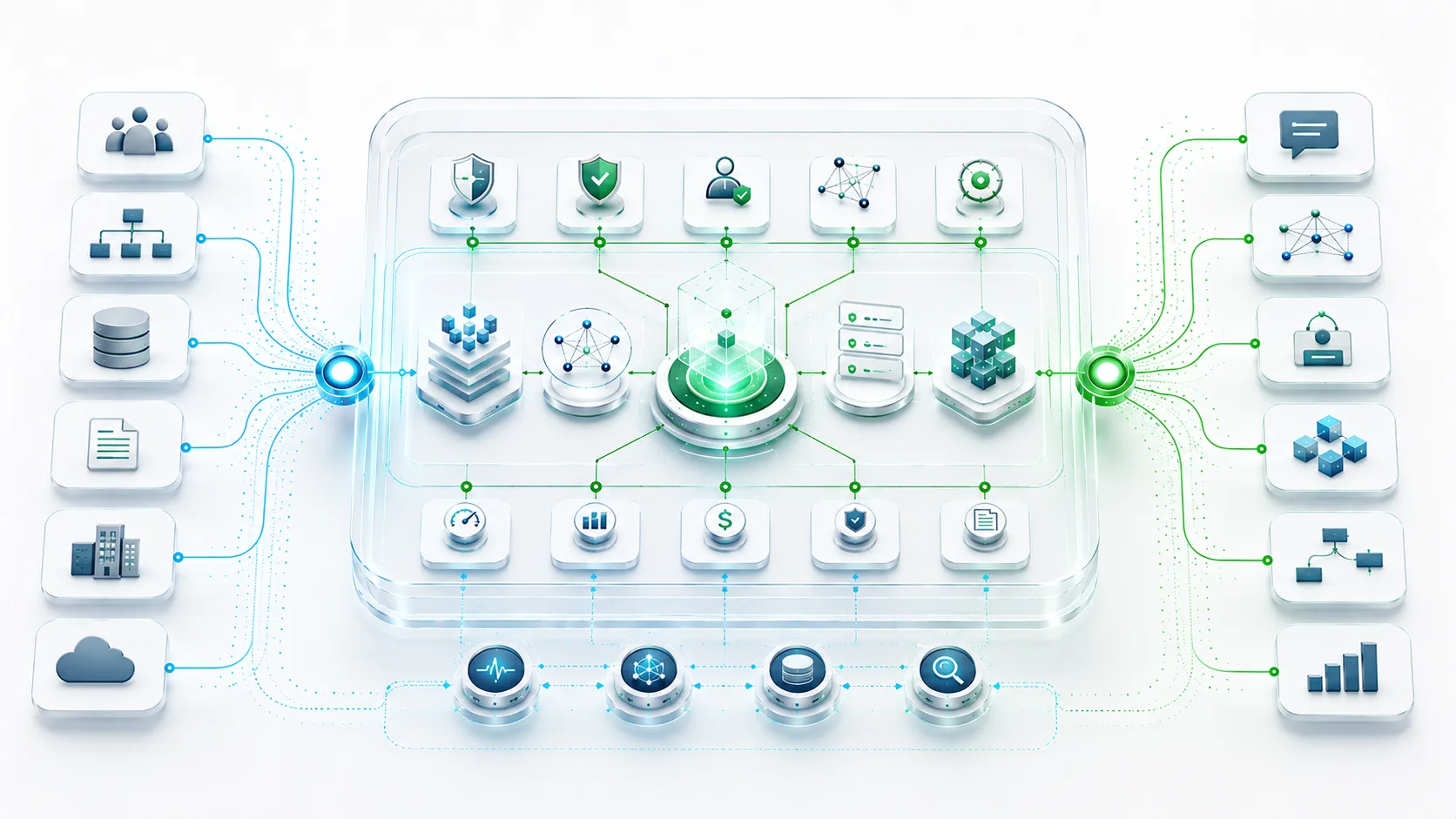
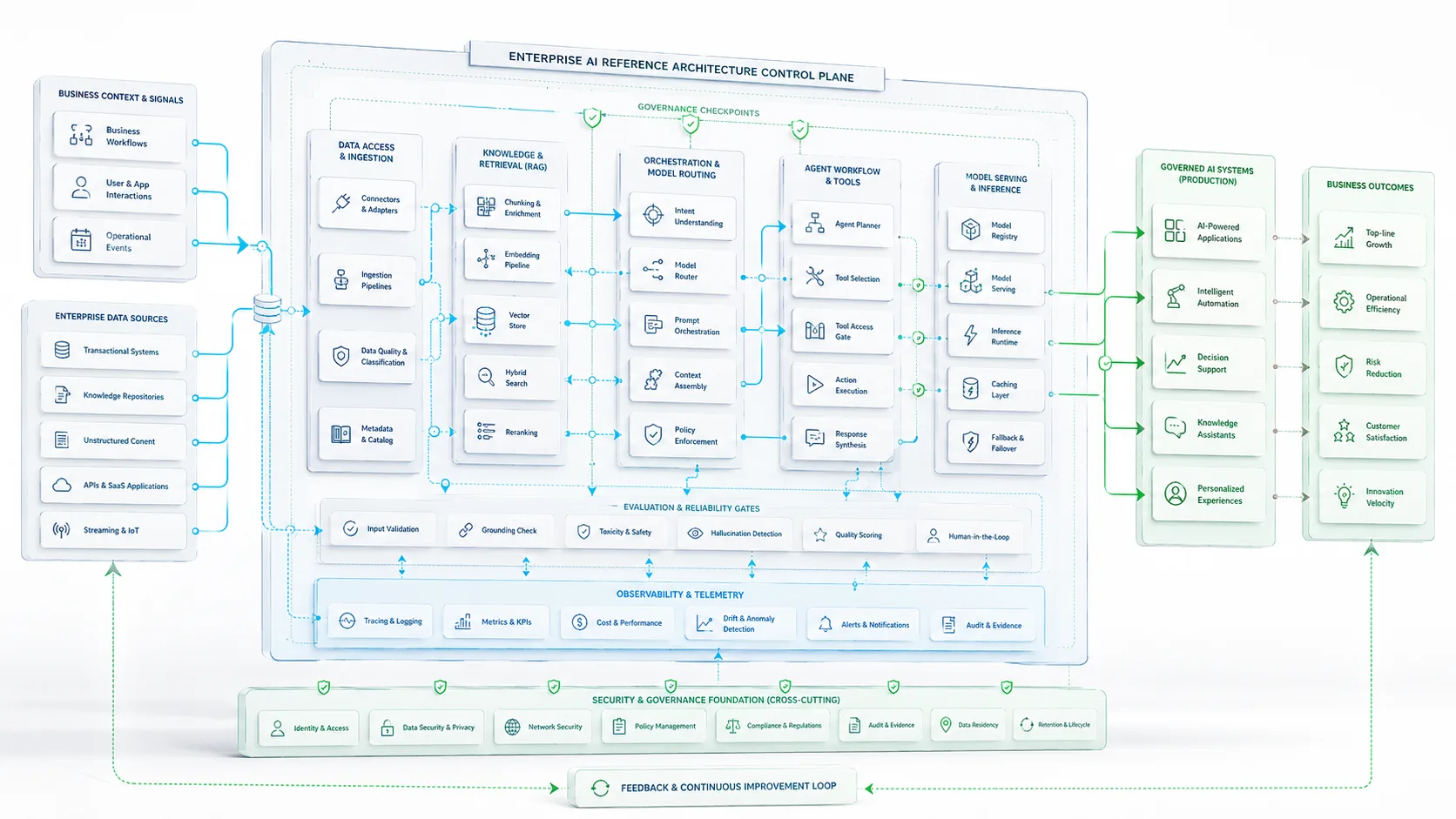
Enterprise AI reference architecture gives organizations a practical blueprint for moving from fragmented AI pilots to governed, scalable, observable, and production-ready AI systems. It connects business use cases, enterprise data, LLMs, RAG pipelines, AI agents, model serving, security, governance, and operations into one coherent architecture.
Why Enterprise AI Reference Architecture Matters
Most enterprises do not fail at AI because they lack access to models. They fail because AI adoption spreads faster than architecture discipline. Teams build isolated copilots, disconnected RAG systems, standalone agent workflows, direct model integrations, and proof-of-concept automations without a shared foundation for governance, security, observability, data access, and production operations.
Enterprise AI reference architecture solves that problem by defining the core layers every production AI system needs. It gives technology leaders a repeatable way to design AI systems that are useful, secure, scalable, measurable, and aligned with business accountability. Instead of treating every AI use case as a separate technical experiment, organizations can build a reusable operating architecture for enterprise intelligence.
Key Insight
Enterprise AI becomes scalable when organizations stop building isolated AI features and start designing a shared architecture for data, models, orchestration, governance, security, observability, and operations.
What Enterprise AI Reference Architecture Actually Is
Enterprise AI reference architecture is a structured design model for building production AI systems across the enterprise. It defines how AI use cases connect to business workflows, data sources, knowledge systems, model providers, retrieval pipelines, agent orchestration, model serving, evaluation, observability, access control, policy enforcement, and operational support.
The architecture is not a single product, framework, or diagram. It is a systems blueprint. It gives enterprises a common language for deciding where AI workloads run, how data enters AI workflows, which models are used, how outputs are validated, how agents access tools, how risks are governed, and how production behavior is monitored over time.
Business Architecture
Defines use cases, ownership, value streams, workflow integration, success metrics, and AI operating responsibilities.
Technical Architecture
Connects data platforms, models, RAG pipelines, agents, APIs, model serving, cloud infrastructure, and deployment workflows.
Governance Architecture
Applies risk tiers, policy checks, data permissions, model evaluation, human approvals, and audit evidence.
Operations Architecture
Enables observability, incident response, cost management, reliability engineering, lifecycle ownership, and continuous improvement.
Why AI Pilots Break Without Architecture
AI pilots often work because they operate in narrow environments with limited users, curated data, manual review, and forgiving performance expectations. Production AI is different. It must operate across real business workflows, messy data, user permissions, compliance requirements, changing model behavior, latency constraints, security boundaries, and executive accountability.
Without a reference architecture, teams make inconsistent decisions. One team connects directly to a model API. Another creates an isolated vector database. Another stores prompts in code. Another logs sensitive data. Another builds an agent with broad tool access. Each choice may seem reasonable locally, but together they create an enterprise AI environment that is difficult to govern, secure, monitor, scale, and improve.
Enterprise Signal
AI moves from experiment to enterprise capability when architecture decisions become reusable, governed, observable, and aligned with business risk.
From Isolated Use Cases to Shared AI Platform Capabilities
Enterprises should avoid rebuilding the same AI foundations repeatedly. Authentication, model routing, prompt management, retrieval controls, evaluation, observability, guardrails, and audit trails should be reusable across use cases.
From Model Experiments to Production Operating Models
Production AI requires ownership. Teams must know who owns the use case, data, model behavior, security controls, support path, cost budget, governance evidence, and improvement cycle.
Core Layers of an Enterprise AI Reference Architecture
A strong enterprise AI reference architecture is layered. Each layer handles a different responsibility, but all layers must operate together. The objective is not architectural complexity. The objective is controlled scalability: the ability to add more AI use cases without multiplying risk, cost, and operational fragmentation.
Reference Architecture Layers
Architecture Should Separate Concerns
The user experience should not directly manage model selection, retrieval rules, security checks, or cost controls. A clean architecture separates front-end experiences from AI orchestration, model serving, data access, and governance enforcement.
Architecture Should Standardize Control Points
Enterprises need consistent control points for identity, data permissions, prompt policies, model routing, tool access, evaluation, observability, and approval gates. These controls should not be recreated inconsistently inside each AI application.
Business and Use-Case Architecture
Enterprise AI architecture should begin with business design, not model selection. Organizations need to define where AI will create measurable value, which workflows it will improve, which decisions it will support, what data it requires, and what risk level it introduces. This prevents teams from building technically interesting AI systems that do not create operational advantage.
Use-Case Classification
Classify AI systems by business value, risk tier, autonomy level, data sensitivity, user audience, and operational dependency.
Ownership Model
Assign business owners, technical owners, data owners, risk owners, support teams, and escalation paths before production.
Success Metrics
Define measurable outcomes such as resolution time, workflow completion, accuracy, cost reduction, user adoption, or revenue impact.
Business Architecture Principle
A production AI system should have a clear business owner, measurable outcome, risk classification, and operational support model before it reaches users.
Data and Knowledge Architecture
AI systems depend on data quality, access control, context relevance, and knowledge freshness. Enterprise AI architecture must define how structured data, unstructured documents, knowledge bases, logs, product data, customer records, policies, code repositories, and external sources enter AI workflows. Without this layer, AI systems produce inconsistent answers and create security exposure.
RAG and Retrieval Architecture
Retrieval-augmented generation should be designed as an enterprise knowledge architecture, not a simple vector database. Teams need ingestion pipelines, chunking strategy, metadata governance, permission-aware retrieval, source ranking, freshness controls, and citation or evidence policies.
Data Access Boundaries
AI systems must respect the same permission boundaries as enterprise applications. If a user cannot access a document, record, or workflow in the source system, the AI layer should not expose that information through retrieval, summarization, or generated output.
Data Architecture Guardrail
Enterprise AI quality is limited by the architecture of its knowledge layer. Secure, current, permission-aware, and well-governed context is a production requirement.
Model, Inference, and LLMOps Architecture
The intelligence layer of enterprise AI architecture includes model selection, model routing, inference infrastructure, prompt management, evaluation pipelines, deployment controls, fallback strategies, and cost governance. Mature enterprises avoid binding every use case directly to one model or provider. Instead, they create a model operating layer that supports flexibility, reliability, and control.
Model Routing
Route requests across models based on complexity, sensitivity, latency, cost, availability, and quality requirements.
Prompt and Version Control
Manage prompts, templates, system instructions, retrieval settings, and evaluation datasets with release discipline.
Inference Governance
Control model access, endpoint usage, latency budgets, token costs, provider routing, and fallback behavior.
Evaluation Pipelines
Test quality, safety, hallucination risk, retrieval performance, latency, regressions, and workflow reliability before release.
Key Takeaways
- ✓ Enterprise AI reference architecture gives organizations a repeatable blueprint for building governed, scalable, production-ready AI systems.
- ✓ Production AI requires more than models. It requires data architecture, orchestration, inference, security, governance, observability, and operational ownership.
- ✓ RAG systems, AI agents, LLM workflows, and copilots should share common platform capabilities instead of being built as isolated systems.
- ✓ Governance and security must be embedded into the architecture, not added manually after AI systems reach production.
- ✓ The strongest enterprise AI architecture is reusable, observable, secure, cost-aware, and aligned with business workflows.
Agentic AI and Workflow Orchestration Architecture
AI agents create a new architecture requirement because they do not only generate responses. They plan, retrieve context, call tools, update systems, coordinate workflows, and sometimes operate with partial autonomy. Enterprise AI reference architecture must define how agents are created, permissioned, monitored, evaluated, and governed before they interact with production workflows.
Agent Orchestration Layer
The agent orchestration layer manages task planning, tool selection, context sharing, state management, agent handoffs, human approval, error handling, and workflow completion. This layer should be designed with clear boundaries so agents do not become uncontrolled access paths across enterprise systems.
Tool and API Governance
Every tool available to an agent should be registered, classified, permissioned, and monitored. Read-only tools, write actions, financial systems, customer communication tools, cloud infrastructure APIs, and security workflows require different levels of control.
Agent Architecture Principle
Agentic AI should be designed as governed workflow architecture, not as unrestricted automation attached to a language model.
Governance, Risk, and Compliance Architecture
Enterprise AI architecture must include governance from the beginning. AI systems can influence customer experience, internal decisions, operations, software delivery, security workflows, and regulated processes. Governance defines which AI use cases are allowed, which controls are required, who approves them, how evidence is collected, and how accountability is maintained.
Risk Tiers
Classify AI systems by impact, autonomy, data sensitivity, user exposure, compliance requirements, and failure consequences.
Policy Gates
Enforce approval, security review, evaluation, privacy checks, and release readiness before production deployment.
Audit Evidence
Capture model versions, prompt changes, evaluation results, approval records, runtime policies, and incident history.
Security and Privacy Architecture
AI systems create new security and privacy challenges because they process prompts, retrieve enterprise knowledge, call models, access tools, generate outputs, and store traces. Enterprise AI architecture must protect sensitive data across the full workflow, from user request to model response to logs and analytics.
Identity and Access Control
Every AI system should integrate with enterprise identity. Users, services, agents, tools, and model endpoints need clear access boundaries. AI workflows should enforce least privilege and permission-aware retrieval.
Privacy and Data Minimization
Architecture should minimize sensitive data exposure in prompts, retrieval context, embeddings, traces, logs, memory, model-provider requests, and cached outputs. Privacy controls should be designed into the workflow, not handled manually later.
Security Guardrail
Enterprise AI systems should not become shortcuts around data governance, identity controls, security review, or compliance obligations.
AI Observability and Production Operations
Production AI must be observable. Enterprises need visibility into user requests, prompts, retrieved context, model responses, tool calls, latency, cost, quality, policy decisions, errors, refusals, hallucination risk, and workflow outcomes. Without observability, teams cannot explain failures, tune performance, manage cost, or build trust.
Operational Telemetry
AI architecture should capture telemetry across the full lifecycle: request entry, context assembly, model call, retrieval events, response generation, tool execution, policy checks, user feedback, and production incidents.
Continuous Improvement Loops
Production signals should feed back into prompt improvements, retrieval tuning, model routing, evaluation datasets, security rules, cost optimization, and governance controls. AI architecture should improve as it operates.
Operations Principle
A production AI system is not complete when it produces outputs. It is complete when the enterprise can monitor, evaluate, secure, improve, and support it continuously.
Common Mistakes
Many enterprise AI programs struggle because architecture decisions are made too late. By the time teams realize they need governance, observability, access control, evaluation, and cost visibility, several disconnected AI systems are already in production.
- Starting with models instead of use cases. Model selection matters, but architecture should begin with business workflows, risk, data, and measurable outcomes.
- Building isolated RAG systems. Disconnected retrieval pipelines create inconsistent data access, poor governance, and duplicated infrastructure.
- Skipping AI observability. Teams cannot improve or trust AI systems they cannot trace, monitor, evaluate, or explain.
- Adding governance after production. Risk tiers, approvals, security checks, evaluation, and audit evidence should be part of the delivery lifecycle.
- Letting agents access tools without controls. Agent workflows need identity, permission boundaries, human approval, action tracing, and rollback paths.
- Treating AI architecture as a one-time diagram. Enterprise AI architecture must evolve with production telemetry, user feedback, model changes, and operational risk.
Enterprise Architecture Perspective
From an enterprise architecture perspective, AI is not a feature layer. It is an operating capability that spans business processes, data platforms, cloud infrastructure, software systems, security architecture, governance, and organizational workflows. Enterprise AI reference architecture provides the blueprint for integrating these layers without creating unmanaged complexity.
The strongest organizations design AI as a platform capability with reusable patterns. They define how use cases are approved, how data is accessed, how models are routed, how agents are controlled, how outputs are evaluated, how incidents are handled, and how costs are managed. This turns AI from scattered experimentation into enterprise-grade technology architecture.
Architecture Principle
Enterprise AI reference architecture should make AI systems repeatable, governable, observable, secure, and aligned with business operations from the beginning.
Implementation Strategy for Enterprise AI Reference Architecture
Enterprises should implement AI reference architecture in phases. The goal is not to pause innovation until a perfect platform exists. The goal is to establish the core control points early, then mature the architecture as production demand grows.
Phase 1: Map Use Cases, Risks, and Business Ownership
Start by identifying AI use cases, business value, data needs, risk levels, user groups, workflow dependencies, ownership, and success metrics. This creates the foundation for architectural decisions.
Phase 2: Define Shared Platform Capabilities
Standardize common capabilities such as model access, RAG patterns, prompt management, evaluation, observability, security controls, policy gates, and cost tracking.
Phase 3: Build Governance and Runtime Controls
Embed risk classification, data access controls, model evaluation, agent permissions, approval workflows, audit evidence, and incident response into the AI delivery lifecycle.
Phase 4: Operationalize Continuous Improvement
Use production telemetry to improve prompts, retrieval quality, model routing, agent behavior, security rules, latency, cost, and governance policies over time.
Implementation Checklist
Foundation
- Inventory AI use cases and owners
- Classify risk tiers and data sensitivity
- Define production readiness criteria
- Establish shared AI architecture principles
Architecture
- Create AI orchestration patterns
- Standardize RAG and knowledge access
- Define model routing and inference controls
- Build reusable evaluation and observability layers
Operations
- Monitor AI quality, cost, latency, and risk
- Connect AI incidents to response workflows
- Maintain governance and audit evidence
- Improve architecture from production signals
Measuring Enterprise AI Architecture Maturity
Enterprise AI architecture maturity should be measured by how well the organization can repeatedly move AI use cases from idea to production while maintaining quality, security, governance, cost control, and operational reliability. A mature organization does not depend on heroic manual review or isolated technical teams. It relies on repeatable architecture and operating discipline.
Metrics to Track
How YggyTech Helps
YggyTech helps enterprises design AI reference architecture that connects strategy, infrastructure, software architecture, governance, security, observability, and production operations. We help organizations move beyond disconnected pilots into scalable AI systems that are engineered for enterprise use.
Enterprise AI Architecture Strategy
We define AI architecture blueprints, use-case classification, platform capabilities, governance models, and production readiness roadmaps.
AI Platform and System Design
We design RAG systems, agent workflows, inference layers, model routing, evaluation pipelines, observability, and secure LLMOps architecture.
Governance and Operations Integration
We connect AI architecture with security, compliance, risk controls, observability, incident response, cost governance, and executive reporting.
Our expertise spans enterprise AI, AI infrastructure, AI agents, LLMOps, cloud architecture, DevOps, cybersecurity, DevSecOps, software architecture, and digital transformation. That systems-level perspective matters because enterprise AI architecture is not only about integrating models. It is about designing a production operating system for intelligence across the organization.
Design Enterprise AI Architecture That Can Actually Reach Production
YggyTech helps technology leaders build enterprise AI reference architecture that connects data, models, RAG, agents, inference, governance, security, observability, and operations into production-ready AI systems.
Talk to YggyTechFAQs About Enterprise AI Reference Architecture
What is enterprise AI reference architecture?
Enterprise AI reference architecture is a structured blueprint for designing production AI systems. It defines how business use cases, data, models, RAG pipelines, AI agents, security, governance, observability, and operations work together.
Why do enterprises need an AI reference architecture?
Enterprises need an AI reference architecture to avoid fragmented pilots, inconsistent security controls, duplicated infrastructure, poor governance, weak observability, and unreliable production behavior. It creates a repeatable path from AI idea to governed production system.
What should enterprise AI architecture include?
Enterprise AI architecture should include use-case governance, data access, RAG architecture, model routing, inference infrastructure, agent orchestration, security controls, evaluation pipelines, observability, cost management, and production operations.
How is enterprise AI architecture different from AI infrastructure?
AI infrastructure focuses on the compute, data, model serving, cloud, and operational systems that run AI workloads. Enterprise AI architecture is broader because it also includes business workflows, governance, security, observability, risk management, and operating models.
How can organizations start building enterprise AI architecture?
Organizations should start by inventorying AI use cases, classifying risk, mapping data and workflow dependencies, defining shared platform capabilities, establishing governance controls, implementing observability, and creating production readiness standards.

Maheer Alishba
Data & Automation Consultant
Maheer writes about data engineering, AI-powered analytics, and intelligent business automation. Her content helps organizations understand how to transform fragmented operational data into measurable business intelligence and predictive systems.