Enterprise AI Security: How Organizations Protect AI Systems, Data, and Autonomous Workflows at Scale
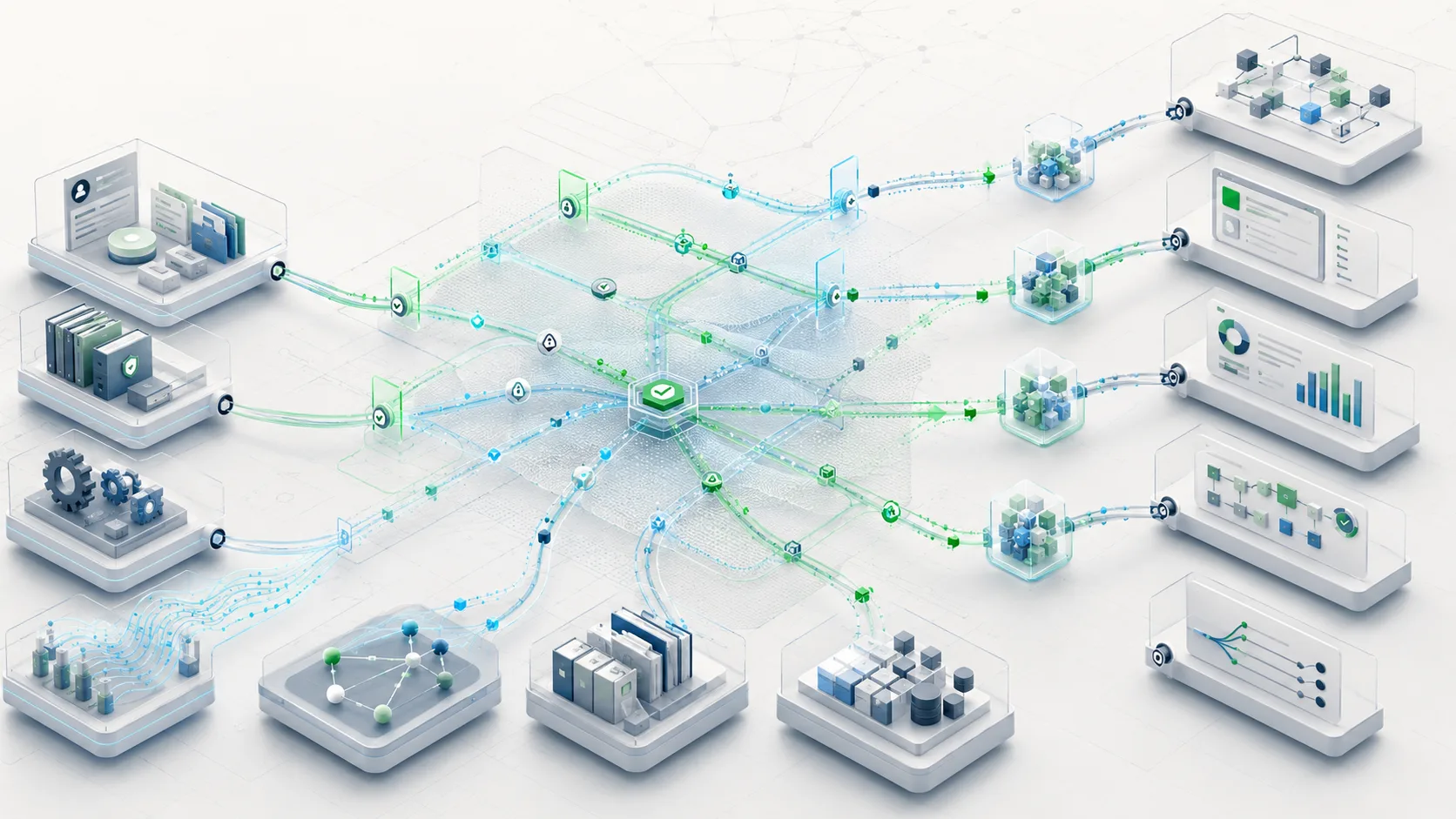
Enterprise AI security gives organizations the architecture, controls, visibility, and governance required to protect AI systems in production. As LLMs, RAG systems, AI agents, and autonomous workflows become part of business operations, security must extend beyond traditional application protection into the full AI operating layer.
Why Enterprise AI Security Matters Now
Enterprises are moving AI from experimentation into production systems that touch customer experiences, internal operations, software delivery, security workflows, financial analysis, knowledge management, and decision support. These AI systems do not operate like traditional applications. They depend on prompts, model behavior, retrieved context, third-party model providers, vector databases, tool integrations, agentic workflows, user permissions, and continuous feedback loops.
That shift expands the security surface. A production AI system can expose sensitive data through retrieval, follow malicious instructions through prompt injection, call the wrong tool, generate unsafe outputs, leak confidential context, violate compliance rules, or create untraceable automation decisions. Enterprise AI security protects against these risks by securing the entire AI lifecycle: data, models, prompts, tools, agents, infrastructure, governance, observability, and operations.
Key Insight
Enterprise AI security is not a single control. It is a layered operating model that protects how AI systems access data, reason over context, use tools, make decisions, and operate inside business workflows.
What Enterprise AI Security Actually Is
Enterprise AI security is the discipline of protecting AI systems, data pipelines, model endpoints, prompts, retrieval layers, AI agents, tool integrations, and operational workflows from misuse, leakage, manipulation, unauthorized access, unsafe behavior, and compliance failure. It combines cybersecurity, DevSecOps, AI governance, data protection, identity architecture, LLMOps, model risk management, observability, and incident response.
Traditional security protects applications, APIs, networks, users, devices, and infrastructure. Enterprise AI security adds new concerns: prompt injection, sensitive context exposure, model output risk, retrieval poisoning, unsafe tool calls, agent autonomy, model supply chain risk, evaluation gaps, and AI-specific observability. Security leaders need an architecture that treats AI systems as production software, business decision engines, and data access interfaces at the same time.
Data Protection
Protects sensitive data across prompts, retrieval, logs, memory, outputs, model calls, embeddings, and analytics.
Model and Prompt Security
Defends against prompt injection, unsafe outputs, instruction override, model misuse, and untrusted context manipulation.
Agent Control
Limits what AI agents can access, execute, automate, approve, escalate, and modify inside enterprise workflows.
Governance Evidence
Creates audit trails, policy records, risk decisions, evaluation evidence, access logs, and compliance visibility.
Why Traditional Security Is Not Enough for AI
Traditional enterprise security assumes that software behavior is mostly deterministic and that access control can be enforced around systems, APIs, users, and data. AI systems introduce probabilistic behavior, natural-language interfaces, dynamic context, model reasoning, retrieval pipelines, and agentic tool use. A malicious or careless user may not need to exploit a server vulnerability. They may simply manipulate the AI system through instructions, context, documents, or workflow ambiguity.
A secure application can still become an insecure AI system if the model receives unauthorized context, exposes confidential information, acts on untrusted instructions, or triggers tools without appropriate validation. Enterprise AI security must therefore operate at multiple levels: infrastructure, identity, data, model behavior, retrieval, orchestration, output validation, monitoring, and governance.
Enterprise Signal
AI security becomes business-critical when AI systems access enterprise knowledge, generate customer-facing outputs, support decisions, call tools, or operate with partial autonomy.
From Perimeter Security to Context Security
Traditional security protects system boundaries. AI security must also protect context boundaries. The system must know what data can enter a prompt, what context can be retrieved, what instructions can be trusted, and what outputs are safe to return.
From Access Control to Action Control
AI agents require a new security model because they can take action. Security must govern what agents can do, which tools they can call, when human approval is required, and how every action is logged, validated, and reversible.
Core Layers of Enterprise AI Security Architecture
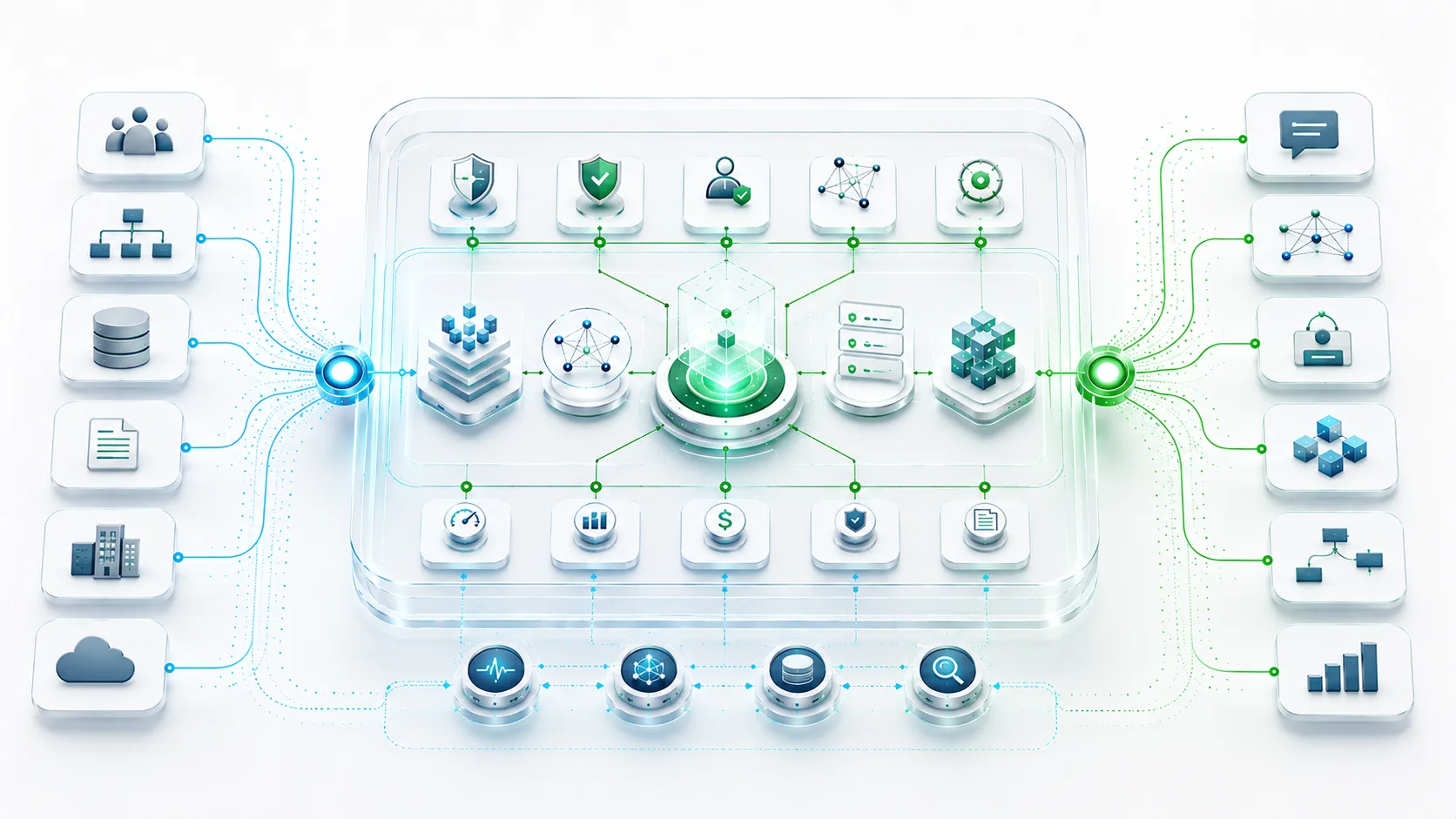
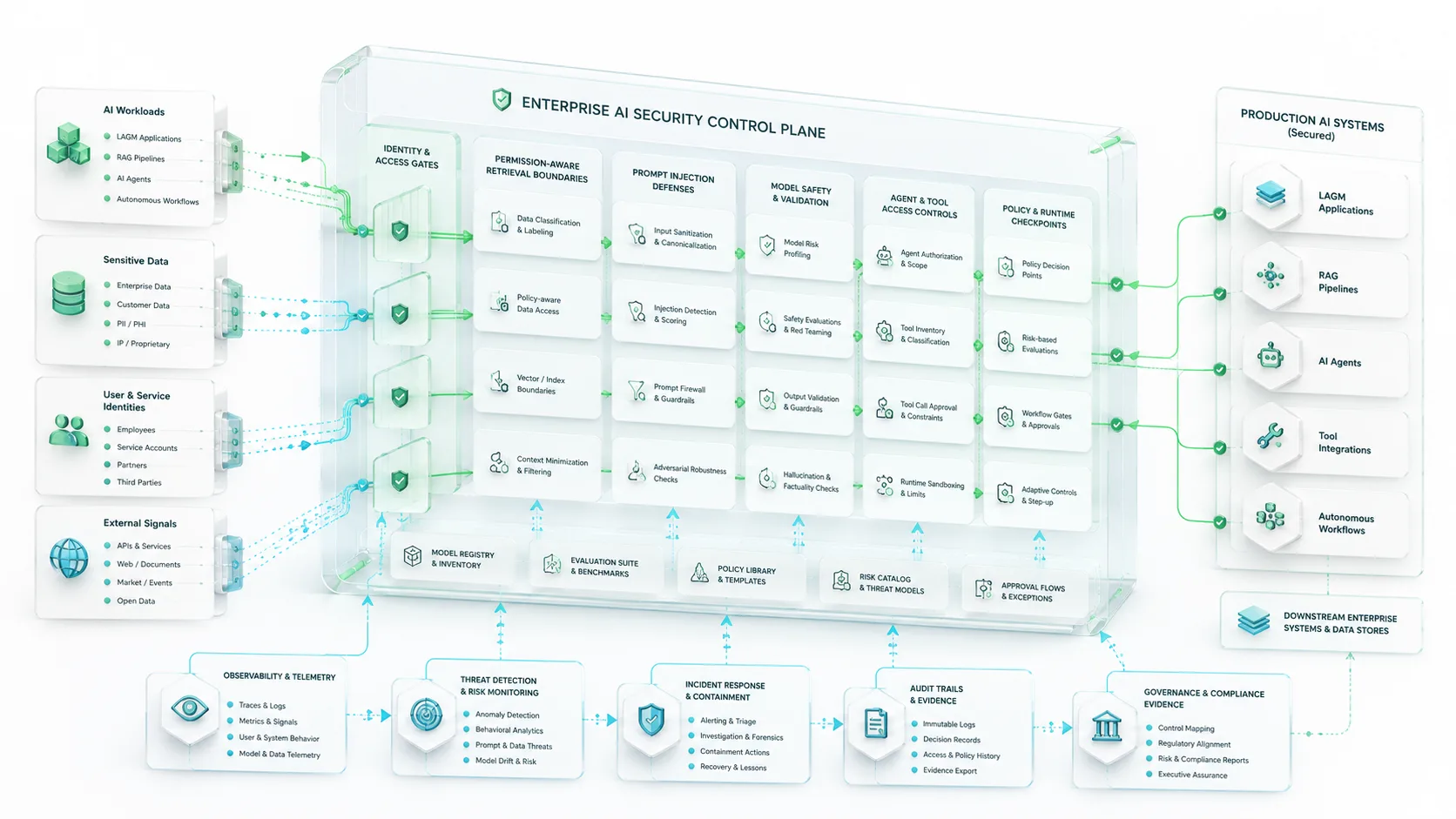
Enterprise AI security should be designed as a layered architecture. Each layer reduces a different type of risk. Together, they create a secure operating model for AI systems across development, deployment, runtime, monitoring, and governance.
Reference Security Architecture Layers
Security Must Follow the AI Workflow
AI security cannot stop at the model endpoint. Controls must follow the full workflow from user request to prompt assembly, retrieval, model generation, tool execution, output delivery, logging, and feedback. This end-to-end coverage is what makes production AI defensible.
Security Must Be Built Into LLMOps
Secure LLMOps integrates security controls into prompt versioning, model evaluation, deployment gates, retrieval testing, agent simulation, output validation, monitoring, and rollback. This turns AI security from manual review into an operational capability.
Prompt Injection and LLM Security
Prompt injection is one of the most important risks in enterprise AI security. Attackers can attempt to override system instructions, extract confidential data, manipulate outputs, bypass safety policies, or influence tool use through carefully crafted user inputs or hidden instructions inside retrieved content. This is especially dangerous in RAG systems and agentic workflows where the model consumes external context.
Instruction Hierarchy
Separate system instructions, developer instructions, user prompts, retrieved context, and tool outputs with clear priority and validation.
Context Filtering
Inspect retrieved content for malicious instructions, sensitive data, unsupported commands, and policy conflicts.
Output Validation
Validate outputs for policy compliance, sensitive disclosure, unsafe recommendations, unsupported claims, and formatting constraints.
LLM Security Principle
Never assume the model will reliably distinguish trusted instructions from untrusted context without architecture-level controls, evaluation, and monitoring.
Data Protection for Enterprise AI Systems
Data protection is central to enterprise AI security. AI systems often require access to knowledge bases, documents, customer records, internal policies, support tickets, logs, source code, contracts, and operational systems. If the data layer is not governed, the AI layer can accidentally become a powerful data exfiltration interface.
Permission-Aware Retrieval
RAG systems must retrieve only the data a user is authorized to access. Access control should apply at query time, retrieval time, and response generation time. This prevents AI systems from summarizing documents, records, or knowledge sources outside the user’s permission boundary.
Sensitive Data Handling
Enterprises should classify sensitive data before it enters AI workflows. Prompts, embeddings, logs, traces, memory stores, analytics events, and model-provider requests should be evaluated for privacy, compliance, retention, and encryption requirements.
Data Security Guardrail
AI systems should never become a shortcut around enterprise data governance. The same data access rules that apply to applications and users must apply to AI retrieval, context assembly, and generated outputs.
Agentic AI Security and Tool-Use Controls
AI agents introduce higher security stakes because they can take action. An agent may read records, update systems, create tickets, send messages, trigger workflows, call APIs, or coordinate with other agents. This means security must govern not only what the AI knows, but what it can do.
Scoped Tool Access
Agents should only access approved tools for approved workflows, with narrow permissions and contextual limits.
Human Approval Gates
High-risk actions should require human review before execution, especially for financial, legal, security, or customer-impacting workflows.
Execution Tracing
Every agent plan, tool call, argument, permission check, failure, escalation, and output should be logged for auditability.
Rollback and Recovery
Critical agent actions should have recovery paths, approval records, undo mechanisms, and incident response triggers.
Key Takeaways
- ✓ Enterprise AI security protects AI systems across data, prompts, models, retrieval, agents, tools, infrastructure, and governance.
- ✓ Traditional security is necessary but not sufficient because AI introduces context risk, prompt injection, model behavior risk, and autonomous tool-use risk.
- ✓ Secure AI architecture must enforce identity, data protection, retrieval permissions, model safety, tool controls, observability, and auditability.
- ✓ AI agents require action-level security, including scoped permissions, approval gates, execution tracing, and recovery mechanisms.
- ✓ AI security must be integrated into LLMOps, DevSecOps, AI observability, governance, and incident response instead of being added after deployment.
AI Observability for Security Monitoring
AI security requires observability. Security teams need visibility into prompts, responses, retrieval events, model versions, tool calls, policy violations, sensitive data exposure, agent decisions, user feedback, and incident signals. Without AI observability, enterprises cannot detect whether AI systems are being manipulated, misused, or degraded.
Runtime Policy Events
AI security monitoring should track policy events such as blocked prompts, sensitive output attempts, unauthorized retrieval, suspicious tool calls, repeated refusal patterns, and unusual workflow behavior. These signals help security teams identify abuse and improve controls.
AI Incident Response
When an AI incident happens, teams must reconstruct what occurred: who submitted the request, which prompt version was used, what context was retrieved, which model responded, what tools were called, what output was delivered, and which controls fired. Observability turns AI security events into actionable investigations.
Monitoring Principle
If an enterprise cannot trace how an AI system reached an output or action, it cannot confidently secure, audit, or improve that system.
Common Mistakes
Many enterprises underestimate AI security because early AI systems feel like productivity tools rather than production systems. But once AI touches enterprise data, customer workflows, code, operations, or automation, it must be secured with the same rigor as critical software infrastructure.
- Treating AI security as model security only. Real risk often comes from retrieval, data access, prompts, tools, logs, agents, and workflow design.
- Ignoring prompt injection. AI systems that consume user input or external documents must defend against malicious instructions and context manipulation.
- Allowing broad agent permissions. AI agents should not inherit excessive access or execute high-risk actions without approval and traceability.
- Logging sensitive prompts without controls. AI logs, traces, prompts, embeddings, and analytics can become privacy and compliance risks if not protected.
- Adding governance after deployment. Risk tiers, approvals, audit trails, and security gates must be part of the AI delivery lifecycle.
- Skipping AI incident response planning. Teams need clear playbooks for AI misuse, data leakage, unsafe outputs, retrieval failures, and agent errors.
Enterprise Architecture Perspective
From an enterprise architecture perspective, AI security is a control plane across the AI operating model. It connects cloud infrastructure, identity, data governance, LLMOps, DevSecOps, AI observability, model risk management, compliance, incident response, and business ownership. The strongest security programs do not isolate AI risk inside one team. They embed AI controls into how the enterprise builds and operates technology.
This matters because AI systems are cross-functional by nature. A customer support assistant may depend on product documentation, CRM data, support policies, model APIs, vector databases, ticketing tools, authentication systems, and human escalation workflows. Securing only one component is not enough. The architecture must secure the entire chain of data, reasoning, action, and accountability.
Architecture Principle
Enterprise AI security should be designed as a governed architecture layer that gives teams speed without sacrificing data protection, control, auditability, or operational trust.
Implementation Strategy for Enterprise AI Security
Enterprises should implement AI security in phases. The objective is to enable AI adoption safely, not block it with unclear policy. A practical AI security strategy defines risk tiers, secures core infrastructure, standardizes reusable controls, and continuously improves from production telemetry.
Phase 1: Inventory AI Systems and Risk Exposure
Identify where AI is being used, which models are involved, what data is accessed, which tools are connected, who owns the system, and what business impact exists if the system fails or is misused.
Phase 2: Define AI Security Controls by Risk Tier
Low-risk internal assistants may require basic monitoring and data controls. High-risk AI agents, customer-facing systems, regulated workflows, and sensitive-data use cases require stronger evaluation, approval, access control, auditability, and incident response.
Phase 3: Integrate Security Into LLMOps and DevSecOps
Add AI security checks to development pipelines, prompt versioning, model evaluation, RAG testing, agent simulation, deployment gates, runtime monitoring, and rollback workflows.
Phase 4: Monitor, Audit, and Improve Continuously
Use production telemetry, incidents, user feedback, evaluation failures, and policy events to improve controls, test sets, prompts, retrieval filters, tool permissions, and governance workflows.
Implementation Checklist
Foundation
- Inventory AI systems and model providers
- Classify AI use cases by risk tier
- Map data, tools, and workflow access
- Assign business and technical owners
Controls
- Enforce permission-aware retrieval
- Add prompt injection defenses
- Scope agent tool permissions
- Validate outputs and high-risk actions
Operations
- Monitor AI security telemetry
- Create AI incident response playbooks
- Maintain audit evidence and policy logs
- Improve controls from production signals
Measuring Enterprise AI Security Maturity
AI security maturity should be measured by how well the enterprise can prevent, detect, investigate, and improve AI-related risks. A mature organization does not only publish AI policies. It operates AI security as a measurable engineering and governance capability.
Metrics to Track
How YggyTech Helps
YggyTech helps enterprises design, implement, and scale AI security architecture with an infrastructure-first and governance-aware approach. We help organizations move from informal AI adoption to production AI systems that are secure, observable, auditable, and aligned with enterprise risk requirements.
AI Security Strategy
We assess AI risk exposure, define security architecture, classify use cases, map control requirements, and create enterprise AI security roadmaps.
Secure LLMOps and Agent Architecture
We design prompt security, RAG controls, agent permissions, evaluation gates, model governance, output validation, and secure deployment patterns.
Governance and Operations Integration
We connect AI security with DevSecOps, cloud security, AI observability, incident response, compliance evidence, and executive risk reporting.
Our expertise spans enterprise AI, cybersecurity, DevSecOps, cloud architecture, LLMOps, AI governance, AI observability, software architecture, and digital transformation. That systems-level perspective matters because AI security is not only a model problem. It is an enterprise architecture problem.
Secure Enterprise AI Before It Becomes Business-Critical
YggyTech helps technology leaders build enterprise AI security architecture that protects data, models, prompts, agents, workflows, infrastructure, governance, and production operations at scale.
Talk to YggyTechFAQs About Enterprise AI Security
What is enterprise AI security?
Enterprise AI security is the practice of protecting AI systems, LLMs, prompts, agents, data, retrieval pipelines, tools, infrastructure, and workflows from misuse, leakage, manipulation, unauthorized access, unsafe behavior, and compliance risk.
Why is AI security important for enterprises?
AI security is important because enterprise AI systems often access sensitive data, generate business-critical outputs, retrieve internal knowledge, call tools, and automate workflows. Without controls, they can create privacy, cybersecurity, compliance, and operational risks.
How is AI security different from traditional cybersecurity?
Traditional cybersecurity focuses on systems, networks, identities, applications, and data. AI security adds controls for prompts, model behavior, retrieved context, vector databases, prompt injection, unsafe outputs, agent actions, model supply chain, and AI observability.
What should an enterprise AI security framework include?
An enterprise AI security framework should include AI system inventory, risk tiers, data protection, permission-aware retrieval, prompt injection defense, model evaluation, agent tool controls, human approval gates, observability, audit trails, and AI incident response.
How can enterprises start improving AI security?
Enterprises should start by inventorying AI use cases, classifying risk, securing data access, monitoring AI behavior, adding prompt and retrieval controls, limiting agent permissions, integrating AI checks into DevSecOps, and creating AI incident response playbooks.

Sarah Anderson
Head of Content
Sarah leads the content strategy at Yggy Tech, bringing 10+ years of experience in technology writing and editorial direction.