Enterprise Knowledge Graphs for AI Decision Intelligence
Enterprise AI systems are rapidly evolving from isolated automation tools into operational intelligence platforms capable of coordinating workflows, analyzing infrastructure signals, orchestrating business decisions, and enabling autonomous execution.
However, most enterprise AI systems still struggle with one major challenge: contextual understanding.
Large language models excel at generating responses, but enterprise operations require persistent contextual awareness, semantic reasoning, relationship mapping, governance visibility, and structured operational intelligence. This is where enterprise knowledge graphs are becoming foundational.
Why Knowledge Graphs Matter in 2026
Modern enterprise AI systems require persistent operational memory and relationship-aware reasoning. Knowledge graphs provide the semantic infrastructure enabling AI systems to understand entities, relationships, workflows, dependencies, and operational context across enterprise environments.
What Is an Enterprise Knowledge Graph?
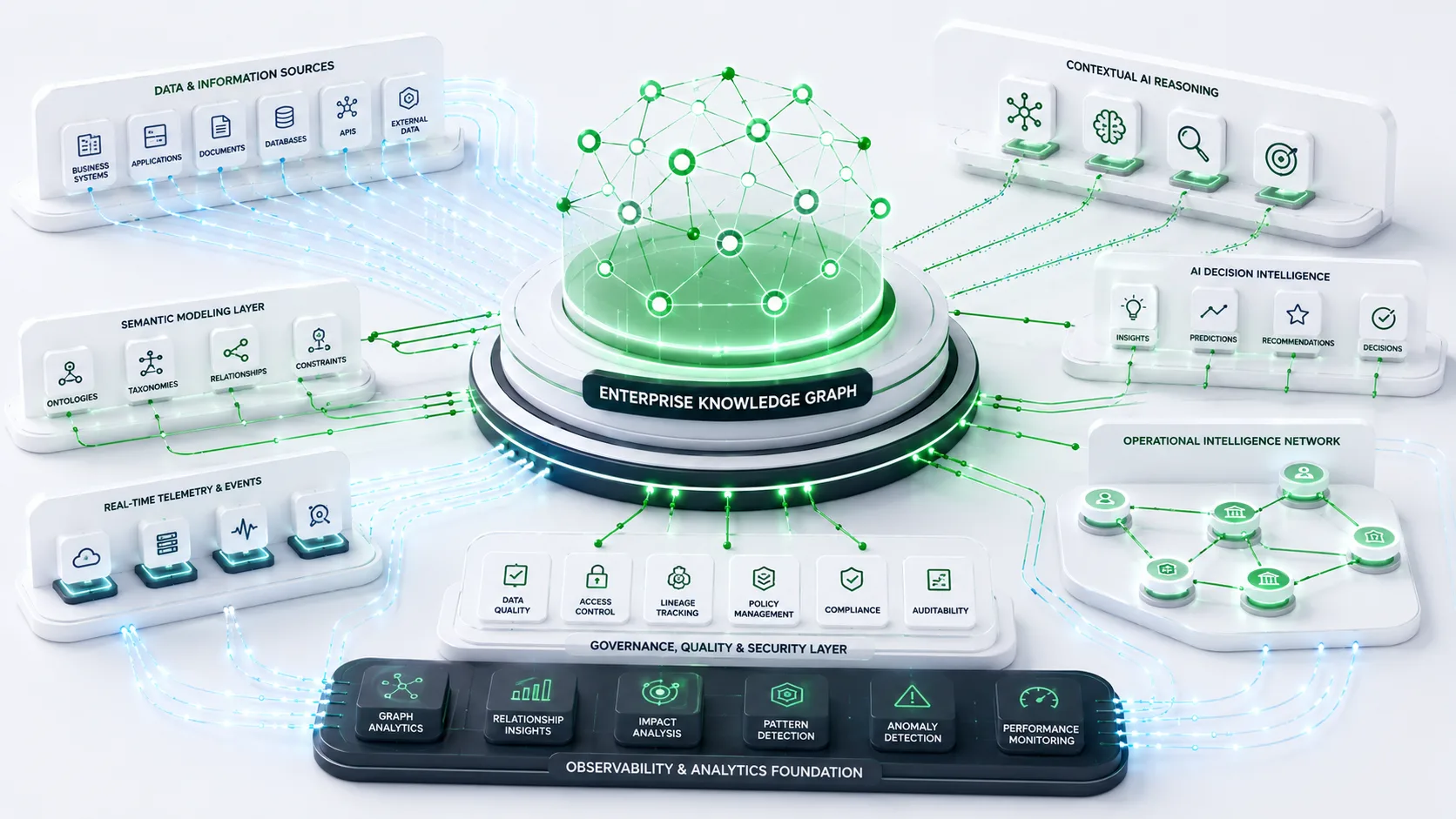
An enterprise knowledge graph is a structured semantic data layer that models relationships between entities, systems, processes, infrastructure, workflows, and operational intelligence across an organization.
Unlike traditional databases, knowledge graphs focus on connected relationships rather than isolated records.
Entity Intelligence
Modeling people, services, infrastructure, workflows, APIs, systems, and operational assets.
Relationship Mapping
Connecting dependencies, operational pathways, ownership structures, and workflow interactions.
Contextual Reasoning
Providing semantic context for AI decision-making systems.
Operational Intelligence
Enabling real-time enterprise awareness across distributed systems.
Why AI Systems Need Knowledge Graphs
Modern enterprise AI systems increasingly depend on contextual operational intelligence.
Without structured semantic relationships, AI systems often:
- Lack persistent context
- Misinterpret operational dependencies
- Fail to understand organizational relationships
- Struggle with infrastructure reasoning
- Operate without governance visibility
- Produce fragmented decision logic
The Context Problem
Enterprise AI systems require operational memory and semantic understanding. Knowledge graphs create structured context layers that enable AI systems to reason across relationships rather than isolated data points.
Core Components of Enterprise Knowledge Graph Architecture
Semantic Data Models
Knowledge graphs organize enterprise entities into semantic structures that define relationships, dependencies, and operational meaning.
Examples include:
- Infrastructure dependency graphs
- Business workflow relationships
- AI orchestration pathways
- Operational telemetry mappings
- Security and governance relationships
Graph Query Systems
Modern AI systems require graph-aware retrieval mechanisms capable of exploring relationships dynamically during runtime operations.
Graph Intelligence Enables:
- Relationship-aware reasoning
- Operational dependency analysis
- Infrastructure impact mapping
- Adaptive workflow coordination
- Semantic AI decision routing
Real-Time Operational Updates
Enterprise knowledge graphs increasingly integrate real-time telemetry, observability signals, infrastructure events, and operational workflows.
This creates continuously evolving operational intelligence layers for AI systems.
Governance and Trust Layers
Modern graph systems also incorporate governance boundaries, identity relationships, compliance policies, and operational trust structures.
How Knowledge Graphs Improve AI Decision Intelligence
Contextual Decision-Making
AI systems can reason based on operational relationships rather than isolated prompts or datasets.
Infrastructure Awareness
Knowledge graphs enable AI systems to understand infrastructure dependencies, service relationships, and operational impact pathways.
Multi-Agent Coordination
Autonomous AI agents increasingly rely on shared semantic context layers for coordination and orchestration.
Governed AI Reasoning
Knowledge graphs improve explainability and governance visibility across AI decisions.
Strategic Enterprise Shift
Enterprise AI is moving beyond isolated prompt-response systems toward operational intelligence platforms capable of reasoning across infrastructure, workflows, telemetry, governance, and semantic relationships.
Enterprise Use Cases
Operational Intelligence
AI systems understanding infrastructure relationships and operational dependencies.
AI Governance
Tracking AI actions, permissions, trust relationships, and compliance pathways.
Workflow Automation
Coordinating intelligent orchestration across distributed operational systems.
Decision Intelligence
Supporting AI reasoning through semantic operational context.
Challenges Enterprises Face
- Integrating fragmented enterprise data
- Maintaining real-time graph consistency
- Scaling semantic infrastructure
- Managing governance complexity
- Aligning graph intelligence with AI workflows
- Supporting distributed operational environments
- Operationalizing graph-based reasoning systems
Implementation Strategy for Enterprise Teams
Start with Critical Operational Domains
Begin with infrastructure, workflow, governance, or operational telemetry relationships before expanding enterprise-wide.
Focus on Semantic Relationships
The value of knowledge graphs comes from connected operational meaning, not simply aggregating data.
Integrate with AI Runtime Systems
Knowledge graphs should operate as live contextual infrastructure supporting runtime AI reasoning and orchestration.
Phase 1
Semantic infrastructure and relationship modeling.
Phase 2
Operational telemetry and graph intelligence integration.
Phase 3
Autonomous AI reasoning and semantic orchestration systems.
Common Enterprise Mistakes
- Treating knowledge graphs as simple databases
- Ignoring operational context relationships
- Failing to integrate runtime telemetry
- Building disconnected semantic systems
- Lacking governance-aware graph models
- Overcomplicating graph ontologies early
- Separating graph infrastructure from AI orchestration
Enterprise Knowledge Graph Checklist
- Define operational entities and relationships
- Establish semantic governance models
- Integrate real-time telemetry streams
- Connect AI orchestration systems
- Implement graph-aware reasoning pipelines
- Build scalable semantic infrastructure
- Enable operational observability visibility
- Support adaptive AI decision systems
Key Takeaways
- Knowledge graphs provide contextual intelligence for enterprise AI systems.
- Semantic infrastructure enables relationship-aware reasoning.
- Operational AI systems require persistent contextual awareness.
- Graph intelligence improves AI governance and explainability.
- Enterprise AI is evolving toward semantic operational intelligence platforms.
How YggyTech Helps
YggyTech helps enterprises design semantic AI infrastructure, operational knowledge graph systems, AI governance architecture, and contextual intelligence platforms for autonomous enterprise operations.
Semantic Infrastructure
Building operational knowledge graph systems for enterprise AI environments.
AI Decision Intelligence
Enabling contextual AI reasoning across workflows and operational systems.
Governance Architecture
Designing governed semantic operational intelligence infrastructure.
Build Context-Aware Enterprise AI Systems
Modern enterprise AI requires contextual intelligence, semantic operational awareness, and relationship-driven reasoning infrastructure. YggyTech helps organizations build scalable knowledge graph platforms for enterprise AI decision intelligence.
Talk to YggyTechFAQs
What is an enterprise knowledge graph?
An enterprise knowledge graph is a semantic infrastructure layer that models relationships between systems, workflows, infrastructure, and operational entities across an organization.
Why are knowledge graphs important for AI?
Knowledge graphs provide contextual intelligence, operational awareness, semantic relationships, and reasoning capabilities that improve AI decision-making systems.
How do knowledge graphs improve enterprise AI systems?
They enable relationship-aware reasoning, operational context visibility, infrastructure awareness, governance intelligence, and better autonomous AI coordination.
What industries benefit from enterprise knowledge graphs?
Industries including finance, healthcare, cybersecurity, logistics, manufacturing, SaaS, and enterprise operations increasingly use knowledge graphs for AI intelligence systems.
What challenges do enterprises face implementing knowledge graphs?
Common challenges include data integration complexity, real-time semantic synchronization, governance alignment, scalability, and operationalizing graph intelligence for AI workflows.

Mason Carter
Cloud & Infrastructure Engineer
Mason focuses on scalable cloud ecosystems, DevOps modernization, and secure distributed infrastructure. His insights at YGGY Tech explore resilient architecture design, Kubernetes operations, cybersecurity strategy, and enterprise scalability.