Event-Driven AI Architectures for Modern SaaS Platforms
Artificial intelligence is fundamentally changing how SaaS platforms operate. However, as AI capabilities become embedded across customer experiences, operational workflows, analytics systems, and autonomous agents, traditional request-response architectures are reaching their limits.
Modern enterprises require systems capable of reacting instantly to changing business conditions, customer interactions, infrastructure events, and AI-generated decisions.
This is where event-driven AI architectures are emerging as a foundational design pattern.
Rather than waiting for users or applications to initiate actions, event-driven AI systems continuously observe, interpret, and respond to streams of operational events in real time.
For modern SaaS companies operating at scale, event-driven AI architectures are becoming essential for delivering intelligent, adaptive, and autonomous digital experiences.
What Is an Event-Driven AI Architecture?
An event-driven AI architecture combines event-driven system design with AI-powered decision-making and orchestration.
In this model, every significant activity within a platform generates an event.
Examples include:
- User actions
- Application state changes
- Infrastructure alerts
- Security incidents
- Business transactions
- Workflow completions
- Telemetry updates
- Agent-generated decisions
These events become triggers that activate AI workflows, orchestration systems, analytics pipelines, or autonomous agents.
Instead of reacting after the fact, platforms continuously operate based on live operational intelligence.
Why SaaS Platforms Are Moving Toward Event-Driven AI
Traditional architectures were designed around user requests.
Modern AI-powered platforms operate in environments where:
- Thousands of events occur every second
- AI models continuously generate outputs
- Autonomous agents execute workflows
- Operational conditions change rapidly
- Customer expectations demand real-time responsiveness
Event-driven AI enables platforms to respond instantly while maintaining scalability and operational flexibility.
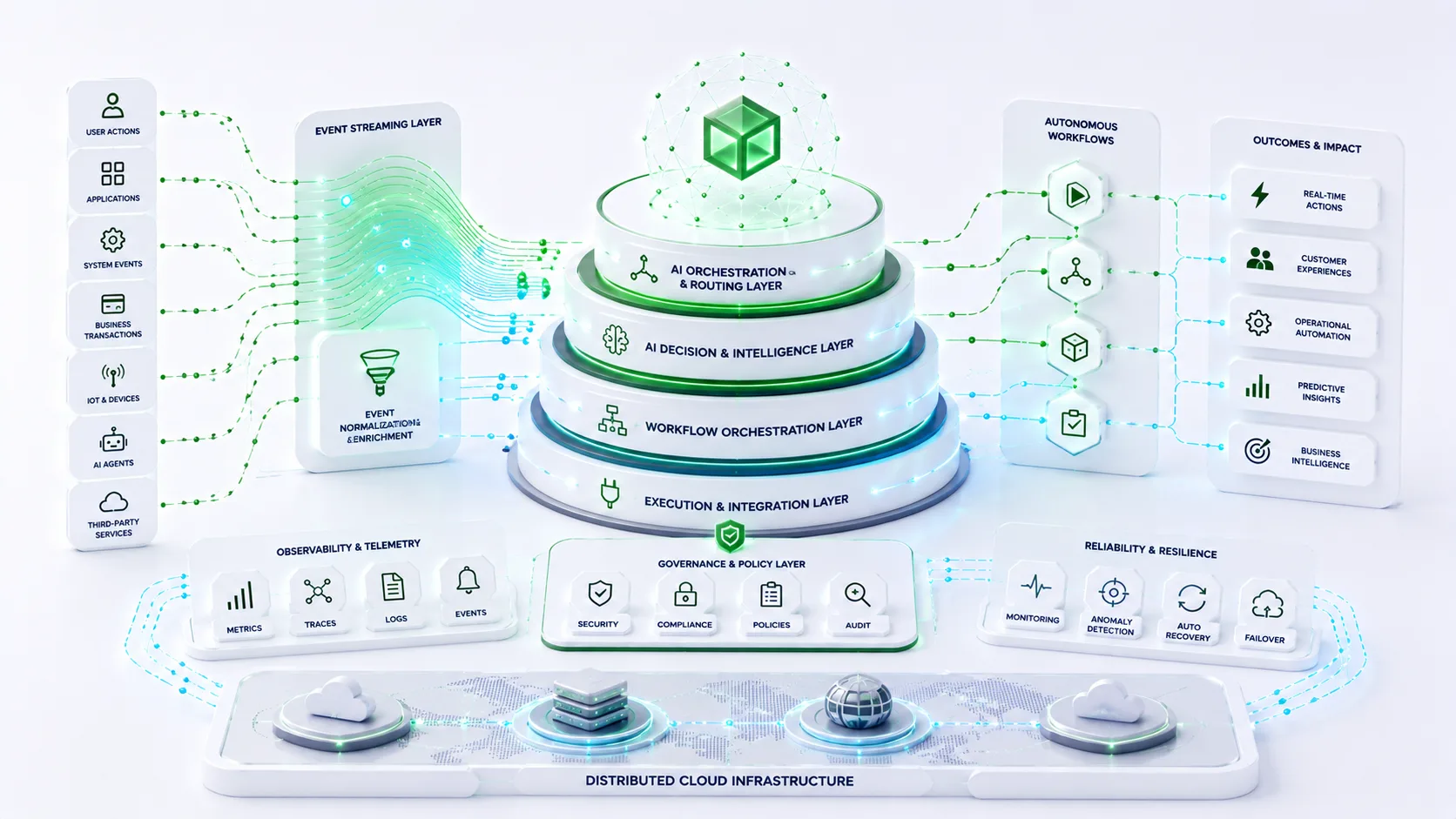
The Core Components of Event-Driven AI Architecture
1. Event Producers
Event producers generate operational signals across the platform.
Examples include:
- Applications
- Microservices
- AI agents
- Infrastructure systems
- Monitoring platforms
- Customer interactions
Every event becomes a potential source of intelligence.
2. Event Streaming Layer
The streaming layer serves as the nervous system of the architecture.
It transports events across distributed systems in real time.
Capabilities typically include:
- High-throughput event processing
- Event persistence
- Scalable distribution
- Fault tolerance
- Operational resilience
This layer enables continuous intelligence flow across the platform.
3. AI Decision Layer
Once events arrive, AI systems evaluate context and determine appropriate actions.
This layer may include:
- Large language models
- Prediction engines
- Knowledge graph systems
- Semantic routing platforms
- Multi-agent orchestration systems
The objective is converting events into intelligent operational decisions.
4. Workflow Orchestration Layer
After decisions are made, orchestration platforms coordinate execution.
Examples include:
- Business workflows
- Customer engagement actions
- Infrastructure automation
- Security responses
- Agent collaboration workflows
This layer transforms intelligence into action.
5. Observability and Governance Layer
Modern event-driven systems require comprehensive visibility.
Organizations must monitor:
- Event flows
- Decision quality
- Agent behavior
- Workflow outcomes
- Governance compliance
Without observability, scaling AI systems becomes increasingly difficult.
How AI Changes Traditional Event-Driven Systems
Conventional event-driven architectures primarily focus on automation.
AI-powered architectures introduce intelligence.
Instead of:
- If X happens, execute Y
Systems evolve toward:
- If X happens, understand context, evaluate options, determine priorities, and choose the optimal action.
This creates significantly more adaptive operational systems.
Event-Driven AI and Multi-Agent Systems
Multi-agent architectures are rapidly becoming a core component of enterprise AI platforms.
Event-driven systems provide the communication framework that allows agents to collaborate.
For example:
- A monitoring event triggers an operations agent.
- The operations agent generates a diagnostic event.
- A remediation agent evaluates recovery options.
- A governance agent validates compliance requirements.
- An execution agent initiates corrective action.
This event-driven coordination enables autonomous enterprise operations.
Real-World SaaS Use Cases
Customer Experience Platforms
Customer interactions generate events that activate recommendation engines, personalization systems, and engagement workflows.
Cybersecurity Platforms
Threat signals trigger AI-driven detection, investigation, and response workflows.
Financial Technology Platforms
Transactions generate events that activate fraud detection, risk assessment, and compliance validation systems.
Operational Intelligence Systems
Infrastructure telemetry activates predictive maintenance, anomaly detection, and operational optimization workflows.
Developer Platforms
Deployment events trigger testing, governance validation, security scanning, and observability workflows.
Key Benefits of Event-Driven AI Architectures
Real-Time Decision Making
AI systems can respond immediately to changing operational conditions.
Scalable Intelligence
Distributed event processing enables organizations to scale AI operations across large ecosystems.
Autonomous Operations
Event-driven architectures provide the foundation for self-managing systems.
Operational Agility
New AI workflows can be introduced without redesigning entire applications.
Improved Resilience
Distributed event systems reduce operational bottlenecks and improve fault tolerance.
Challenges Organizations Must Address
- Event volume growth
- Observability complexity
- Governance enforcement
- Agent coordination reliability
- Infrastructure scaling requirements
- Data consistency challenges
- Operational security risks
Successful implementations require strong architectural discipline and operational governance.
Building an Event-Driven AI Strategy
Organizations should focus on five critical areas:
- Event streaming infrastructure
- AI orchestration platforms
- Observability systems
- Governance frameworks
- Reliability engineering practices
Together, these capabilities create the foundation for intelligent enterprise operations.
The Future of SaaS Architecture
Over the next several years, SaaS platforms will increasingly evolve from application-centric systems to intelligence-driven ecosystems.
Events will become the operational language of enterprise software, while AI becomes the decision engine that interprets those events.
The result will be platforms capable of autonomous optimization, proactive decision-making, and real-time operational intelligence.
Key Takeaways
- Event-driven AI architectures enable real-time enterprise intelligence.
- Events serve as triggers for AI-powered operational decisions.
- Multi-agent systems rely heavily on event-driven coordination.
- Observability and governance remain critical for success.
- Modern SaaS platforms are increasingly adopting event-driven AI as a foundational architectural pattern.
How YggyTech Helps
YggyTech helps organizations design event-driven AI platforms that combine orchestration systems, AI control planes, observability frameworks, governance architectures, and cloud-native infrastructure.
Our solutions enable enterprises to build scalable, reliable, and intelligent operational ecosystems capable of supporting next-generation AI applications.
Conclusion
The future of SaaS is not simply powered by AI. It is orchestrated through events.
Event-driven AI architectures enable organizations to move from reactive workflows toward intelligent systems capable of understanding operational signals and responding autonomously.
For enterprises building the next generation of digital platforms, event-driven AI is rapidly becoming a strategic necessity.
FAQs
What is an event-driven AI architecture?
An event-driven AI architecture combines real-time event processing with AI-powered decision-making and workflow orchestration.
Why are SaaS companies adopting event-driven AI?
It enables real-time intelligence, autonomous workflows, operational scalability, and improved customer experiences.
How do AI agents use event-driven systems?
Agents communicate and coordinate through events, enabling autonomous collaboration across distributed workflows.
What technologies support event-driven AI?
Event streaming platforms, AI orchestration systems, observability tools, governance frameworks, and cloud-native infrastructure platforms.
What is the biggest benefit of event-driven AI architecture?
The ability to transform real-time operational signals into intelligent, automated actions at enterprise scale.

Ava Mitchell
UX & Digital Experience Strategist
Ava combines product psychology, interface systems, and user-centered design to create digital experiences that feel intuitive and scalable. Her work at YGGY Tech focuses on high-conversion UX systems, enterprise interfaces, and design-driven growth.