Semantic Routing Systems in Enterprise AI Architecture
Enterprise AI is rapidly evolving from isolated model deployments toward interconnected ecosystems of agents, workflows, knowledge systems, and operational platforms. As organizations scale AI adoption, a critical challenge emerges: how do AI systems determine where information, requests, decisions, and actions should flow?
The answer increasingly lies in semantic routing systems.
Semantic routing represents a new architectural layer that enables AI systems to make context-aware routing decisions based on meaning rather than predefined rules alone. Instead of simply forwarding requests through static workflows, semantic routing platforms understand intent, context, relationships, operational priorities, and organizational knowledge.
In 2026, semantic routing is becoming a foundational capability for enterprise AI architecture.
What Is Semantic Routing?
Semantic routing is the process of intelligently directing information, tasks, workflows, prompts, agents, or decisions based on contextual understanding rather than keyword matching or hardcoded logic.
Traditional routing systems answer:
- Where should this request go?
- Which workflow should execute?
- What system should respond?
Semantic routing answers:
- What does this request actually mean?
- What context surrounds this decision?
- Which AI agent is most qualified to respond?
- What knowledge should influence execution?
- Which governance rules apply?
This shift dramatically improves enterprise AI effectiveness.
Why Traditional Routing Is No Longer Enough
Modern enterprises operate increasingly complex AI ecosystems that include:
- Multiple foundation models
- Specialized AI agents
- Knowledge graph systems
- Enterprise applications
- Operational intelligence platforms
- Governance frameworks
- Cloud-native infrastructure
Static routing approaches struggle because they lack awareness of context, intent, and business objectives.
Semantic routing enables systems to dynamically determine the optimal execution path in real time.
The Core Components of Semantic Routing Architecture
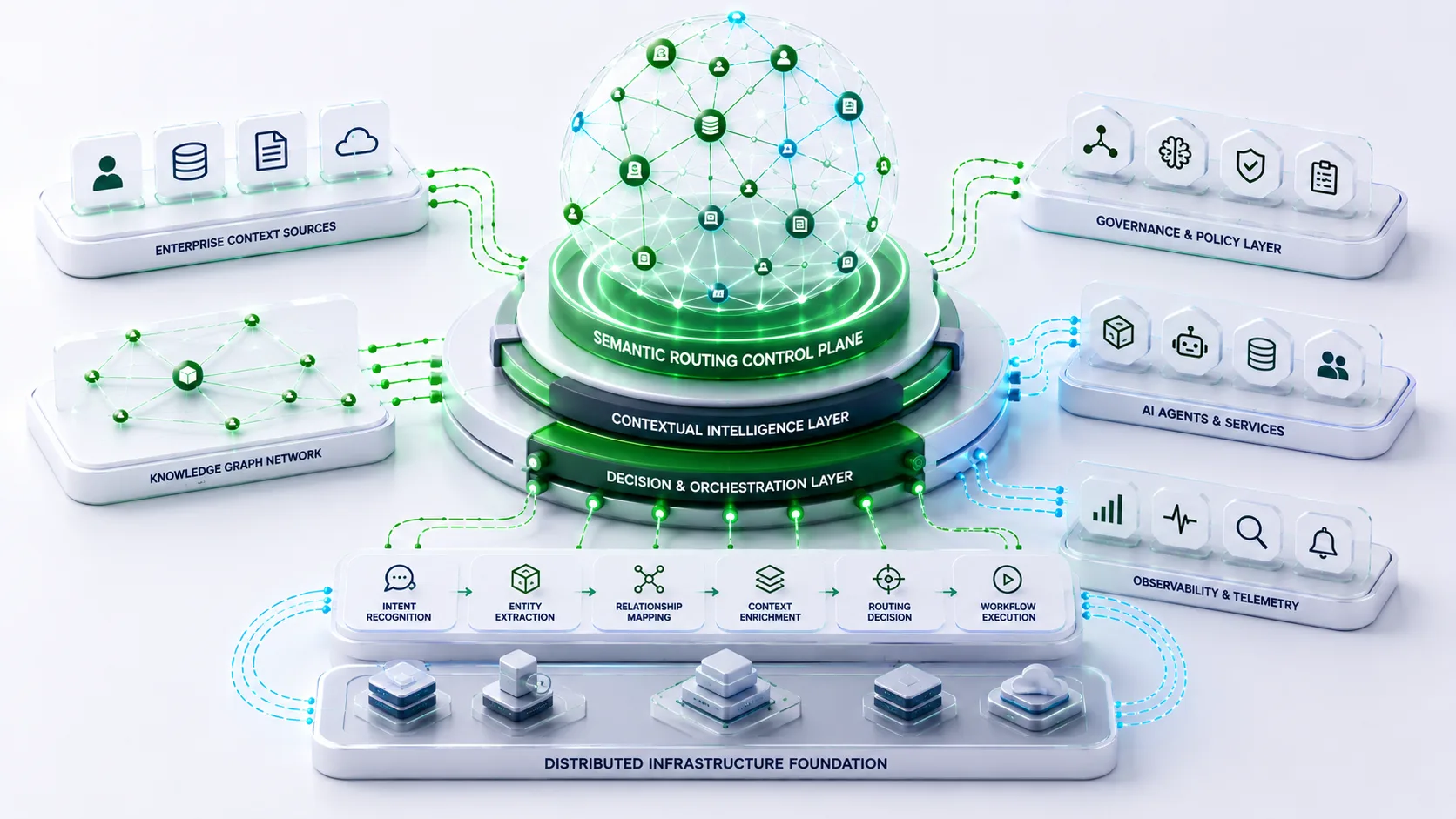
1. Context Understanding Layer
The first responsibility of a semantic routing system is understanding intent.
This layer analyzes:
- User intent
- Business context
- Operational priorities
- Historical interactions
- Organizational knowledge
- Workflow objectives
Without contextual understanding, intelligent routing is impossible.
2. Semantic Intelligence Engine
This engine transforms raw inputs into structured meaning.
Capabilities often include:
- Intent classification
- Entity extraction
- Relationship discovery
- Context enrichment
- Knowledge graph integration
- Semantic similarity analysis
The semantic engine acts as the reasoning layer behind routing decisions.
3. Routing Decision Layer
After context is established, the routing layer determines the optimal destination.
This could include:
- AI agents
- Model endpoints
- Operational workflows
- Knowledge systems
- Human review channels
- Governance controls
The objective is delivering the right information to the right system at the right time.
4. Governance Integration Layer
Enterprise AI requires governance-aware routing.
Semantic routing platforms increasingly evaluate:
- Security requirements
- Compliance policies
- Data sensitivity levels
- Authorization boundaries
- Operational risk profiles
Routing decisions are becoming governance decisions.
The Role of Knowledge Graphs
Knowledge graphs are emerging as a key foundation for semantic routing.
Unlike traditional databases, knowledge graphs model relationships between entities, systems, processes, and concepts.
This allows routing engines to understand:
- Business relationships
- Operational dependencies
- System interactions
- Domain expertise mappings
- Organizational context
The result is significantly more intelligent workflow orchestration.
Semantic Routing in Multi-Agent AI Systems
As enterprises adopt multi-agent architectures, semantic routing becomes increasingly important.
Rather than assigning all tasks to a single model, organizations deploy specialized agents with distinct responsibilities.
Examples include:
- Research agents
- Operations agents
- Security agents
- Compliance agents
- Customer support agents
- Engineering agents
Semantic routing determines which agent—or combination of agents—should participate in solving a specific problem.
Enterprise Benefits
Improved Decision Quality
Better context leads to better routing decisions and ultimately better business outcomes.
Reduced Operational Complexity
Organizations can manage increasingly sophisticated AI ecosystems without relying on massive rule sets.
Scalable AI Coordination
Semantic routing enables thousands of workflows and agents to operate cohesively.
Enhanced User Experience
Users receive faster, more accurate responses because requests reach the appropriate systems immediately.
Governance Alignment
Operational controls become embedded directly into workflow execution paths.
Real-World Enterprise Use Cases
Customer Operations
Semantic routing directs customer requests to the appropriate AI agent, knowledge source, or support workflow.
Enterprise Search
Context-aware search systems identify relevant information based on meaning rather than keywords.
Operational Intelligence
AI systems route alerts, telemetry, and incidents to specialized workflows automatically.
Software Engineering Platforms
Developer requests are routed across deployment systems, documentation sources, observability platforms, and infrastructure services.
Financial Services
Risk assessments are directed to specialized models and governance workflows depending on transaction characteristics.
Challenges Enterprises Must Address
- Context quality issues
- Incomplete knowledge systems
- Governance complexity
- Agent coordination challenges
- Observability limitations
- Semantic model drift
- Infrastructure scalability requirements
Successful implementations require both architectural planning and operational discipline.
Building a Semantic Routing Strategy
Organizations should focus on five foundational pillars:
- Knowledge graph architecture
- Context engineering frameworks
- AI control plane integration
- Governance-aware orchestration
- End-to-end observability systems
Together, these components create the foundation for enterprise-scale semantic intelligence.
The Future of Enterprise AI Architecture
Over the next several years, semantic routing will become a core architectural capability across enterprise AI environments.
Organizations will increasingly move beyond workflow automation toward intelligent orchestration systems that continuously evaluate context, understand intent, and dynamically coordinate operational decisions.
Semantic routing will serve as the connective tissue linking AI agents, knowledge systems, governance platforms, and operational infrastructure into a unified intelligence architecture.
Key Takeaways
- Semantic routing enables context-aware AI workflow orchestration.
- Knowledge graphs provide foundational intelligence for routing decisions.
- Multi-agent systems depend on intelligent routing capabilities.
- Governance and security must be integrated into routing architecture.
- Semantic routing is becoming a strategic layer within enterprise AI infrastructure.
How YggyTech Helps
YggyTech helps organizations design intelligent AI architectures that combine semantic routing, knowledge graphs, AI control planes, governance frameworks, and operational intelligence systems. Our solutions enable enterprises to scale context-aware AI operations while maintaining visibility, security, and reliability.
Conclusion
The future of enterprise AI is not simply about larger models or more agents. It is about creating intelligent systems that understand context and coordinate decisions effectively.
Semantic routing provides the architectural foundation for that future, enabling enterprises to transform fragmented AI deployments into connected, scalable, and operationally intelligent ecosystems.
FAQs
What is semantic routing in AI?
Semantic routing is the process of directing tasks, information, or workflows based on contextual meaning and intent rather than static rules or keyword matching.
Why is semantic routing important for enterprise AI?
It improves decision quality, workflow efficiency, agent coordination, and operational scalability across complex AI ecosystems.
How do knowledge graphs support semantic routing?
Knowledge graphs provide relationship-aware context that helps routing systems make more intelligent decisions.
Can semantic routing work with multi-agent systems?
Yes. Semantic routing is becoming a critical capability for coordinating specialized AI agents across enterprise workflows.
What industries benefit from semantic routing?
Financial services, healthcare, manufacturing, logistics, software engineering, customer operations, and enterprise knowledge management all benefit from semantic routing architectures.

Maheer Alishba
Data & Automation Consultant
Maheer writes about data engineering, AI-powered analytics, and intelligent business automation. Her content helps organizations understand how to transform fragmented operational data into measurable business intelligence and predictive systems.