Operational Guardrails for Autonomous Enterprise AI Systems
Enterprise AI is rapidly moving beyond simple automation. Modern organizations are deploying autonomous systems capable of making decisions, orchestrating workflows, coordinating agents, and executing business operations with minimal human intervention.
While this evolution unlocks significant productivity and operational efficiency, it also introduces a new challenge: how do organizations ensure autonomous AI behaves safely, reliably, and within acceptable operational boundaries?
The answer lies in operational guardrails.
Operational guardrails provide the governance, controls, monitoring, and enforcement mechanisms that enable autonomous AI systems to operate responsibly at scale. In 2026, these guardrails are becoming one of the most critical components of enterprise AI architecture.
What Are Operational Guardrails?
Operational guardrails are policies, controls, monitoring systems, and governance mechanisms that constrain and guide autonomous AI behavior during execution.
Rather than limiting innovation, guardrails create safe operating boundaries that allow AI systems to act independently while remaining aligned with business objectives, security requirements, and compliance standards.
Operational guardrails answer critical questions such as:
- What actions can an AI system take?
- What actions require approval?
- What policies govern execution?
- How should risks be evaluated?
- When should escalation occur?
- How is compliance enforced?
Why Autonomous AI Requires Guardrails
Traditional software systems execute predefined instructions. Autonomous AI systems evaluate situations, make decisions, and adapt dynamically based on context.
This flexibility creates tremendous value but also introduces risks:
- Unintended actions
- Policy violations
- Security breaches
- Compliance failures
- Data misuse
- Workflow disruptions
- Escalating operational costs
Without operational controls, organizations expose themselves to significant operational and reputational risk.
The Evolution from Static Rules to Dynamic Governance
Early AI systems relied heavily on static rules and hard-coded restrictions.
Modern enterprise environments are too complex for purely rule-based governance.
Today's guardrail systems increasingly combine:
- Policy engines
- Risk scoring models
- Runtime governance systems
- AI observability platforms
- Context-aware controls
- Human-in-the-loop workflows
This creates adaptive governance capable of scaling alongside autonomous operations.
The Five Layers of Operational Guardrails
1. Identity and Access Controls
Every autonomous AI system must operate within clearly defined permissions.
Guardrails should define:
- Authorized resources
- Permitted actions
- Role-based access policies
- Data access boundaries
- Service permissions
Identity becomes the foundation of operational trust.
2. Policy Enforcement Controls
Policy engines evaluate decisions before actions are executed.
Examples include:
- Financial approval thresholds
- Compliance validation rules
- Data handling requirements
- Operational risk limits
- Security enforcement policies
Policies transform governance requirements into executable controls.
3. Runtime Governance
Runtime governance ensures AI systems remain compliant while operating.
Capabilities often include:
- Decision validation
- Behavior monitoring
- Risk assessments
- Workflow inspections
- Execution controls
This layer continuously evaluates AI behavior in real time.
4. Observability and Monitoring
Organizations cannot govern what they cannot see.
AI observability platforms provide visibility into:
- Agent actions
- Model decisions
- Workflow execution
- Context utilization
- Infrastructure performance
- Policy compliance
Observability transforms autonomous systems into auditable systems.
5. Human Escalation Controls
Not every decision should be fully autonomous.
Guardrails define when:
- Human review is required
- Escalation occurs
- Approvals are necessary
- Execution should pause
- Additional validation is needed
This creates a balanced model of human-AI collaboration.
Operational Guardrails in Multi-Agent Systems
Multi-agent AI architectures are becoming increasingly common across enterprises.
These systems often involve specialized agents responsible for:
- Research
- Planning
- Operations
- Compliance
- Security
- Execution
Guardrails become even more important as agent interactions increase.
Organizations must govern:
- Agent permissions
- Communication pathways
- Decision authority
- Escalation processes
- Execution boundaries
Without coordination controls, autonomous ecosystems become difficult to manage.
Real-World Enterprise Use Cases
Financial Services
AI systems evaluating transactions must comply with regulatory requirements, fraud controls, and risk thresholds.
Healthcare
Clinical AI workflows require strict governance around patient data access and decision support recommendations.
Cybersecurity
Autonomous response systems require guardrails that prevent overreaction while enabling rapid threat mitigation.
Software Engineering
AI-driven deployment systems must follow governance policies before modifying production infrastructure.
Customer Operations
Autonomous customer support workflows require escalation pathways for high-risk interactions.
Operational Metrics for Guardrail Effectiveness
Leading enterprises increasingly track governance-focused operational metrics.
Examples include:
- Policy compliance rates
- Guardrail intervention frequency
- Human escalation rates
- Unauthorized action attempts
- Risk threshold violations
- Governance audit coverage
- Decision approval times
These metrics provide insight into operational maturity.
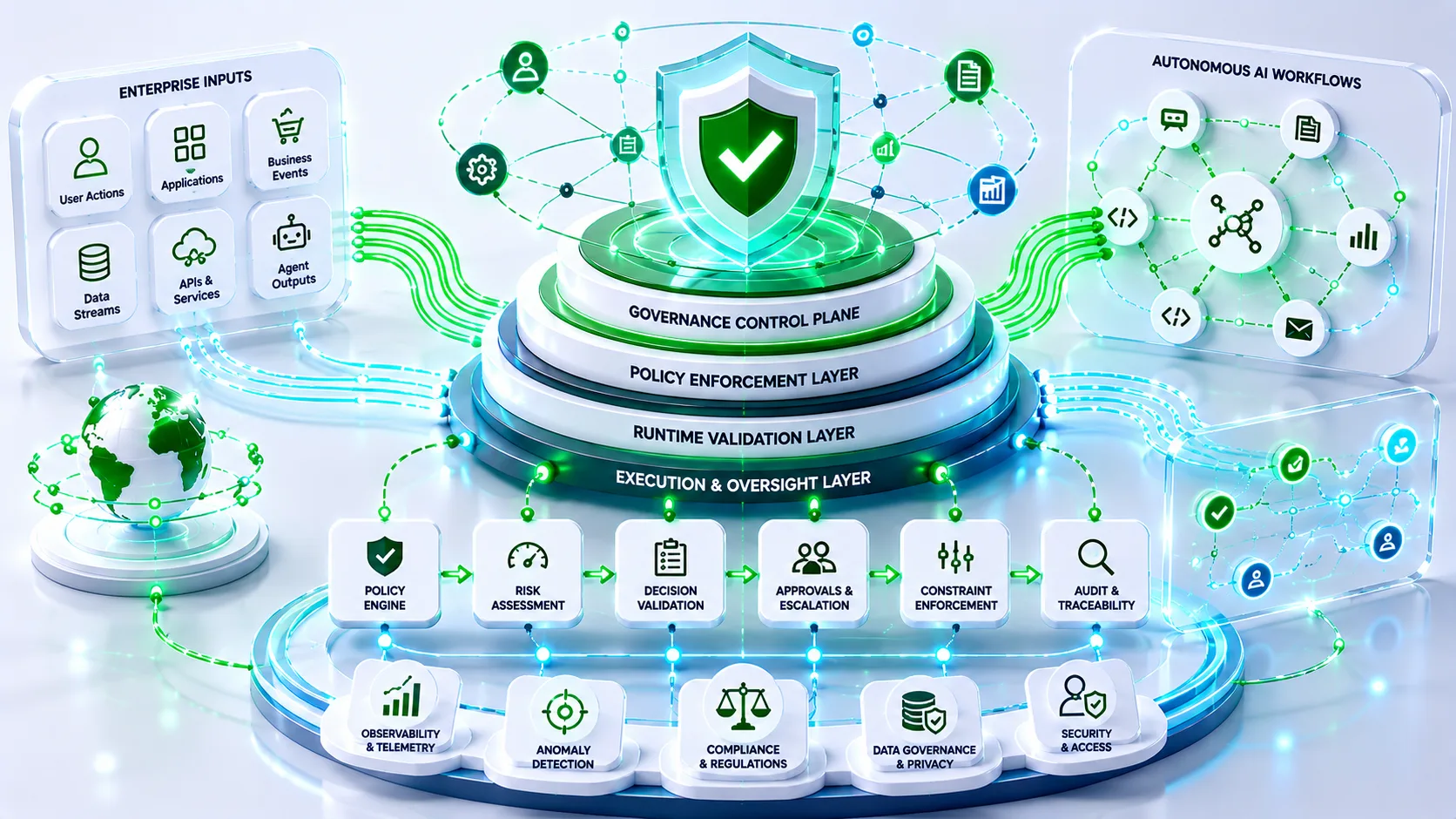
The Role of AI Control Planes
AI control planes are emerging as a critical mechanism for enforcing operational guardrails.
Control planes provide centralized governance capabilities including:
- Policy management
- Identity controls
- Workflow oversight
- Agent coordination
- Telemetry integration
- Governance enforcement
They serve as the operational command center for autonomous AI ecosystems.
Challenges Organizations Face
- Rapid AI adoption
- Complex agent ecosystems
- Insufficient observability
- Policy fragmentation
- Governance scalability issues
- Evolving regulatory requirements
- Cross-platform orchestration complexity
Addressing these challenges requires both technology and organizational maturity.
Building an Operational Guardrail Strategy
Organizations should focus on six foundational capabilities:
- Identity-aware governance
- Policy-as-code frameworks
- Runtime governance platforms
- AI observability systems
- Human escalation workflows
- Centralized AI control planes
Together, these components create a scalable governance foundation.
The Future of Autonomous AI Governance
Over the next several years, operational guardrails will evolve from standalone controls into intelligent governance systems.
Future platforms will continuously assess risk, adapt policies dynamically, and orchestrate governance decisions alongside operational workflows.
The goal is not to restrict autonomy but to enable trustworthy autonomy at enterprise scale.
Key Takeaways
- Operational guardrails are essential for governing autonomous AI systems.
- Guardrails combine policy enforcement, observability, governance, and human oversight.
- Multi-agent environments significantly increase governance complexity.
- AI control planes are becoming central to guardrail implementation.
- Successful enterprises balance autonomy with accountability.
How YggyTech Helps
YggyTech helps enterprises design governance-first AI architectures through AI control planes, runtime governance platforms, operational intelligence systems, observability frameworks, and autonomous workflow guardrails.
Our solutions enable organizations to scale AI confidently while maintaining compliance, security, reliability, and operational transparency.
Conclusion
Autonomous AI systems represent one of the most significant shifts in enterprise technology.
However, autonomy without governance creates risk.
Operational guardrails provide the controls necessary to ensure AI systems remain aligned with organizational objectives while delivering the speed, intelligence, and scalability that modern enterprises require.
FAQs
What are operational guardrails for AI?
Operational guardrails are governance controls, policies, monitoring systems, and enforcement mechanisms that guide AI behavior during execution.
Why are guardrails important for autonomous AI?
They reduce risk, improve compliance, enforce policies, and ensure AI systems operate within approved boundaries.
What is runtime governance?
Runtime governance continuously evaluates AI behavior during execution to ensure compliance with operational and regulatory requirements.
How do AI control planes support guardrails?
AI control planes provide centralized policy enforcement, observability, workflow governance, and operational oversight.
Can guardrails limit AI innovation?
No. Effective guardrails enable safe innovation by creating clear operational boundaries while allowing autonomous systems to operate efficiently.

Mason Carter
Cloud & Infrastructure Engineer
Mason focuses on scalable cloud ecosystems, DevOps modernization, and secure distributed infrastructure. His insights at YGGY Tech explore resilient architecture design, Kubernetes operations, cybersecurity strategy, and enterprise scalability.