Privacy-First Agentic AI: How Enterprises Can Scale Autonomous Workflows Without Losing Control
Privacy-first agentic AI gives enterprises a path to autonomous workflow execution without exposing sensitive data, weakening governance, or giving AI agents uncontrolled access to business systems. It is the architecture discipline required for the next generation of enterprise automation.
Why Privacy-First Agentic AI Matters
Agentic AI is changing the enterprise automation conversation. Traditional automation executes predefined steps. AI agents can interpret context, use tools, make decisions, coordinate tasks, and adapt workflows based on new information. That makes agentic systems powerful, but it also changes the risk model. When AI agents can access data, call APIs, update records, generate customer-facing responses, or trigger operational actions, privacy and control become architecture requirements rather than compliance afterthoughts.
Privacy-first agentic AI means designing autonomous systems so they use the minimum necessary data, operate under clear permission boundaries, preserve auditability, enforce human oversight where needed, and align every action with policy. The objective is not to block automation. The objective is to scale autonomous workflows in a way that executives, security teams, legal teams, product leaders, and customers can trust.
Key Insight
The future of enterprise AI will not be defined by the most autonomous agent. It will be defined by the most controlled, observable, privacy-aware, and business-aligned agentic operating model.
What Privacy-First Agentic AI Actually Means
Privacy-first agentic AI is an approach to designing AI agents and autonomous workflows where privacy, security, governance, and accountability are built into the system from the beginning. It is not just about anonymizing data or adding legal review before launch. It is about creating an operational architecture where every agent has a defined role, every data access event is permission-aware, every tool call is logged, every high-risk action has an approval path, and every workflow can be audited after execution.
For enterprises, this distinction matters. A basic AI agent can summarize a document or complete a task. A privacy-first AI agent understands boundaries: what data it can access, which systems it can touch, what it can decide independently, when it must escalate, and how its actions will be reviewed. This is what turns AI agents from experimental productivity tools into enterprise-grade workflow infrastructure.
Least-Privilege Access
Agents receive only the data, tools, and permissions required for a specific task or workflow stage.
Policy-Aware Execution
Autonomous actions are routed through governance rules, risk scoring, workflow limits, and approval checkpoints.
Auditable Workflows
Every agent decision, tool call, data retrieval, escalation, and final action can be traced and reviewed.
Human Oversight
High-risk decisions remain accountable to humans through approval gates, exception review, and operational ownership.
The Enterprise Risk Behind Autonomous Workflows
Autonomous workflows create value because they reduce manual handoffs, accelerate operations, and allow teams to scale complex work. But the same autonomy can introduce risk when agents operate across sensitive systems. An agent that drafts an email is low risk. An agent that reads customer records, updates CRM fields, triggers billing changes, or opens security tickets is materially different.
Enterprises must think beyond prompt quality. Agentic AI risk appears in identity, access, data exposure, memory, tool calls, vendor systems, workflow state, exception handling, and operational accountability. Privacy-first architecture makes these risks explicit and manageable.
Enterprise Signal
Agentic AI becomes an enterprise governance priority the moment agents can access sensitive data, use business tools, make workflow decisions, or interact with customers.
Data Exposure Risk
Agents often require context to act effectively. That context may include customer records, contracts, internal documents, usage logs, source code, support history, identity information, financial data, or regulated records. Without access boundaries, sensitive data can leak through prompts, memory stores, logs, third-party APIs, or generated outputs.
Operational Control Risk
An agent may produce a correct answer but take the wrong action. It may escalate incorrectly, update the wrong record, misclassify a customer request, or trigger a workflow before required approval. Privacy-first agentic AI pairs data control with action control so agents cannot exceed their authority.
Core Architecture of Privacy-First Agentic AI
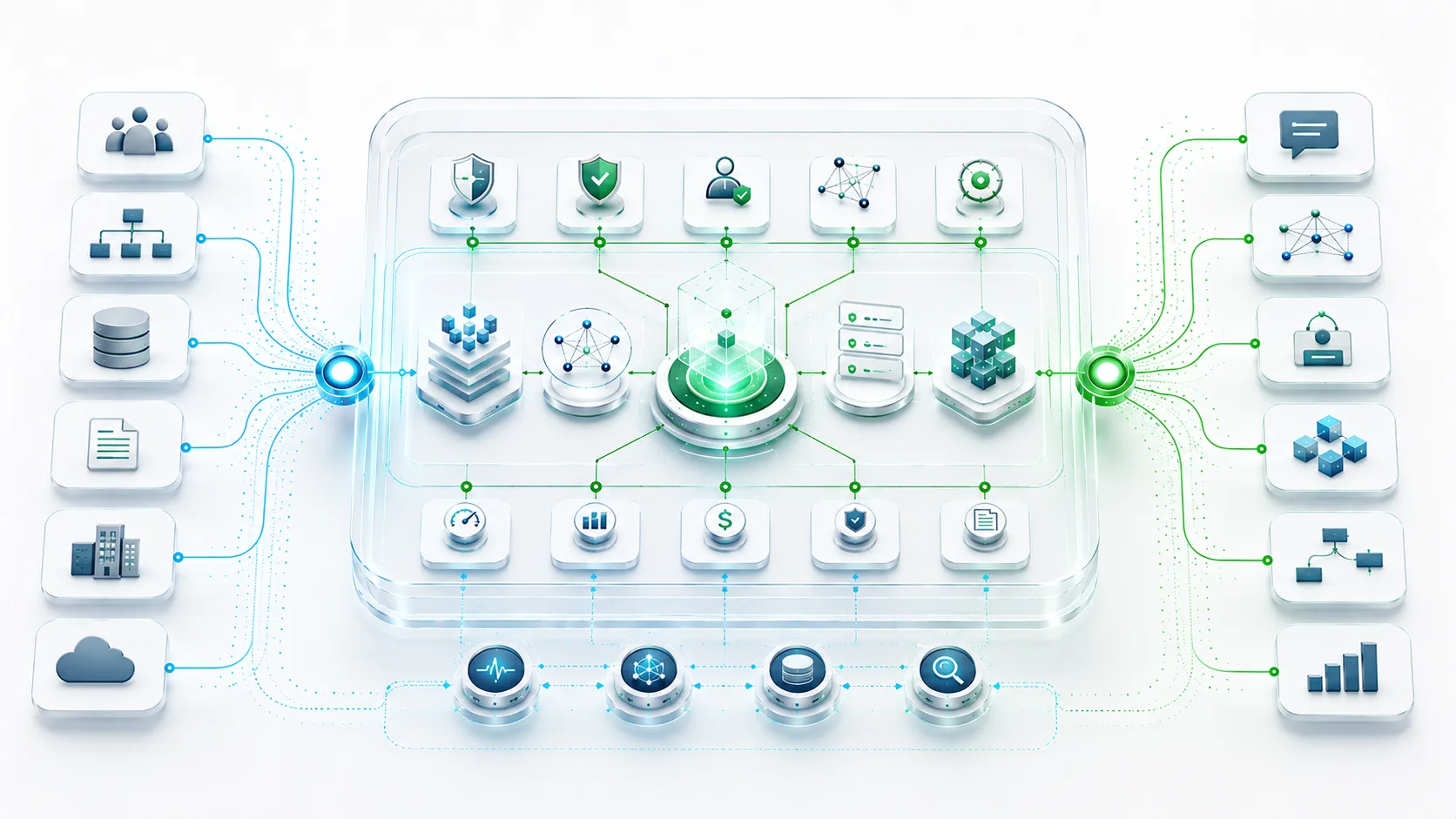
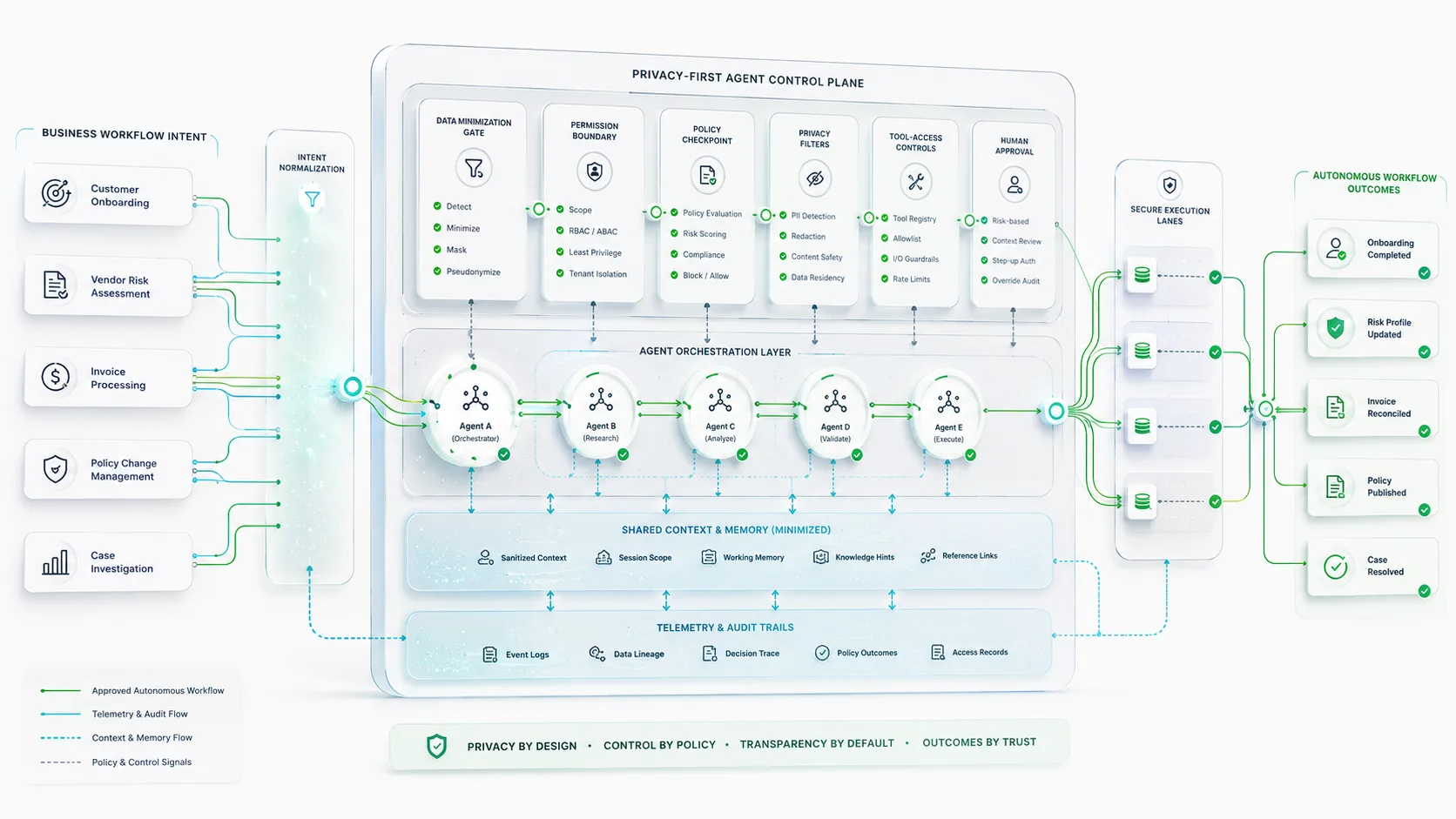
Privacy-first agentic AI requires a deliberate architecture. The goal is to separate intelligence from authority. Agents can reason, plan, summarize, and recommend, but access to data and execution of actions should pass through controlled layers. This architecture allows enterprises to scale automation while keeping privacy, security, and governance intact.
Reference Architecture Layers
AI Gateways and Policy Engines
A privacy-first agentic architecture should include an AI gateway or policy enforcement layer between agents and enterprise systems. This layer can inspect requests, enforce permissions, redact sensitive information, validate tool calls, restrict unsupported actions, and route high-risk requests to human review.
Workflow State and Memory Boundaries
Agents need memory to coordinate complex tasks, but unmanaged memory can become a privacy liability. Enterprises should define what agents can remember, where memory is stored, how long it persists, who can access it, and when it must be deleted. Workflow state should preserve operational traceability without collecting unnecessary sensitive context.
Key Takeaways
- ✓ Privacy-first agentic AI enables autonomous workflows without giving agents unrestricted access to enterprise data or systems.
- ✓ The core architecture separates agent intelligence from execution authority through policy layers, access controls, and approval gates.
- ✓ Agent memory, retrieval, logs, prompts, and tool calls must be governed because each can expose sensitive information.
- ✓ Human-in-the-loop AI remains essential for high-risk decisions, regulated workflows, customer impact, and operational exceptions.
- ✓ Enterprises should measure agentic AI success through workflow outcomes, privacy incidents, policy violations, escalation quality, and business impact.
Privacy Controls Every Agentic AI System Needs
Privacy-first agentic AI depends on technical controls that operate at runtime. Static policy documents are not enough. Agents need active constraints that determine what data they can retrieve, how they can use it, whether it can be stored, and what actions can be taken based on that information.
1. Data Minimization
Agents should access the smallest amount of data needed to complete a task. Broad context may improve output quality, but it increases privacy exposure.
2. Context Filtering
Retrieval systems should filter documents, records, and fields based on user permissions, agent role, task purpose, and data classification.
3. Redaction and Masking
Sensitive fields should be masked or redacted before they enter prompts, memory stores, analytics systems, or third-party model calls.
4. Tool Permissioning
Agents should call only approved tools, with scoped permissions, input validation, action limits, and full logging.
5. Retention Boundaries
Prompt history, workflow memory, agent outputs, and logs should have defined retention rules aligned with privacy and compliance obligations.
6. Explainable Audit Trails
Enterprises need to know why an agent acted, what data it used, which policies applied, and who approved or reviewed the result.
Privacy Guardrail
The safest agent is not the one with the most context. The safest enterprise agent is the one with the right context, the right permissions, and the right escalation path.
Human-in-the-Loop AI for Enterprise Control
Privacy-first agentic AI does not mean every task needs manual approval. It means autonomy should be proportional to risk. Low-risk workflow steps can run automatically. Medium-risk actions can run with post-action review. High-risk decisions should require explicit approval before execution. This tiered oversight model allows enterprises to scale automation without surrendering accountability.
Approval Gates
Approval gates should be embedded where agents might affect customers, finances, legal obligations, security posture, production systems, regulated data, or brand trust. The approval interface should show the evidence behind the agent’s recommendation, not just the recommendation itself.
Escalation Logic
Agents should escalate when confidence is low, policies conflict, required data is missing, unusual behavior appears, customer impact is high, or the requested action exceeds their authority. Escalation should be a designed workflow, not a fallback message.
Low Risk
Summaries, internal drafts, categorization, simple routing, and low-impact knowledge retrieval can often run autonomously.
Medium Risk
Record updates, customer communications, operational recommendations, and workflow changes may need review or sampling.
High Risk
Financial decisions, legal changes, production deployments, access grants, and regulated actions should require human approval.
Security Governance for Secure AI Agents
Secure AI agents must be treated as software identities inside the enterprise. They should not inherit broad user permissions by default. They should have scoped roles, monitored behavior, restricted tool access, and clear ownership. Security governance becomes especially important when agents operate in multiagent systems where tasks move across multiple autonomous components.
Agent Identity
Each agent should have a unique identity, owner, access scope, environment boundary, and operational purpose.
Runtime Monitoring
Monitor abnormal tool calls, unusual data retrieval, repeated failures, policy bypass attempts, and unexpected workflow behavior.
Prompt and Tool Defense
Defend against prompt injection, malicious instructions, unsafe tool arguments, unauthorized retrieval, and indirect data exfiltration.
Security Principle
Treat every enterprise AI agent as both an application component and an operational actor. It needs software security, identity governance, observability, and accountability.
Common Mistakes
Many agentic AI initiatives fail because teams optimize for impressive autonomy before designing privacy, governance, and operational controls. The result is a prototype that works in a demo but cannot be trusted in production.
- Giving agents too much context. Broad context can improve responses, but it also increases privacy exposure and makes auditability harder.
- Treating approval as an afterthought. Human oversight should be designed into the workflow before agents are allowed to take meaningful action.
- Allowing unmanaged tool access. Agents should not call enterprise APIs, databases, or operational tools without scoped permissions and logging.
- Ignoring memory risk. Agent memory can store sensitive context if retention, masking, and access boundaries are not defined.
- Confusing autonomy with maturity. More autonomy is not always better. Mature systems know when not to act.
- Measuring only productivity. Enterprise agentic AI should also be measured by privacy incidents, policy compliance, escalation quality, and trust.
Enterprise Architecture Perspective
From an enterprise architecture perspective, privacy-first agentic AI is not a chatbot deployment pattern. It is an autonomous workflow control architecture. It must connect identity, access management, AI gateways, data governance, model orchestration, security monitoring, LLMOps, DevSecOps, compliance reporting, and business process ownership.
The most important design principle is separation of concerns. Agents should not directly own authority over sensitive systems. Instead, agents should operate through controlled interfaces that enforce policy, validate requests, limit actions, record evidence, and trigger human review. This allows enterprises to gain the benefit of autonomous workflow execution without creating unmanaged operational actors.
Architecture Principle
Privacy-first agentic AI should be designed as governed infrastructure. Agents reason inside boundaries; the enterprise control plane decides what they are allowed to access, execute, remember, and escalate.
Implementation Strategy for Privacy-First Agentic AI
Enterprises should implement privacy-first agentic AI in phases. The safest path is to start with visibility, define governance boundaries, pilot constrained workflows, and scale only after controls are proven. The goal is not to automate the most complex workflow first. The goal is to establish a repeatable operating model for secure autonomy.
Phase 1: Map Data, Tools, and Workflow Risk
Before deploying agents, identify which systems they may touch, what data they need, what actions they may perform, which users are affected, and what business risks exist. This creates the foundation for privacy and control decisions.
Phase 2: Define Agent Roles and Permission Boundaries
Each agent should have a specific responsibility, data scope, tool scope, memory boundary, and escalation rule. Avoid general-purpose enterprise agents with broad access unless there is a mature governance platform behind them.
Phase 3: Build Runtime Governance Controls
Implement policy checks, access filters, redaction, tool validation, audit logging, approval gates, error handling, and monitoring. These controls should operate inside the workflow, not as manual review after deployment.
Phase 4: Scale Through Platform Patterns
Once pilots prove reliable, standardize reusable patterns through internal developer platforms, AI orchestration layers, LLMOps pipelines, service catalogs, and governance templates. This allows teams to scale agentic workflows without reinventing privacy controls for every use case.
Implementation Checklist
Foundation
- Inventory agentic AI use cases
- Map sensitive data access
- Define workflow ownership
- Classify autonomy and risk levels
Controls
- Enforce least-privilege permissions
- Add policy-aware tool gates
- Design human approval paths
- Log prompts, retrieval, and tool calls
Scale
- Standardize reusable agent patterns
- Monitor privacy and policy metrics
- Review incidents and exceptions
- Improve controls through telemetry
Measuring Success in Privacy-First Agentic AI
Agentic AI success should not be measured only by task automation volume. Enterprises need metrics that capture workflow efficiency, privacy protection, governance quality, user trust, and business impact. A system that completes tasks quickly but creates data exposure or audit gaps is not mature.
Metrics to Track
How YggyTech Helps
YggyTech helps enterprises design, implement, and scale privacy-first agentic AI systems with architecture-first discipline. We help organizations move beyond AI experiments and build autonomous workflow infrastructure that is secure, governed, observable, and aligned with enterprise operations.
Agentic AI Strategy
We identify high-value autonomous workflow opportunities, define risk tiers, map governance requirements, and create adoption roadmaps.
Privacy and Control Architecture
We design agent orchestration, AI gateways, permission models, data minimization controls, audit trails, and human approval workflows.
Implementation and Scale
We help teams pilot, validate, monitor, and scale secure AI agents across business operations, software delivery, customer workflows, and enterprise platforms.
Our expertise spans enterprise AI, AI agents, multiagent systems, cloud architecture, LLMOps, DevSecOps, cybersecurity, software architecture, and digital transformation. That systems-level perspective matters because privacy-first agentic AI succeeds only when intelligence, governance, infrastructure, and operations are designed together.
Scale Autonomous Workflows Without Losing Enterprise Control
YggyTech helps technology leaders design privacy-first agentic AI systems that automate work securely, protect sensitive data, preserve auditability, and keep human accountability where it matters most.
Talk to YggyTechFAQs About Privacy-First Agentic AI
What is privacy-first agentic AI?
Privacy-first agentic AI is an approach to building AI agents and autonomous workflows where data minimization, permission boundaries, policy enforcement, auditability, and human oversight are built into the system architecture from the start.
Why is privacy important for AI agents?
Privacy is important because AI agents often need access to customer records, internal documents, workflows, APIs, and business systems. Without privacy controls, agents can expose sensitive data through prompts, memory, logs, retrieval systems, or generated outputs.
How can enterprises control autonomous AI workflows?
Enterprises can control autonomous AI workflows through scoped agent identities, least-privilege access, AI gateways, policy engines, tool-call validation, audit logs, approval gates, monitoring, and human-in-the-loop escalation.
What are the risks of agentic AI without privacy controls?
The risks include sensitive data leakage, unauthorized tool use, uncontrolled workflow actions, weak auditability, poor accountability, prompt injection, policy bypass, regulatory exposure, and loss of customer trust.
How should enterprises start with privacy-first agentic AI?
Enterprises should start by inventorying use cases, mapping sensitive data access, defining agent roles, setting permission boundaries, building runtime governance controls, piloting constrained workflows, and scaling only after privacy and security controls are validated.

Ava Mitchell
UX & Digital Experience Strategist
Ava combines product psychology, interface systems, and user-centered design to create digital experiences that feel intuitive and scalable. Her work at YGGY Tech focuses on high-conversion UX systems, enterprise interfaces, and design-driven growth.