Zero Trust Architecture for Autonomous AI Platforms
Enterprise AI systems are evolving from isolated copilots into autonomous operational platforms capable of making decisions, coordinating workflows, and orchestrating infrastructure at scale.
As AI autonomy increases, traditional perimeter-based security models are no longer sufficient. Modern enterprise AI platforms require continuous verification, runtime governance, identity-aware orchestration, and operational trust boundaries designed specifically for distributed autonomous systems.
Why Zero Trust Matters for AI
Autonomous AI systems continuously interact with enterprise infrastructure, APIs, workflows, data layers, and operational systems. Every AI interaction becomes a potential security boundary requiring verification, governance, and observability.
What Is Zero Trust Architecture?
Zero Trust Architecture is a security model based on continuous verification rather than assumed trust.
Instead of relying on network location or perimeter access, Zero Trust systems validate:
- Identity
- Context
- Runtime behavior
- Policy compliance
- Operational risk
- Infrastructure integrity
For autonomous AI platforms, Zero Trust extends beyond users and devices into AI agents, orchestration systems, inference environments, and runtime workflows.
Why Autonomous AI Platforms Require Zero Trust
Autonomous AI introduces operational complexity far beyond traditional applications.
AI-to-AI Communication
Autonomous agents increasingly coordinate with other agents and infrastructure systems.
Dynamic Decision-Making
AI systems continuously adapt workflows based on operational conditions.
Distributed Runtime Systems
AI workloads operate across cloud, edge, and multi-region environments.
Autonomous Execution
AI systems increasingly trigger actions without direct human approval.
Security Paradigm Shift
Traditional security assumes controlled workflows and predictable behavior. Autonomous AI systems introduce adaptive operational pathways that require continuous runtime verification and dynamic governance controls.
Core Principles of Zero Trust AI Architecture
Identity-Aware AI Systems
Every AI service, orchestration layer, workflow, and autonomous agent should maintain verifiable identity controls.
This includes:
- Service identity verification
- AI agent authentication
- Secure workload authorization
- Role-based operational access
Continuous Runtime Verification
AI systems should be continuously validated during runtime execution rather than trusted after initial authentication.
Runtime Governance Includes:
- Behavioral anomaly detection
- Execution tracing
- Operational risk scoring
- Dynamic policy enforcement
- Real-time compliance monitoring
Least-Privilege Infrastructure Access
AI systems should only access the infrastructure, APIs, tools, and operational workflows necessary for specific tasks.
This significantly reduces operational blast radius during anomalies or failures.
Segmentation and Trust Boundaries
Modern AI infrastructure requires segmented execution environments with isolated operational trust zones.
This prevents unrestricted lateral movement across enterprise systems.
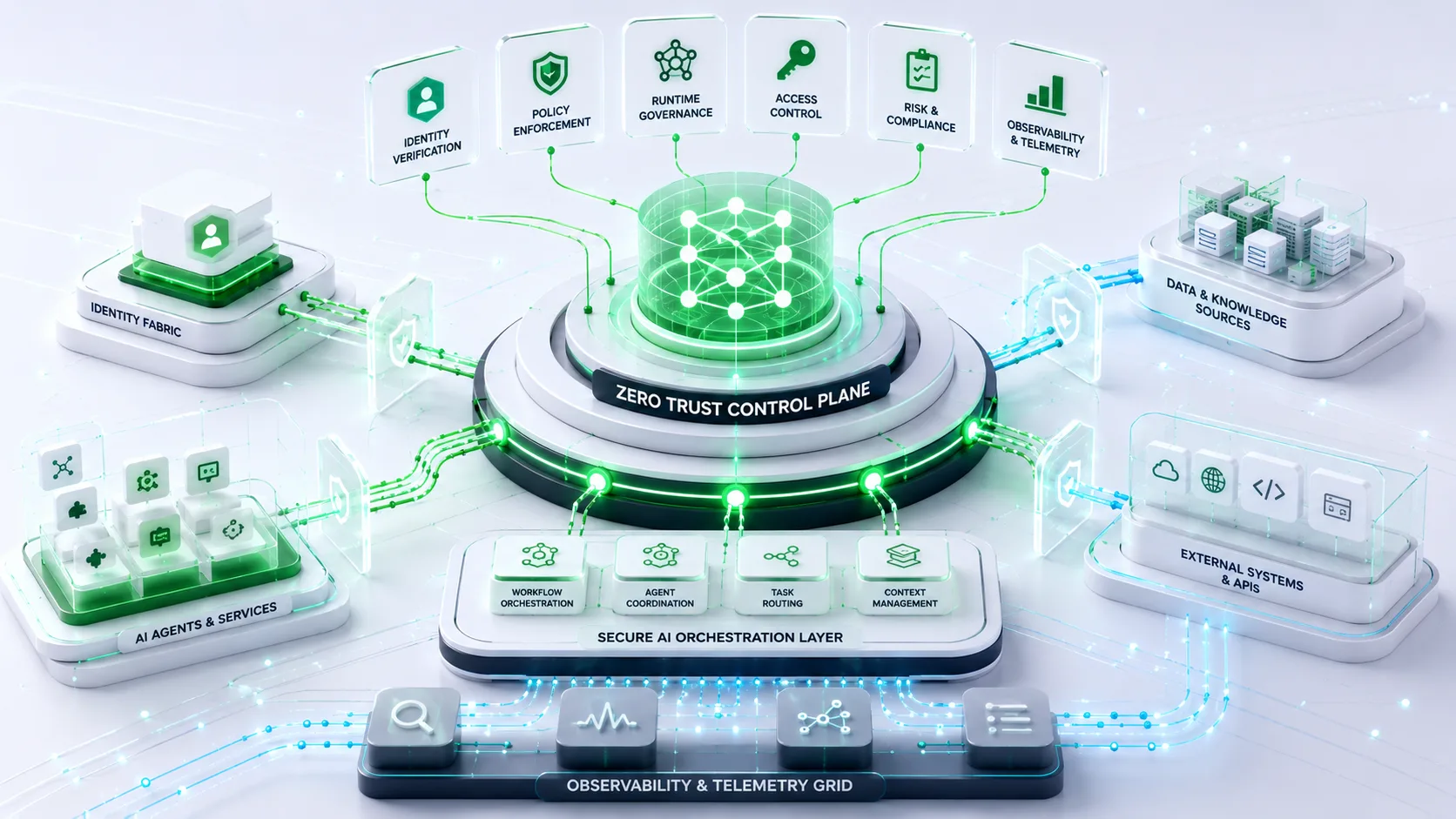
Key Components of Zero Trust AI Platforms
Identity Governance
Centralized identity validation across AI agents, orchestration systems, and runtime services.
Policy Enforcement Engines
Runtime validation systems enforcing operational governance continuously.
Telemetry and Observability
Infrastructure visibility systems monitoring runtime AI behavior and operational signals.
Adaptive Risk Analysis
Real-time operational risk scoring and anomaly intelligence systems.
How Zero Trust Changes AI Operations
Secure Multi-Agent Coordination
Autonomous AI agents increasingly collaborate across operational workflows. Zero Trust ensures these interactions remain governed, verified, and observable.
Dynamic Infrastructure Security
Infrastructure policies adapt continuously based on operational behavior, risk scoring, and runtime conditions.
Operational Resilience
Runtime isolation and segmented trust boundaries improve enterprise resilience against failures, compromise, and AI operational anomalies.
Operational Reality in 2026
Enterprise AI systems are becoming increasingly autonomous. Security models must evolve from static protection into adaptive runtime governance capable of managing dynamic AI behavior across distributed operational environments.
Common Enterprise Challenges
- Managing identity across autonomous AI agents
- Monitoring distributed AI runtime behavior
- Implementing policy enforcement at scale
- Reducing excessive infrastructure permissions
- Preventing lateral movement across AI systems
- Maintaining observability across autonomous workflows
- Balancing security with operational performance
Implementation Strategy for Enterprise Teams
Start with AI Identity Governance
Establish verifiable identity systems across AI services, orchestration layers, and autonomous workflows.
Deploy Runtime Observability
Continuous telemetry visibility is essential for detecting operational anomalies and policy violations.
Implement Segmented Trust Zones
Separate operational workloads into controlled execution environments with strict policy boundaries.
Phase 1
Identity governance and access controls.
Phase 2
Runtime observability and policy enforcement.
Phase 3
Adaptive governance and autonomous risk intelligence.
Common Mistakes Enterprises Make
- Treating AI systems as traditional applications
- Over-trusting autonomous workflows
- Ignoring runtime observability requirements
- Using static security policies
- Failing to segment AI operational environments
- Lacking AI-specific governance frameworks
- Insufficient operational telemetry visibility
Zero Trust AI Security Checklist
- Implement AI identity governance
- Deploy runtime observability systems
- Create policy-enforcement checkpoints
- Segment AI operational environments
- Enable continuous runtime validation
- Monitor autonomous workflow behavior
- Establish operational escalation pathways
- Continuously evaluate infrastructure risk
Key Takeaways
- Autonomous AI platforms require continuous runtime governance.
- Zero Trust Architecture is becoming foundational for enterprise AI security.
- Identity-aware orchestration enables safer AI operations.
- Observability is critical for AI runtime security.
- Segmented trust boundaries improve operational resilience.
How YggyTech Helps
YggyTech helps enterprises build secure AI platforms designed for operational governance, runtime observability, resilient orchestration, and Zero Trust autonomous AI execution.
AI Governance Architecture
Designing Zero Trust operational frameworks for autonomous AI systems.
Runtime Security Systems
Building runtime observability and policy-enforcement infrastructure.
Operational Resilience
Implementing secure orchestration and AI operational protection systems.
Secure Your Autonomous AI Infrastructure
Modern enterprise AI systems require adaptive governance, runtime security, identity-aware orchestration, and resilient operational trust architecture. YggyTech helps organizations build secure autonomous AI platforms ready for enterprise-scale execution.
Talk to YggyTechFAQs
What is Zero Trust Architecture for AI?
Zero Trust AI Architecture continuously verifies AI systems, workflows, runtime behavior, and operational access rather than assuming trusted infrastructure.
Why do autonomous AI platforms require Zero Trust?
Autonomous AI systems dynamically interact with enterprise infrastructure and execute workflows independently, creating new operational security challenges that require continuous governance and runtime validation.
What are the core components of Zero Trust AI systems?
Key components include identity governance, runtime observability, policy enforcement, segmented trust boundaries, and adaptive operational risk analysis.
How does runtime governance improve AI security?
Runtime governance continuously monitors AI behavior, validates policy compliance, detects anomalies, and limits operational risk during autonomous execution.
What challenges do enterprises face implementing Zero Trust AI?
Common challenges include AI identity management, runtime observability complexity, policy enforcement at scale, infrastructure segmentation, and balancing security with operational performance.

Ethan Brooks
Senior AI Systems Strategist
Ethan specializes in enterprise AI architecture, scalable automation systems, and intelligent workflow optimization. At YGGY Tech, he writes about practical AI implementation, cloud-native systems, and how modern businesses can eliminate operational fragmentation through intelligent infrastructure.